 Indietro
Basic Concepts of Chemical Bonding: Study Notes
Guida di studio - Note intelligenti
 Appunti personalizzati basati sui tuoi materiali, ampliati con definizioni chiave, esempi e contesto.
Basic Concepts of Chemical Bonding
Chemical Bonds
Chemical bonds are the forces that hold atoms together in compounds. There are three primary types of chemical bonds:
Ionic Bonds: Electrostatic attraction between ions, typically formed between metals and nonmetals.
Covalent Bonds: Sharing of electrons between atoms, usually between nonmetals.
Metallic Bonds: Free electrons hold metal atoms together, resulting in a 'sea of electrons' model.
Lewis Symbols and the Octet Rule
G. N. Lewis introduced a method to represent valence electrons using dots around the element symbol. The octet rule states that atoms tend to gain, lose, or share electrons to achieve eight valence electrons, resembling the electron configuration of a noble gas.
Ionic Bonding
Ionic bonding occurs between metals and nonmetals (excluding group 8A elements) and involves the transfer of electrons. This process is highly exothermic.
One element (metal) gives up electrons easily (low ionization energy).
Another element (nonmetal) gains electrons easily (high electron affinity).
Arrows in diagrams indicate electron transfer.
Properties of Ionic Substances
Brittle
High melting points
Crystalline structure
Cleave along smooth lines
Energetics of Ionic Bonding
The formation of ionic compounds involves several energy changes:
Energy is required to convert elements to atoms (endothermic).
Energy is required to create cations (endothermic).
Energy is released to form anions (exothermic).
Formation of the solid releases a large amount of energy (exothermic).
The Born–Haber Cycle is used to calculate the overall energy change.
Lattice Energy
Lattice energy is a measure of the stability gained by arranging oppositely charged ions in an ionic solid. It is defined as the energy required to completely separate one mole of a solid ionic compound into its gaseous ions.
Lattice energy increases with:
Increasing charge on the ions
Decreasing size of the ions
Electron Configuration of Ions
Main group metals lose electrons to achieve the configuration of the previous noble gas.
Nonmetals gain electrons to achieve the configuration of the nearest noble gas.
Transition metals lose valence electrons first, then d-electrons as needed for the ion charge.
Covalent Bonding
In covalent bonds, atoms share electrons, primarily between nonmetals. The bond formation involves:
Attractions between electrons and nuclei
Repulsions between electrons
Repulsions between nuclei
For a bond to form, attractions must outweigh repulsions.
Lewis Structures
Lewis structures visually represent the sharing of electrons in covalent bonds. Each atom aims to achieve the electron configuration of the nearest noble gas by sharing electrons.
Lone pairs are unshared pairs of electrons on one atom, while bonding pairs are shared between two atoms. Bonding pairs can be shown as two dots or a line.
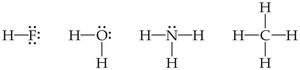
Number of Bonds for Nonmetals
The group number indicates the number of valence electrons. The number of bonds needed to complete the octet equals the number of electrons required to reach eight.
Multiple Bonds
Single bonds: One pair of electrons shared.
Double bonds: Two pairs of electrons shared.
Triple bonds: Three pairs of electrons shared.
Polarity of Bonds and Electronegativity
Electrons in covalent bonds are not always shared equally. Bond polarity measures the equality of electron sharing:
Nonpolar covalent bond: Electrons shared equally.
Polar covalent bond: One atom attracts electrons more strongly.
Electronegativity is the ability of an atom to attract electrons in a molecule. It increases from left to right across a period and from bottom to top within a group.
The greater the difference in electronegativity, the more polar the bond. If the difference exceeds 2.0, the bond is often ionic.
Dipole Moments
A dipole moment arises when two equal but opposite charges are separated by a distance. It is measured in debyes (D).
The dipole moment () is calculated as:
where is the magnitude of the charge and is the distance between charges.
Comparing Ionic and Covalent Bonding
Ionic: Complete electron transfer (metal + nonmetal).
Covalent: Electron pair sharing (two nonmetals).
Electronegativity difference and physical properties (e.g., melting points) help distinguish between the two.
Drawing Lewis Structures
Steps to draw Lewis structures:
Sum the valence electrons from all atoms, adjusting for overall charge.
Write the symbols for the atoms, connect them with single bonds.
Complete the octets around atoms bonded to the central atom.
Place remaining electrons on the central atom.
If the central atom lacks an octet, form multiple bonds.
Assign formal charges to atoms.
The dominant Lewis structure has formal charges closest to zero and places negative charges on the most electronegative atoms.
Resonance Structures
Some molecules cannot be accurately depicted by a single Lewis structure. Resonance structures are used to represent such molecules, where electrons are delocalized over multiple atoms. Examples include ozone and benzene.
Exceptions to the Octet Rule
Three types of exceptions exist:
Ions or molecules with an odd number of electrons
Ions or molecules with less than an octet
Ions or molecules with more than eight valence electrons (expanded octet)
Elements in period 3 or higher can have expanded octets due to available d-orbitals.
Strengths and Lengths of Single and Multiple Bonds
Bond enthalpy is the energy required to break a bond. Multiple bonds are stronger and shorter than single bonds. Bond enthalpy values are averages and may vary between compounds.
As the number of bonds increases, bond length decreases.
Bond breaking is always endothermic (positive bond enthalpy).
Summary Table: Types of Chemical Bonds
Bond Type | Formation | Example | Properties |
|---|---|---|---|
Ionic | Electron transfer | NaCl | High melting point, brittle, crystalline |
Covalent | Electron sharing | H2O | Lower melting point, flexible, molecular |
Metallic | Delocalized electrons | Fe | Conductive, malleable, ductile |
