Indietro
Bonding: General Concepts – Structured Study Notes for General Chemistry
Guida di studio - Note intelligenti
 Appunti personalizzati basati sui tuoi materiali, ampliati con definizioni chiave, esempi e contesto.
Bonding: General Concepts
Types of Chemical Bonds
Chemical bonds are the forces that hold atoms together in compounds. The three primary types of chemical bonds are covalent, ionic, and metallic bonds.
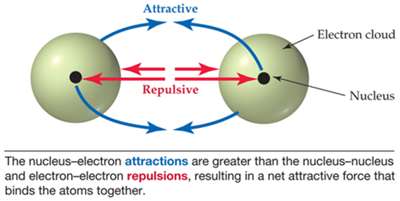
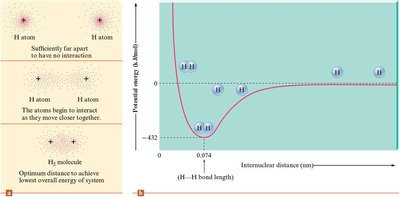
Covalent Bonds: Occur when electrons are shared between two or more nonmetals. The attraction between the electrons of one atom and the nucleus of another leads to bond formation if the attraction outweighs repulsion. Resulting compounds are called molecules or molecular compounds.
Ionic Bonds: Formed when electrons are transferred from a metal (which loses electrons to become a cation) to a nonmetal (which gains electrons to become an anion). Ionic compounds are typically formed between metals and nonmetals.
Metallic Bonds: Involve the sharing of electrons among a lattice of metal atoms (not covered in detail in this chapter).
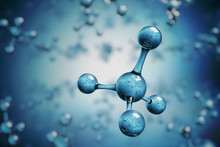
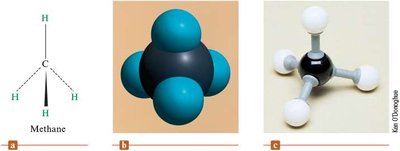
Representation of Molecular Structures: Molecules can be represented by chemical formulas, structural formulas, space-filling models, and ball-and-stick models.
Bond Length
Bond length is the distance between two bonded atoms where the energy of the system is lowest. This optimal distance results from a balance between attractive and repulsive forces.
Ionic Bonds: Formation and Properties
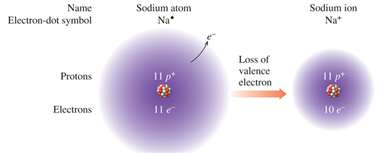
Ionic bonds occur when an atom with low ionization energy (metal) transfers electrons to an atom with high electron affinity (nonmetal). The resulting ions are held together by electrostatic attraction.
Cation: A positively charged ion formed by loss of electrons (e.g., Na+).
Anion: A negatively charged ion formed by gain of electrons (e.g., Cl-).
Categories of Elements
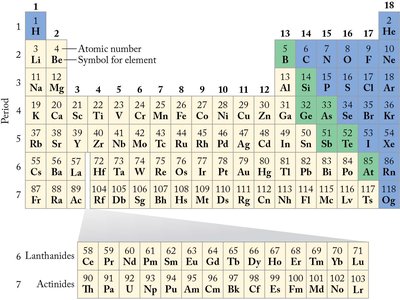
Metals: Shiny, solid, good conductors, malleable, ductile. Exception: Mercury is liquid.
Nonmetals: Can be solids (brittle), liquids, or gases; nonconductors.
Metalloids: Shiny like metals but brittle like nonmetals; semiconductors.
Commonly Used Names of Groups
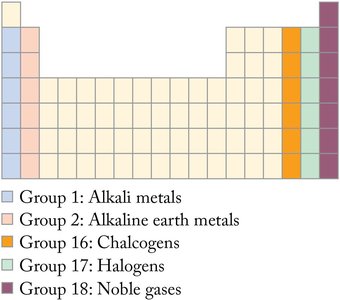
Groups in the periodic table are often referred to by specific names:
Group 1: Alkali metals
Group 2: Alkaline earth metals
Group 16: Chalcogens
Group 17: Halogens
Group 18: Noble gases
Electronegativity and Bond Polarity
Electronegativity
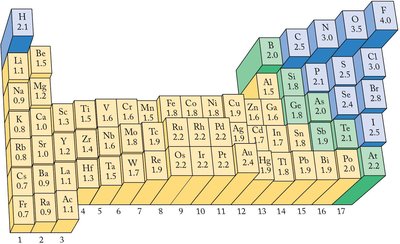
Electronegativity (χ) is a measure of an atom's ability to attract electrons in a chemical bond. The difference in electronegativity between two atoms determines the bond's polarity:
Δχ < 0.4: Nonpolar covalent bond
0.4 < Δχ < 2.0: Polar covalent bond
Δχ > 2.0: Ionic bond
Unequal Sharing and Polar Bonds
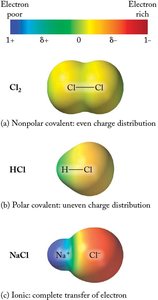
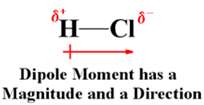
In covalent bonds, electrons may be shared unequally, resulting in a polar covalent bond with partial positive and negative charges (dipole).
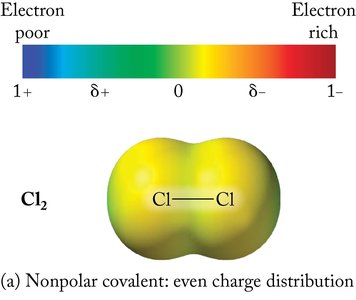
Nonpolar Covalent Bonds
Nonpolar covalent bonds occur when electrons are shared equally, typically between identical atoms or when the electronegativity difference is very small (Δχ ≤ 0.4).
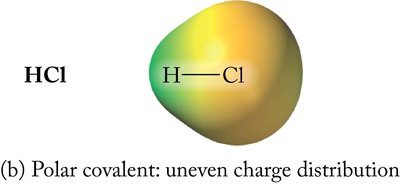
Polar Covalent Bonds
Polar covalent bonds occur when electrons are shared unequally due to a moderate difference in electronegativity (0.4 < Δχ < 2.0). This results in a dipole moment.
Ions: Electron Configurations and Sizes
Electron Configuration of Compounds
Atoms achieve stable electron configurations (often noble gas configurations) through electron sharing (covalent) or transfer (ionic). Isoelectronic species have the same number of electrons.
Predicting Formulas of Ionic Compounds
Ionic compounds are electrically neutral. The empirical formula is determined by balancing the charges of the ions involved.
Sizes of Ions
Ion size affects the structure and stability of ionic solids. Isoelectronic ions are compared based on nuclear charge; the ion with the smallest nuclear charge is largest.
The Covalent Chemical Bond: A Model
Bonding Models
Models are used to explain chemical bonding at the microscopic level. They are simplifications and may evolve over time as new data emerges.
The Localized Electron Bonding Model
LE Model
The Localized Electron (LE) Model describes molecules as collections of atoms bound by shared pairs of electrons. Lone pairs are localized on atoms, while bonding pairs are shared between atoms.
Lewis Structures
Writing Lewis Structures
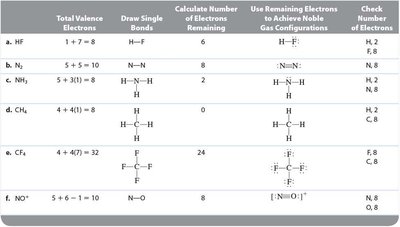
Lewis structures show the arrangement of valence electrons in molecules. Only valence electrons are included, and dots represent electrons. The octet rule states that atoms form stable molecules when surrounded by eight electrons.
Draw the basic molecule with single bonds.
Sum the valence electrons.
Satisfy the octet for outer atoms.
Place leftover electrons on the central atom.
If the central atom is not satisfied, form double bonds.
For charged molecules, use brackets and indicate the charge.
Example: Lewis Structures for Common Molecules
Exceptions to the Octet Rule
Incomplete Octet
Boron and beryllium often form compounds with fewer than eight electrons around them.
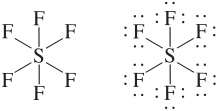
Expanded Octet
Elements in Period 3 and beyond can have more than eight electrons (expanded octet), as seen in molecules like SF6 and PCl5.
Resonance
Resonance Structures
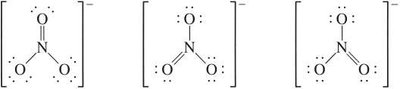
Some molecules have more than one valid Lewis structure. The true structure is a hybrid of all resonance forms, represented by double-headed arrows.
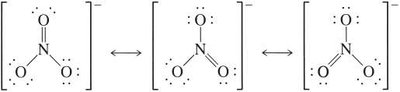
Formal Charge
Calculating Formal Charge
Formal charge helps estimate the charge distribution in molecules. It is calculated as:
Formal charge = (number of valence electrons on free atom) − (number of electrons assigned in molecule)
Atoms strive for formal charges close to zero; negative charges should reside on the most electronegative atoms.
Naming Simple Compounds (Nomenclature)
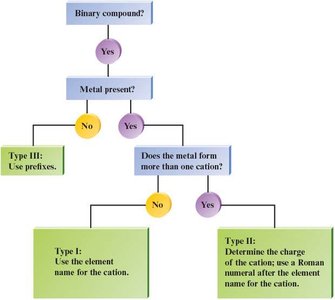
Binary Ionic Compounds (Type I)
Type I compounds have a cation followed by an anion. The cation is named first, and the anion is named by adding -ide to the root of the element name.
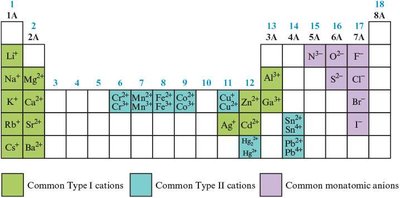
Common Monatomic Cations and Anions
Name | Anion | Name | Cation |
|---|---|---|---|
Hydride | H− | Hydrogen | H+ |
Fluoride | F− | Lithium | Li+ |
Chloride | Cl− | Sodium | Na+ |
Bromide | Br− | Potassium | K+ |
Iodide | I− | Cesium | Cs+ |
Oxide | O2− | Beryllium | Be2+ |
Sulfide | S2− | Magnesium | Mg2+ |
Nitride | N3− | Calcium | Ca2+ |
Phosphide | P3− | Barium | Ba2+ |
Aluminum | Al3+ |
Binary Ionic Compounds (Type II)
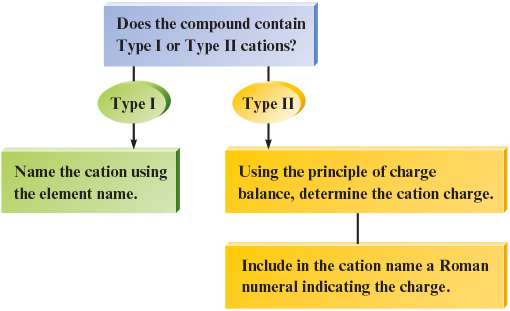
Transition metals can form more than one type of cation. The charge is specified using Roman numerals (e.g., Fe(III)).
Polyatomic Ions
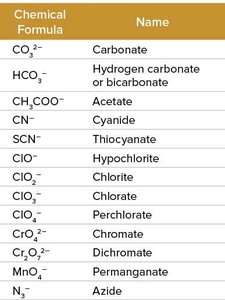
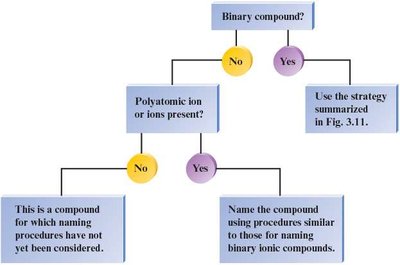
Polyatomic ions are groups of atoms joined by covalent bonds that carry a charge. Oxyanions are polyatomic ions containing oxygen.
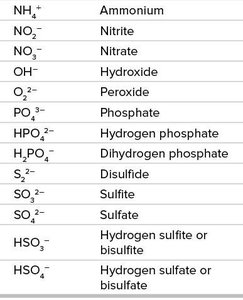
Oxyanions Naming
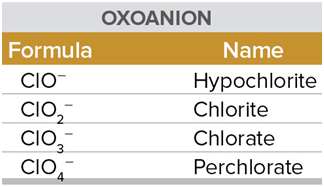
Oxyanions are named based on the number of oxygen atoms:
One less oxygen: -ite
Standard number: -ate
Two less: hypo- ... -ite
One more: per- ... -ate
Binary Covalent Compounds (Type III)
Formed between two nonmetals. Prefixes are used to indicate the number of atoms (e.g., dinitrogen monoxide for N2O).
Acids
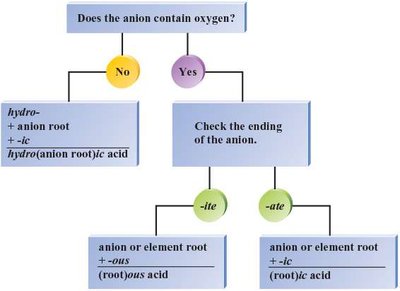
Binary Acids
Named with the prefix hydro- and suffix -ic (e.g., hydrochloric acid for HCl).
Oxoacids
Named based on the root of the anion:
Anion ends in -ate: acid name ends in -ic
Anion ends in -ite: acid name ends in -ous