 Indietro
Bonding in Molecules:Lecture 16
Guida di studio - Note intelligenti
 Appunti personalizzati basati sui tuoi materiali, ampliati con definizioni chiave, esempi e contesto.
Multiple Central Atoms and Their Geometries
Understanding Molecular Structure with Multiple Centers
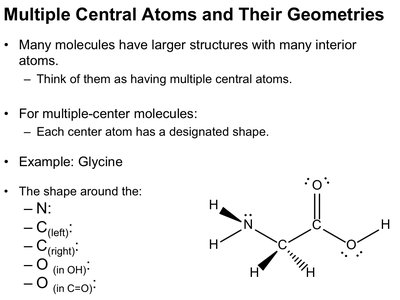
Many molecules, especially organic compounds, contain more than one central atom. Each central atom in such molecules has its own designated geometry, determined by the number of electron domains (bonding and lone pairs) around it. The VSEPR (Valence Shell Electron Pair Repulsion) theory is used to predict these shapes.
Key Point 1: Each central atom is treated independently for shape determination.
Key Point 2: Example: Glycine (an amino acid) has multiple central atoms (N, C, O).
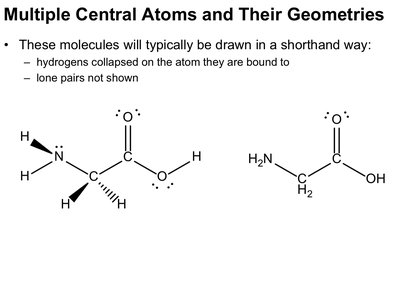
Key Point 3: Molecular drawings often use shorthand: hydrogens are shown attached to their atoms, and lone pairs may be omitted for clarity.
Example: The shape around each atom in glycine is determined by its bonding and lone pairs.
Sigma and Pi Bonding
Types of Covalent Bonds: Sigma (σ) and Pi (π)
Covalent bonds are formed by the overlap of atomic orbitals. The two main types are sigma (σ) bonds and pi (π) bonds. Understanding their formation is crucial for predicting molecular properties and reactivity.
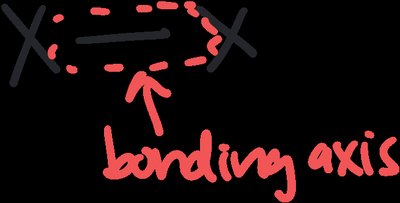
Key Point 1: Sigma bonds are formed by head-on (axial) overlap of orbitals, resulting in electron density along the bond axis.
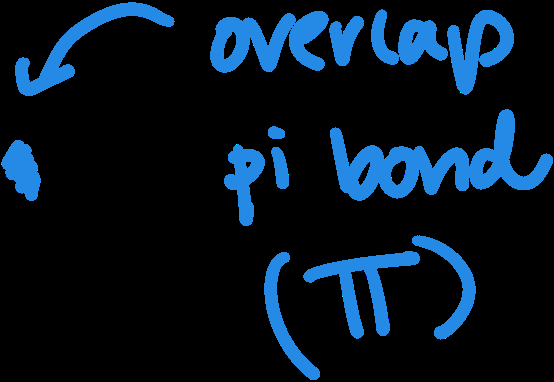
Key Point 2: Pi bonds are formed by side-to-side overlap of p orbitals, with electron density above and below the bond axis.
Key Point 3: Every single bond is a sigma bond; double bonds consist of one sigma and one pi bond; triple bonds have one sigma and two pi bonds.
Example: In ethylene (C2H4), the C=C double bond contains one sigma and one pi bond.




Bond Length, Bond Strength, and Bond Energy
Bond Length
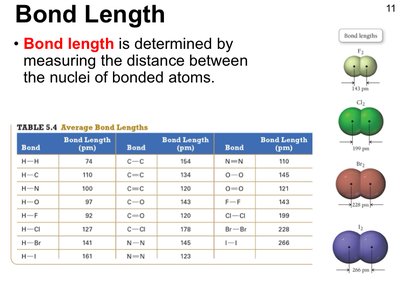
Bond length is the distance between the nuclei of two bonded atoms. It is measured in picometers (pm) and varies depending on the type of atoms and the bond order (single, double, triple).
Key Point 1: Shorter bonds are generally stronger and have higher bond energies.
Key Point 2: Bond length decreases as bond order increases (triple < double < single).
Example: The C≡C bond (triple) is shorter than the C=C (double) and C–C (single).
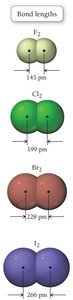
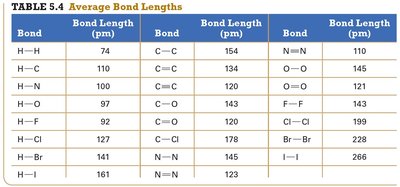
Bond | Bond Length (pm) |
|---|---|
H–H | 74 |
C–C | 154 |
C=C | 134 |
C≡C | 120 |
H–Cl | 127 |
H–Br | 141 |
H–I | 161 |
N≡N | 110 |
O=O | 121 |
Br–Br | 228 |
I–I | 266 |
Bond Energy
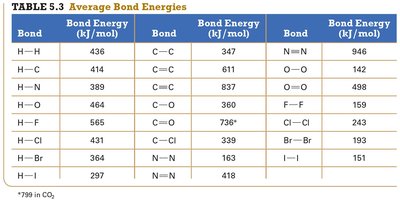
Bond energy is the amount of energy required to break a bond in a molecule. It is measured in kilojoules per mole (kJ/mol). Stronger bonds require more energy to break.
Key Point 1: Bond energy increases as bond order increases (triple > double > single).
Key Point 2: Bond energy is inversely related to bond length; shorter bonds are stronger.
Example: The C≡C bond has a bond energy of 837 kJ/mol, much higher than C–C (347 kJ/mol).
Bond | Bond Energy (kJ/mol) |
|---|---|
H–H | 436 |
C–C | 347 |
C=C | 611 |
C≡C | 837 |
H–Cl | 431 |
H–Br | 364 |
H–I | 297 |
N≡N | 946 |
O=O | 498 |
Br–Br | 193 |
I–I | 151 |
Factors Affecting Bond Strength
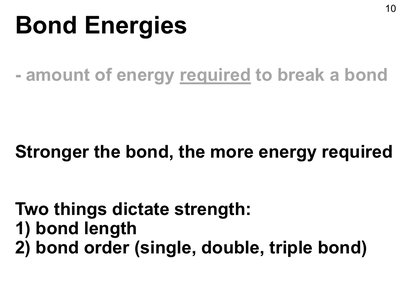
The strength of a bond is determined by two main factors: bond length and bond order. Higher bond order (more shared electron pairs) and shorter bond length result in stronger bonds.
Key Point 1: Single bonds are longer and weaker; double bonds are shorter and stronger; triple bonds are shortest and strongest.
Key Point 2: The energy required to break a bond is called bond dissociation energy.
Example: Comparing H–Cl (431 kJ/mol) and H–I (297 kJ/mol) shows that shorter bonds are stronger.
Summary Table: Bond Length and Bond Energy
Bond | Bond Length (pm) | Bond Energy (kJ/mol) |
|---|---|---|
C≡C | 120 | 837 |
C=C | 134 | 611 |
C–C | 154 | 347 |
H–Cl | 127 | 431 |
H–Br | 141 | 364 |
H–I | 161 | 297 |
Key Equations
Bond Energy Calculation: The energy change for a reaction can be estimated using average bond energies:
Bond Length: Measured in picometers (pm), typically using X-ray crystallography or spectroscopy.
Practice and Further Reading
Recommended Practice Problems: 10.85, 11.93
Accompanying Readings: Section 10.10, 11.7 (sp2 hybridization section on sigma and pi bonds)
Additional info:
Bond order is defined as the number of shared electron pairs between two atoms. For example, a single bond has bond order 1, a double bond has bond order 2, and a triple bond has bond order 3.
Bond dissociation energy is always positive, as energy must be supplied to break a bond.
