 Indietro
Bonding Theories, Hybridization, Molecular Orbitals, and Chemical Quantities: General Chemistry Study Guide
Guida di studio - Note intelligenti
 Appunti personalizzati basati sui tuoi materiali, ampliati con definizioni chiave, esempi e contesto.
Lewis Bonding Theory and Chemical Bonding
Lewis Bonding Theory: Overview
The Lewis Bonding Theory provides a foundational model for understanding how atoms bond to achieve stable electron configurations. Atoms bond to lower their potential energy, typically by transferring or sharing electrons to obtain a noble gas-like configuration, often an octet of electrons. The Lewis model does not account for bond energies but is useful for predicting molecular structures and formulas.
Octet Rule: Atoms tend to gain, lose, or share electrons to achieve eight electrons in their valence shell.
Exceptions: Some elements (e.g., Be, B, Al) may have incomplete octets; elements in period 3 and beyond can have expanded octets.
Empirical Formula: Ionic compounds are represented by empirical formulas, showing the simplest ratio of ions.
Lewis Theory and Ionic Bonding
Metals lose valence electrons to form cations, while nonmetals gain electrons to form anions. The transfer of electrons results in ions that are attracted to each other, forming ionic bonds. The Lewis model helps predict the number of electrons transferred and the resulting compound's formula.
Coulomb's Law: The electrostatic force between two charges is proportional to the product of their charges and inversely proportional to the square of the distance between them.
Properties of Ionic Compounds: Hard, brittle solids; high melting points; conduct electricity in liquid or aqueous states.
Covalent Bonding: Lewis Structures
Covalent bonds form when atoms share pairs of electrons. Lewis structures depict these shared pairs (bonding pairs) and lone pairs (nonbonding pairs) to show how atoms achieve octets.
Single, Double, Triple Bonds: Sharing one, two, or three pairs of electrons, respectively. Double and triple bonds are shorter and stronger than single bonds.
Bond Directionality: Covalent bonds are highly directional, leading to discrete molecules.
Electronegativity and Bond Polarity
Electronegativity is the ability of an atom to attract bonding electrons. Differences in electronegativity between atoms lead to bond polarity, with polar covalent bonds exhibiting partial charges.
Bond Types: Pure covalent (difference = 0), nonpolar covalent (0.1–0.4), polar covalent (0.4–1.9), ionic (≥2.0).
Dipole Moment: Measures bond polarity; proportional to charge separation and distance.
Writing Lewis Structures and Resonance
Lewis structures are written by arranging atoms, counting valence electrons, distributing electrons to achieve octets, and forming multiple bonds if necessary. Resonance occurs when multiple valid Lewis structures exist for a molecule, with the actual structure being a resonance hybrid.
Formal Charge: Calculated as
Resonance: Delocalization of electrons stabilizes molecules.
Valence Bond Theory and Hybridization
Valence Bond Theory: Concepts
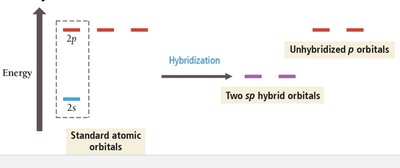
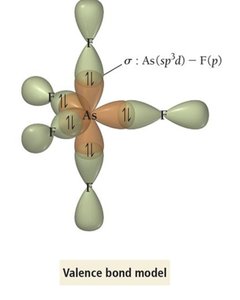
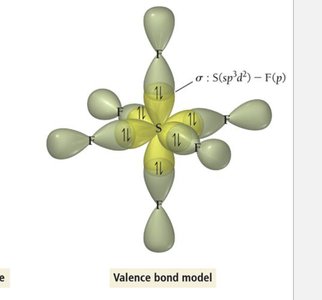
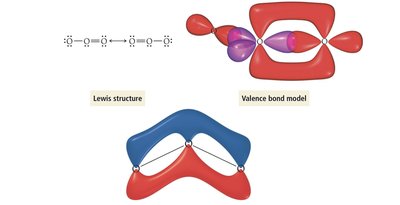
Valence Bond (VB) Theory describes chemical bonding as the overlap of atomic or hybrid orbitals, with electrons localized on individual atoms. Hybridization explains the formation of equivalent orbitals for bonding.
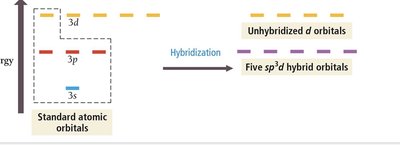
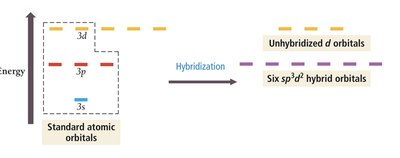
Hybridization: Mixing of atomic orbitals to form new hybrid orbitals (e.g., sp, sp2, sp3, sp3d, sp3d2).
Bond Types: Sigma () bonds form by head-to-head overlap; pi () bonds form by side-to-side overlap of unhybridized p orbitals.
Hybridization Table
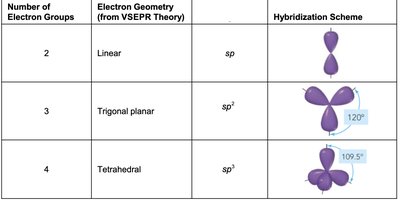
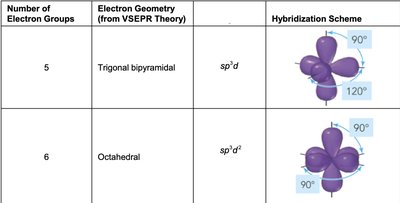
The type of hybridization depends on the number of electron groups around the central atom, as predicted by VSEPR theory.
Number of Electron Groups | Electron Geometry | Hybridization Scheme |
|---|---|---|
2 | Linear | sp |
3 | Trigonal planar | sp2 |
4 | Tetrahedral | sp3 |
5 | Trigonal bipyramidal | sp3d |
6 | Octahedral | sp3d2 |
Molecular Orbital Theory
Molecular Orbital (MO) Theory: Overview
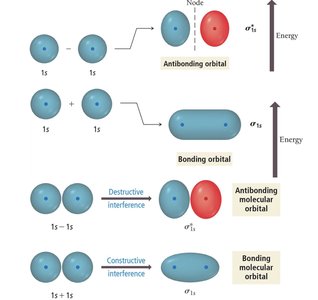
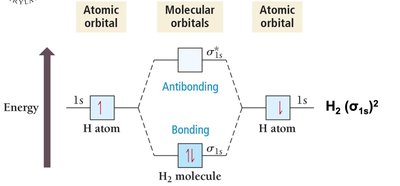
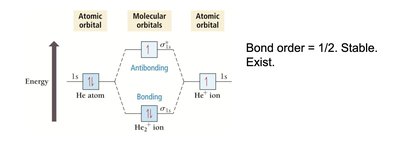
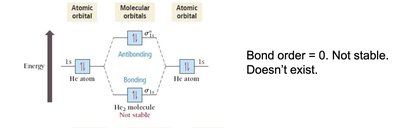
MO Theory applies quantum mechanics to molecules, combining atomic orbitals to form molecular orbitals that are delocalized over the entire molecule. The Linear Combination of Atomic Orbitals (LCAO) method is used to construct MOs.
Bonding Orbitals: Constructive interference lowers energy, stabilizing the molecule.
Antibonding Orbitals: Destructive interference raises energy, destabilizing the molecule.
Bond Order:

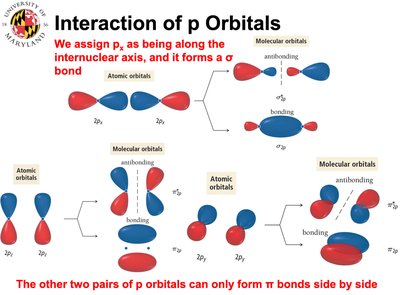
Interaction of p Orbitals
p orbitals can form both sigma and pi bonds. The px orbital forms sigma bonds along the internuclear axis, while py and pz orbitals form pi bonds side by side.
MO Diagrams for Second-Period Diatomic Molecules
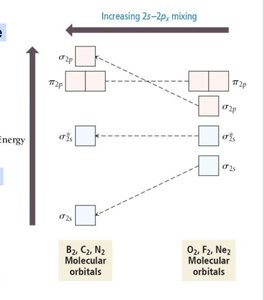
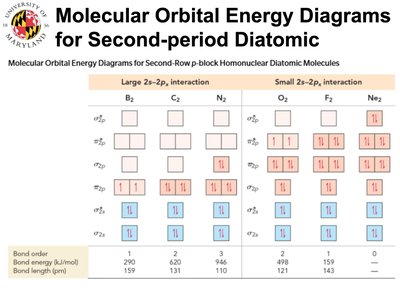
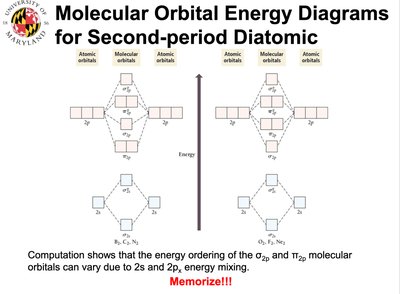
Second-period homonuclear diatomic molecules (B2, C2, N2, O2, F2, Ne2) have unique MO energy orderings due to 2s–2p mixing. The bond order, bond energy, and bond length can be determined from the MO diagram.
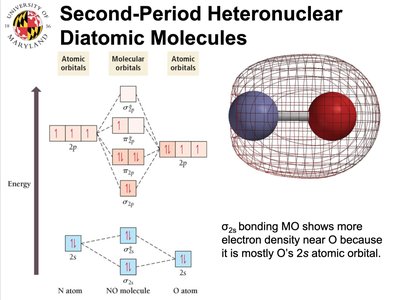
Second-Period Heteronuclear Diatomic Molecules
For heteronuclear diatomics, the more electronegative atom's orbitals are lower in energy and contribute more to bonding MOs. Nonbonding orbitals remain localized on the atom donating them.
VSEPR Theory and Molecular Geometry
VSEPR Theory: Electron and Molecular Geometry
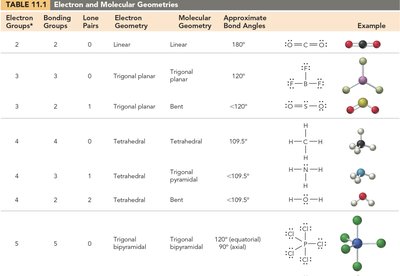
Valence Shell Electron Pair Repulsion (VSEPR) Theory predicts molecular shapes based on the repulsion between electron groups. Electron geometry considers all electron groups, while molecular geometry considers only the arrangement of atoms.
Electron Groups | Bonding Groups | Lone Pairs | Electron Geometry | Molecular Geometry | Approximate Bond Angles | Example |
|---|---|---|---|---|---|---|
2 | 2 | 0 | Linear | Linear | 180° | CO2 |
3 | 3 | 0 | Trigonal planar | Trigonal planar | 120° | BF3 |
3 | 2 | 1 | Trigonal planar | Bent | <120° | SO2 |
4 | 4 | 0 | Tetrahedral | Tetrahedral | 109.5° | CH4 |
4 | 3 | 1 | Tetrahedral | Trigonal pyramidal | <109.5° | NH3 |
4 | 2 | 2 | Tetrahedral | Bent | <109.5° | H2O |
5 | 5 | 0 | Trigonal bipyramidal | Trigonal bipyramidal | 120° (eq), 90° (ax) | PCl5 |
Molecular Polarity
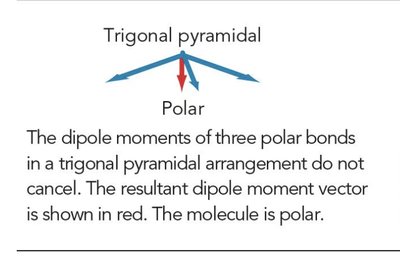
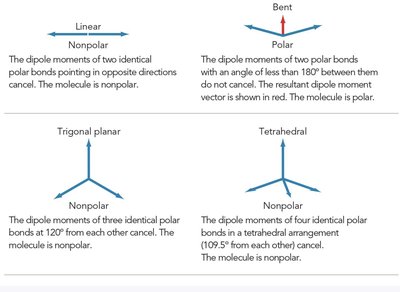
Molecular polarity depends on both the polarity of individual bonds and the molecular geometry. The net dipole moment determines whether a molecule is polar or nonpolar.
Mole Concept and Chemical Quantities
The Mole and Avogadro's Number
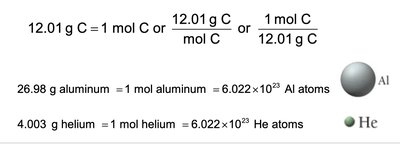
The mole is a fundamental unit for counting atoms, molecules, or particles. One mole contains entities, known as Avogadro's number.


Converting Between Mass, Moles, and Number of Atoms
To convert between mass, moles, and number of atoms, use the molar mass and Avogadro's number as conversion factors.
Formula Mass and Molar Mass
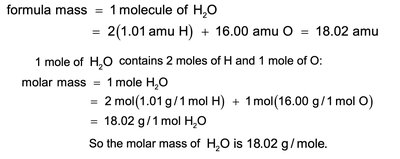
The formula mass is the sum of the atomic masses of all atoms in a molecule or formula unit. The molar mass is the mass of one mole of a substance, numerically equal to the formula mass in grams per mole.


Counting Molecules by Weighing
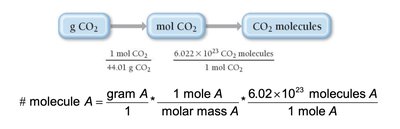
Molar mass and Avogadro's number are used to determine the number of molecules in a given mass of a substance.
Mass Percent Composition
Mass percent composition expresses the mass ratio of each element in a compound. It is calculated as:
Empirical and Molecular Formulas
The empirical formula shows the simplest whole-number ratio of elements in a compound. The molecular formula is a whole-number multiple of the empirical formula, determined by the molar mass.

Additional info:
These notes cover key concepts from General Chemistry chapters on chemical bonding, hybridization, molecular orbital theory, VSEPR theory, and chemical quantities. The included images directly reinforce the explanations and tables, providing visual aids for hybridization schemes, molecular orbital diagrams, and conversion factors.
