 Indietro
Calculating the Energy Change for the Formation of LiCl(s) from Its Elements
Guida di studio - Note intelligenti
 Appunti personalizzati basati sui tuoi materiali, ampliati con definizioni chiave, esempi e contesto.
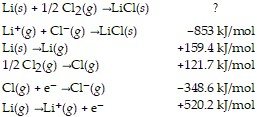
Q15. Calculate the energy change for the formation of LiCl(s) from its elements in their standard states using the provided tabulated information.
Background
Topic: Thermochemistry – Born-Haber Cycle
This question tests your understanding of the Born-Haber cycle, which is used to calculate the lattice energy and overall enthalpy change for the formation of an ionic compound from its elements.
Key Terms and Formulas
Born-Haber Cycle: A stepwise method to analyze the formation of ionic compounds using enthalpy changes.
Lattice Energy: The energy released when ions combine to form an ionic solid.
Ionization Energy: Energy required to remove an electron from an atom.
Electron Affinity: Energy change when an atom gains an electron.
Enthalpy of Formation (): The total energy change for forming a compound from its elements.
General formula for the Born-Haber cycle:
Step-by-Step Guidance
Identify the target reaction:
List all the relevant steps and their enthalpy changes from the table:
(sublimation)
(ionization energy)
(bond dissociation)
(electron affinity)
(lattice energy)
Write out the enthalpy values for each step (from the table):
Sublimation of Li: kJ/mol
Ionization of Li: kJ/mol
Dissociation of Cl: kJ/mol
Electron affinity of Cl: kJ/mol
Lattice energy: kJ/mol
Set up the sum of all these enthalpy changes to find the overall for the formation of LiCl(s):
Try solving on your own before revealing the answer!
Final Answer: -400.3 kJ/mol
kJ/mol$
This value represents the enthalpy change for the formation of LiCl(s) from its elements in their standard states, calculated using the Born-Haber cycle.
