 Indietro
Chapter 1: Atoms – Foundations of Matter and Atomic Theory
Guida di studio - Note intelligenti
 Appunti personalizzati basati sui tuoi materiali, ampliati con definizioni chiave, esempi e contesto.
Atoms and Matter
What is Matter?
Matter is defined as anything that has mass and occupies space. Chemistry is the scientific discipline that seeks to understand matter and its properties. Matter is composed of particles, including atoms, molecules, and subatomic particles such as neutrons, protons, and electrons. The way these particles combine determines the physical properties of matter.
Atoms: Basic submicroscopic particles that are the fundamental building blocks of ordinary matter.
Molecules (Compounds): Substances formed when two or more atoms bond in specific geometric arrangements. Example: Water (H2O) consists of two hydrogens and one oxygen.
Subatomic Particles: Neutrons, protons, and electrons are the primary particles studied in chemistry.

Classification of Matter
States of Matter
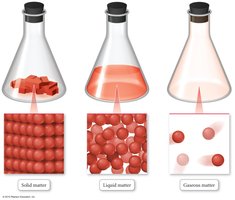
Matter can be classified by its physical state: solid, liquid, or gas. The state of matter depends on temperature and pressure, and each state exhibits distinct properties.
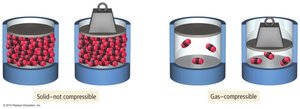
Solid: Atoms or molecules are closely packed in fixed locations. Solids have a fixed volume and rigid shape. Examples: ice, aluminum, diamond.
Liquid: Atoms or molecules are close together but can move relative to each other. Liquids have a fixed volume but not a fixed shape, and they flow to assume the shape of their container.
Gas: Atoms or molecules have much space between them and are free to move. Gases are compressible and have neither fixed volume nor shape.
Classification by Composition
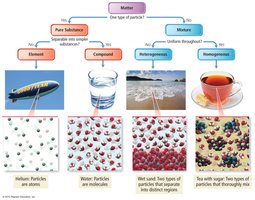
Matter can also be classified by its composition: elements, compounds, and mixtures.
Pure Substance: Made up of only one component with uniform composition. Can be an element or a compound.
Mixture: Composed of two or more components in variable proportions. Can be separated by physical means.
Types of Mixtures
Heterogeneous Mixture: Varying composition or state throughout the sample. Examples: non-homogenized milk, muddy water.
Homogeneous Mixture: Uniform composition and properties throughout. Examples: coffee, most beers.
The Scientific Method and Knowledge
The Scientific Approach
Scientific knowledge is empirical, based on observation and experimentation. The scientific method is a systematic process for understanding nature.
Observations: Descriptions about the characteristics or behavior of nature.
Hypothesis: Tentative interpretation or explanation of observations. Must be falsifiable.
Theory: Well-established hypothesis or set of hypotheses that explain why phenomena occur. Theories are validated by experiments and can predict future observations.
Scientific Law: Concise statement summarizing past observations and predicting future ones. Example: Law of Conservation of Mass.
Early Atomic Theory
Historical Development
Leucippus and Democritus first proposed that matter was composed of small, indestructible particles called atoms. Later, John Dalton provided evidence supporting the atomic theory.
Dalton's Atomic Theory:
Each element is composed of tiny, indestructible particles called atoms.
All atoms of a given element have the same mass and properties.
Atoms combine in simple, whole-number ratios to form compounds.
Atoms of one element cannot change into atoms of another element.
Fundamental Laws of Chemistry
Law of Conservation of Mass
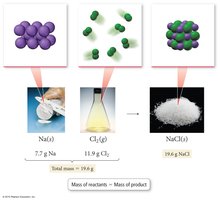
Formulated by Antoine Lavoisier: In a chemical reaction, matter is neither created nor destroyed. The total mass of substances involved does not change.
Law of Definite Proportions
Joseph Proust observed that all samples of a given compound have the same proportions of their constituent elements.
Example: Decomposition of water yields an oxygen-to-hydrogen mass ratio of 8:1.

Law of Multiple Proportions
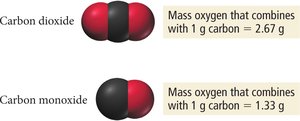
John Dalton's law states that when two elements form different compounds, the ratios of the masses of the second element that combine with a fixed mass of the first element are small whole numbers.
Example: Carbon monoxide (CO) and carbon dioxide (CO2) have O:C ratios of 1:1 and 2:1, respectively.
Discovery of Subatomic Particles
Discovery of the Electron
J. J. Thomson discovered the electron, a negatively charged, low-mass particle present in all atoms. Electrons can be removed from atoms.

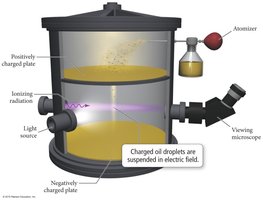
Millikan’s Oil Drop Experiment
Robert Millikan determined the charge of the electron (–1.60 × 10⁻¹⁹ C) by measuring the electric field required to halt the free fall of oil drops.
Early Atomic Models
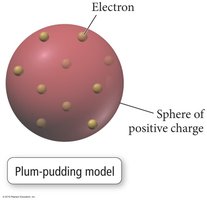
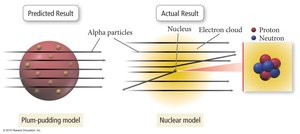
J. J. Thomson proposed the Plum-Pudding Model, where electrons are embedded in a positively charged sphere.
Rutherford’s Gold Foil Experiment
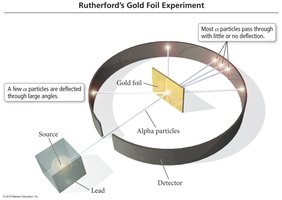
Ernest Rutherford directed alpha particles at a thin sheet of gold foil. Most particles passed through, but some were deflected, indicating a dense nucleus.
Nuclear Atomic Model
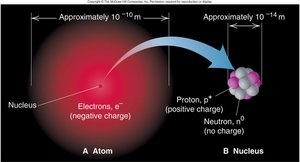
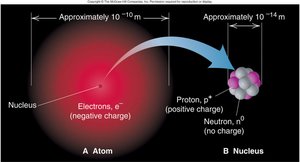
Most of an atom’s mass and all its positive charge are contained in a small core called the nucleus. Electrons are dispersed in empty space around the nucleus. The number of protons equals the number of electrons in a neutral atom.
Neutrons
James Chadwick discovered the neutron, a neutral particle with a mass similar to the proton, accounting for the previously unexplained mass in the nucleus.
Subatomic Particles and Atomic Structure
Subatomic Particles
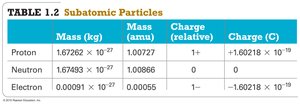
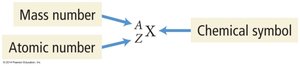
Atoms are composed of protons, neutrons, and electrons. The number of protons (atomic number, Z) defines the element.
Particle | Mass (kg) | Mass (amu) | Charge (relative) | Charge (C) |
|---|---|---|---|---|
Proton | 1.67262 × 10⁻²⁷ | 1.00727 | +1 | +1.60218 × 10⁻¹⁹ |
Neutron | 1.67493 × 10⁻²⁷ | 1.00866 | 0 | 0 |
Electron | 0.00091 × 10⁻²⁷ | 0.00055 | –1 | –1.60218 × 10⁻¹⁹ |
Isotopes
Atoms of the same element can have different numbers of neutrons, resulting in isotopes. The mass number (A) is the sum of protons and neutrons.
Example: Neon has three isotopes: Ne-20, Ne-21, Ne-22.


Ions
Atoms can lose or gain electrons to become ions. Cations are positively charged, anions are negatively charged. The charge is calculated as:
Charge = Number of protons (p+) – Number of electrons (e–)
Atomic Mass and the Mole
Atomic Mass
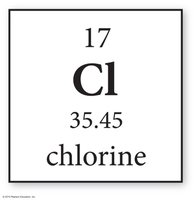
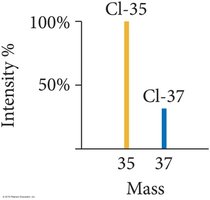
The atomic mass of an element is the weighted average of the masses of its isotopes, based on their natural abundance.
Formula:
The Mole and Avogadro’s Constant
A mole (mol) is a counting unit in chemistry, defined as exactly 6.02214076 × 10²³ entities (Avogadro’s constant, NA). It allows chemists to relate mass, number of particles, and volume.
1 mol atoms = 6.022 × 10²³ atoms
Mole Conversions
Converting between mass and moles uses the molar mass (g/mol) as a conversion factor. For example:
35.45 g Cl atoms = 1 mol Cl atoms
To convert between mass, moles, and number of atoms:
Divide by atomic mass (g/mol) to get moles
Multiply by Avogadro’s constant to get number of atoms
Mass Spectrometry
Mass spectrometry is a technique used to measure the masses and abundances of isotopes by separating particles according to their mass-to-charge ratio.
Summary Table: Classification of Matter
Type | Definition | Example |
|---|---|---|
Element | Substance that cannot be chemically broken down | Helium |
Compound | Substance composed of two or more elements in fixed proportions | Water (H2O) |
Heterogeneous Mixture | Composition varies throughout | Wet sand |
Homogeneous Mixture | Uniform composition throughout | Tea with sugar |
Additional info: These notes cover the foundational concepts of matter, atomic theory, and the structure of atoms, as well as key laws and methods used in chemistry. They are suitable for exam preparation and provide a comprehensive overview of Chapter 1 in a General Chemistry course.
