 Indietro
Chapter 1 study notes
Guida di studio - Note intelligenti
 Appunti personalizzati basati sui tuoi materiali, ampliati con definizioni chiave, esempi e contesto.
Scientific Method and Measurement in Chemistry
Scientific Method
The scientific method is a systematic approach used in chemistry to minimize bias and establish reliable cause-and-effect relationships. It involves observation, hypothesis formation, experimentation, and analysis to ensure reproducibility and accuracy in scientific findings.
Minimizes bias by relying on objective data and repeatable experiments.
Establishes cause-and-effect through controlled testing and logical reasoning.
SI Units and Measurement
Fundamental SI Units
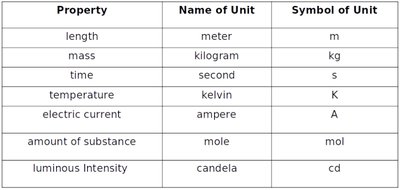
Chemistry relies on standardized units of measurement to ensure consistency and reproducibility. The International System of Units (SI) defines seven fundamental units:
Length: meter (m)
Mass: kilogram (kg)
Time: second (s)
Temperature: kelvin (K)
Electric current: ampere (A)
Amount of substance: mole (mol)
Luminous intensity: candela (cd)
Prefixes: Making Units Bigger or Smaller
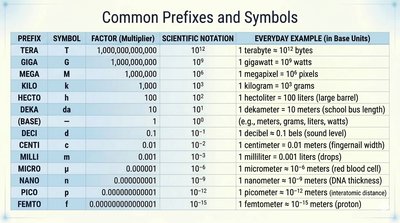
SI units can be modified using prefixes to represent multiples or fractions of base units. These prefixes are essential for expressing measurements across a wide range of scales.
Kilo (k): (1,000 times the base unit)
Milli (m): (1/1,000 of the base unit)
Micro (μ): (1/1,000,000 of the base unit)
Nano (n): (1/1,000,000,000 of the base unit)
Tera (T): (1,000,000,000,000 times the base unit)
Practice: Prefix Relationships
Understanding how to convert between units using prefixes is fundamental in chemistry. For example:
1 m = 100 cm
1 cm = 0.01 m
1 kg = 1,000,000 mg
5 kg = 5,000 g
6.7 cm = 67 mm
Measurement of Mass, Length, and Temperature
Mass
Mass is the amount of matter in an object, measured in kilograms (kg). It is distinct from weight, which depends on gravitational force.
1 kg = 2.2059 lb
1 kg = 1,000 g
Length
Length is measured in meters (m), defined as the distance light travels in 1/299,792,458th of a second.
1 km = 1,000 m
1 m = 100 cm
1 in = 2.54 cm
Temperature
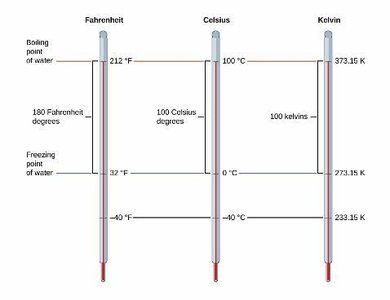
Temperature is a measure of the hotness or coolness of an object. The three main scales are Celsius (°C), Fahrenheit (°F), and Kelvin (K).
Celsius: Used worldwide; water freezes at 0°C and boils at 100°C.
Fahrenheit: Used mainly in the US; water freezes at 32°F and boils at 212°F.
Kelvin: Absolute scale; water freezes at 273.15 K and boils at 373.15 K.
Temperature Conversion Formulas
From Celsius to Fahrenheit:
From Fahrenheit to Celsius:
From Celsius to Kelvin:
From Kelvin to Celsius:
Derived Units: Volume, Density, and Energy
Volume
Volume is a derived unit, commonly measured in liters (L) or milliliters (mL). The SI unit is cubic meter (), but this is often too large for laboratory use.
1 = 1,000
1 = 1 L = 1,000 mL
1 L = 1.057 qt
Density
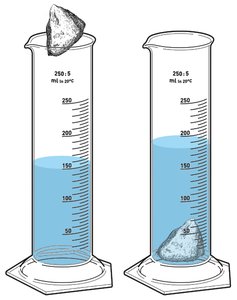
Density is the mass per unit volume of a substance, and is temperature dependent. It is calculated as:
Units: g/cm3 (solids), g/mL (liquids), g/L (gases)
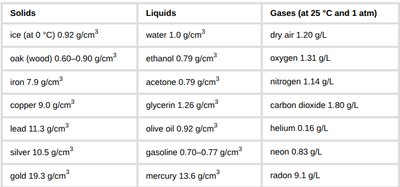
For irregularly shaped objects, volume is often determined by liquid displacement.
Practice: Density Calculations
Given mass and density, calculate volume:
Given mass and cube density, calculate side length:
Energy
Energy is the capacity to supply heat or do work. It is measured in joules (J).
Kinetic energy:
Potential energy:
1 cal = 4.184 J
1 Calorie (nutritional) = 1,000 cal = 1 kcal
Other Derived Units
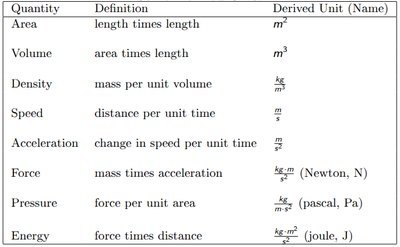
Many physical quantities in chemistry are expressed as derived units, calculated from fundamental SI units.
Accuracy, Precision, and Significant Figures
Accuracy vs. Precision
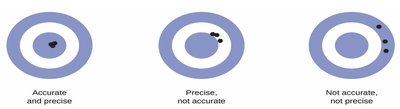
Accuracy refers to how close a measurement is to the true value. Precision refers to how closely repeated measurements agree with each other. Both are important for reliable scientific data.
Accurate and precise: Measurements are close to the true value and to each other.
Precise, not accurate: Measurements are close to each other but not to the true value.
Not accurate, not precise: Measurements are neither close to the true value nor to each other.
Significant Figures in Measurements
Significant figures indicate the precision of a measurement. Rules for determining significant figures:
Nonzero digits are always significant.
Zeros are significant when sandwiched between nonzero digits, in scientific notation coefficients, or as trailing zeros with a decimal present.
Leading zeros and trailing zeros without a decimal are not significant.
Scientific Notation
Scientific notation is used to express large or small numbers and clarify the number of significant figures. For example, 365,000,000 km with five significant figures is written as km.
Dimensional Analysis and Unit Conversions
Dimensional Analysis
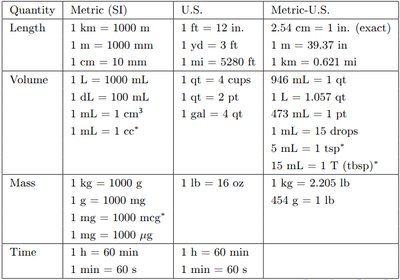
Dimensional analysis is a method for converting between units using conversion factors derived from equalities. Units are treated algebraically, allowing unwanted units to cancel and leaving only the desired units.
Example: (rounded to three significant figures)
Significant Figures in Calculations
Multiplication/Division: The result should have the same number of significant figures as the measured value with the least significant figures.
Addition/Subtraction: The result should be rounded to the right-most place value that all measured numbers share.
Reference Equalities and Conversion Factors
Common conversion factors are used in chemistry for length, volume, mass, and time.
Practice: Dimensional Analysis
Convert 32.5 to using appropriate conversion factors.
Convert swimming distance from yards to meters and time from minutes to seconds.
Summary Table: SI and Derived Units
The following table summarizes the main SI units and their derived forms used in chemistry:
Quantity | Definition | Derived Unit (Name) |
|---|---|---|
Area | length times length | |
Volume | area times length | |
Density | mass per unit volume | |
Speed | distance per unit time | |
Acceleration | change in speed per unit time | |
Force | mass times acceleration | (Newton, N) |
Pressure | force per unit area | (pascal, Pa) |
Energy | force times distance | (joule, J) |
Additional info: These notes expand on brief points from the original slides, providing definitions, formulas, and examples for clarity and completeness. All images included directly reinforce the adjacent content and are strictly relevant to the explanation.
