 Indietro
Chapter 1: Chemical Tools – Experimentation & Measurement
Guida di studio - Note intelligenti
 Appunti personalizzati basati sui tuoi materiali, ampliati con definizioni chiave, esempi e contesto.
Scientific Method and Measurement in Chemistry
Introduction to the Scientific Method
The scientific method is a systematic approach used in scientific investigation to minimize bias and establish reliable cause-and-effect relationships. It involves observation, hypothesis formation, experimentation, and analysis to draw conclusions about the natural world.
SI Units and Measurement
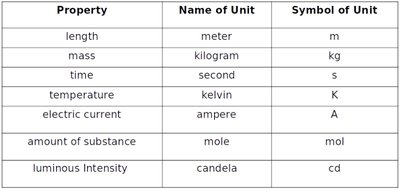
Fundamental SI Units
Chemistry relies on standardized units to ensure reproducibility and clarity in measurements. The International System of Units (SI) defines seven fundamental units for key physical properties:
Prefixes: Making Units Bigger or Smaller
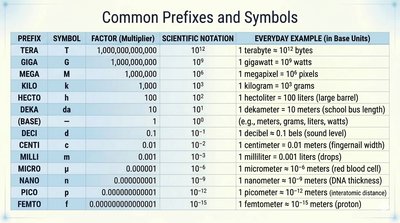
SI prefixes are used to express multiples or fractions of base units, making it easier to handle very large or very small quantities. Each prefix has a specific factor and symbol.
Practice with Prefix Relationships
1 m = 100 cm
1 cm = 0.01 m
1 kg = 1,000,000 mg
5 kg = 5000 g
6.7 cm = 67 mm
Mass and Length
Mass is the amount of matter in an object, measured in kilograms (kg). It is distinct from weight, which depends on gravity. Length is measured in meters (m), defined as the distance light travels in 1/299,792,458th of a second.
1 kg = 2.2059 lb
1 kg = 1000 g
1 km = 1000 m
1 m = 100 cm
1 in = 2.54 cm
Temperature Scales
Celsius, Fahrenheit, and Kelvin
Temperature is a measure of the hotness or coolness of an object. The three main scales are Celsius (°C), Fahrenheit (°F), and Kelvin (K). The Kelvin scale is the SI unit for temperature and starts at absolute zero.
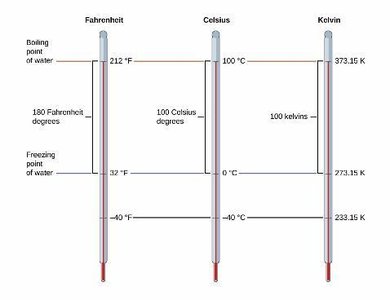
Conversion between °C and °F:
Conversion between °C and K:
Derived Units in Chemistry
Volume
Volume is a derived unit, commonly measured in liters (L) or milliliters (mL). The SI derived unit is the cubic meter (m3).
1 m3 = 1000 L
1 L = 1000 mL
1 L = 1.057 qt
Density
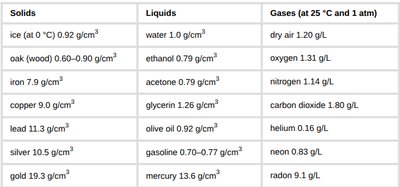
Density is defined as mass per unit volume and is temperature dependent. It is calculated as:
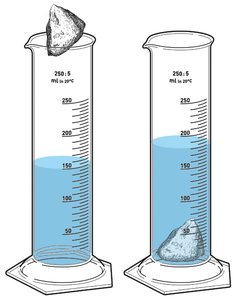
Density allows conversion between mass and volume. For irregular objects, volume is often determined by liquid displacement.
Other Derived Units
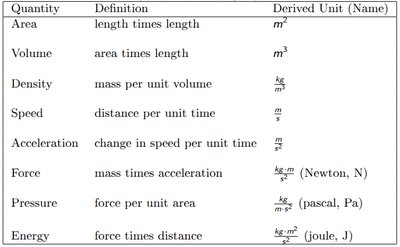
Other important derived units in chemistry include area, speed, acceleration, force, pressure, and energy. These are combinations of the base SI units.
Energy
Energy is the capacity to do work or supply heat. It can be kinetic (motion) or potential (stored). The SI unit is the joule (J).
Kinetic energy:
Potential energy:
1 cal = 4.184 J
1 Calorie (nutritional) = 1000 cal = 1 kcal
Accuracy, Precision, and Significant Figures
Accuracy vs. Precision
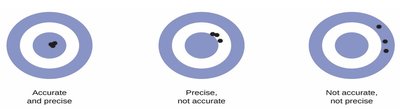
Accuracy refers to how close a measurement is to the true value. Precision refers to how closely repeated measurements agree with each other.
Significant Figures
Significant figures reflect the precision of a measurement. Rules for determining significant figures:
All nonzero digits are significant.
Zeros between nonzero digits are significant.
Trailing zeros are significant only if a decimal is present.
Leading zeros are not significant.
Scientific notation is used to clearly indicate the number of significant figures in large or small numbers.
Dimensional Analysis and Unit Conversions
Dimensional Analysis
Dimensional analysis is a method for converting between units using conversion factors derived from equalities. Units are treated algebraically, and unwanted units are canceled out.
Example: (rounded to 3 significant figures)
Reference Equalities and Conversion Tables
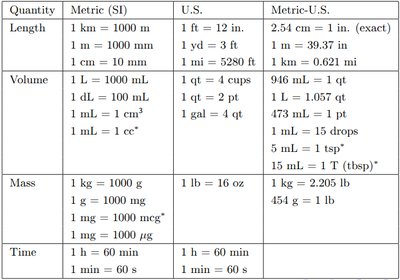
Common conversion factors are used for length, volume, mass, and time between metric and U.S. customary units.
Significant Figures in Calculations
Multiplication/Division: Result has the same number of significant figures as the measured value with the fewest significant figures.
Addition/Subtraction: Result is rounded to the least precise decimal place among the measured values.
Practice Problems
Convert 32.5 m3 to in3.
If a swimmer swims 85.4 yards in five minutes, how many meters will they swim in 70.0 seconds?
Express 6,000,000 s with 4 significant figures in scientific notation.
Additional info: For more practice with dimensional analysis, visit the provided online resource or scan the QR code in your course materials.
