 Indietro
Chapter 1: Introduction to Matter and Measurement – General Chemistry Study Notes
Guida di studio - Note intelligenti
 Appunti personalizzati basati sui tuoi materiali, ampliati con definizioni chiave, esempi e contesto.
Matter and Measurement
1.1 The Study of Chemistry
Chemistry is the scientific discipline that studies matter, its properties, and the changes it undergoes. It is central to understanding the natural world and is foundational to many scientific and technological fields.
Matter: Anything that has mass and occupies space.
Chemistry: The science that seeks to understand the properties of matter by studying the properties and behavior of atoms and molecules.
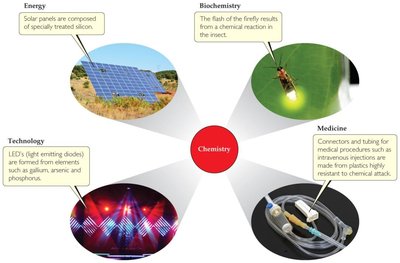
Applications: Chemistry is involved in healthcare, technology, energy, biochemistry, and more.
Atoms: The fundamental building blocks of matter.
Elements: Substances made of only one kind of atom.
Compounds: Substances composed of two or more different elements chemically bonded together.
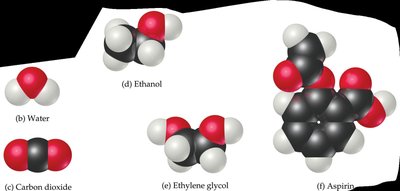
Example: Water (H2O), carbon dioxide (CO2), and aspirin are all compounds formed from atoms linked in specific ways.
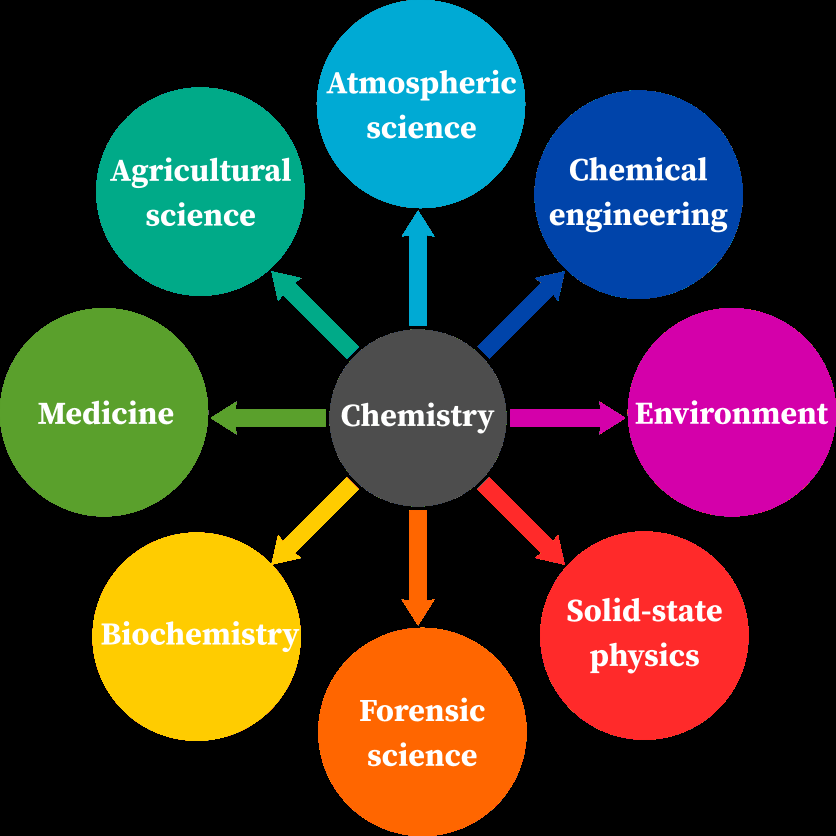
Additional info: Chemistry is often called the central science because it connects physical sciences with life sciences and applied sciences.
1.2 Classification of Matter
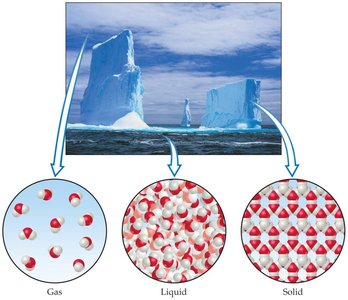
Matter can be classified by its physical state (solid, liquid, gas) and by its composition (element, compound, mixture).
States of Matter:
Solid: Definite shape and volume; particles are closely packed in a fixed arrangement.
Liquid: Definite volume but no definite shape; particles are close but can move past one another.
Gas: No definite shape or volume; particles are far apart and move freely.
Classification by Composition:
Element: A pure substance made of only one kind of atom (e.g., O2, Au).
Compound: A pure substance made of two or more elements chemically combined in fixed proportions (e.g., H2O, NaCl).
Mixture: A combination of two or more substances in which each retains its own identity. Mixtures can be homogeneous (uniform composition, e.g., air) or heterogeneous (non-uniform, e.g., sand and water).
Law of Definite Proportions: In a given chemical compound, the elements are always combined in the same proportions by mass.
Example: Pure H2O is always 11% hydrogen and 89% oxygen by mass.
1.3 Properties and Changes of Matter
Properties of matter can be classified as physical or chemical, and as intensive or extensive. Matter can undergo physical or chemical changes.
Physical Properties: Can be measured without changing the substance's identity (e.g., density, color, melting point).
Chemical Properties: Describe how a substance reacts to form new substances (e.g., flammability, reactivity).
Intensive Properties: Independent of the amount of substance (e.g., density, boiling point).
Extensive Properties: Dependent on the amount of substance (e.g., mass, volume).
Physical Changes: Do not alter the composition of the substance (e.g., melting, boiling, dissolving).
Chemical Changes: Result in the formation of new substances (e.g., combustion, oxidation).
Example: Cutting copper wire is a physical change; burning propane is a chemical change.
1.4 Separation of Mixtures
Mixtures can be separated into their components by exploiting differences in physical properties.
Filtration: Separates solids from liquids.
Distillation: Separates substances based on differences in boiling points.
Chromatography: Separates substances based on differences in solubility or ability to adhere to a surface.
Example: Salt can be separated from water by evaporation (a physical process).
1.5 Units of Measurement
Scientific measurements require both a number and a unit. The metric system and SI (International System of Units) are standard in science.
Base SI Units: Meter (m) for length, kilogram (kg) for mass, second (s) for time, kelvin (K) for temperature, mole (mol) for amount of substance.
Prefixes: Used to indicate multiples or fractions of units (e.g., kilo-, milli-, centi-).
Temperature Scales: Celsius (°C), Kelvin (K), and Fahrenheit (°F). The Kelvin scale is the SI unit for temperature.
Volume: The SI unit is the cubic meter (m3), but liters (L) and milliliters (mL) are commonly used in chemistry.
1 L = 1 dm3 = 1000 mL = 1000 cm3
Density: The ratio of mass to volume. Common units are g/mL or g/cm3.
Example: If a metal cube has a mass of 6.67 g and a volume of 1.48 cm3, its density is .
1.6 Uncertainty in Measurements
All measurements have some degree of uncertainty. Accuracy and precision are important concepts in measurement.
Accuracy: How close a measurement is to the true value.
Precision: How close repeated measurements are to each other.
Significant Figures: The digits in a measurement that are known with certainty plus one estimated digit.
Rules for Significant Figures:
All nonzero digits are significant.
Zeros between significant digits are significant.
Leading zeros are not significant.
Trailing zeros are significant only if there is a decimal point.
Calculations:
Addition/Subtraction: Round to the least number of decimal places.
Multiplication/Division: Round to the least number of significant figures.
1.7 Dimensional Analysis
Dimensional analysis is a method for converting one unit to another using conversion factors.
Conversion Factor: A ratio that expresses how many of one unit are equal to another unit (e.g., 1 in = 2.54 cm).
Set up the calculation so that units cancel, leaving the desired unit.
Example: To convert 8.00 m to inches:
8.00 m × (100 cm / 1 m) × (1 in / 2.54 cm) = 315 in
General Problem Solving Strategy:
Identify the starting point (given information).
Identify the end point (what you must find).
Devise a way to get from the starting point to the end point using appropriate conversion factors.
