 Indietro
Chapter 1: Introduction to Matter, Energy, and Measurement – Study Notes
Guida di studio - Note intelligenti
 Appunti personalizzati basati sui tuoi materiali, ampliati con definizioni chiave, esempi e contesto.
Introduction to Matter, Energy, and Measurement
Overview
This chapter introduces the foundational concepts of measurement in chemistry, including the metric and SI systems, units, significant figures, and the use of scientific notation and dimensional analysis. Mastery of these topics is essential for accurate scientific communication and problem-solving in chemistry.
Units of Measurement
SI Base Units
The International System of Units (SI) is the standard system of measurement in science. It consists of seven base units, each corresponding to a fundamental physical quantity.
Physical Quantity | Name of Unit | Abbreviation |
|---|---|---|
Mass | Kilogram | kg |
Length | Meter | m |
Time | Second | s |
Temperature | Kelvin | K |
Amount of substance | Mole | mol |
Electric current | Ampere | A |
Luminous intensity | Candela | cd |
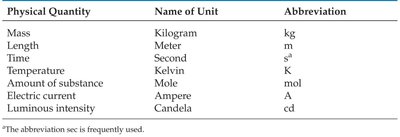
Key Point: Recognizing units and their associated quantities is crucial for problem-solving in chemistry.
Metric System Prefixes
Prefixes are used to convert base units into units appropriate for the scale of measurement. Each prefix represents a specific power of ten.
Prefix | Abbreviation | Meaning | Example |
|---|---|---|---|
Giga | G | 109 | 1 gigameter (Gm) = 1 × 10⁹ m |
Mega | M | 106 | 1 megameter (Mm) = 1 × 10⁶ m |
Kilo | k | 103 | 1 kilometer (km) = 1 × 10³ m |
Deci | d | 10-1 | 1 decimeter (dm) = 0.1 m |
Centi | c | 10-2 | 1 centimeter (cm) = 0.01 m |
Milli | m | 10-3 | 1 millimeter (mm) = 0.001 m |
Micro | μ | 10-6 | 1 micrometer (μm) = 1 × 10⁻⁶ m |
Nano | n | 10-9 | 1 nanometer (nm) = 1 × 10⁻⁹ m |
Pico | p | 10-12 | 1 picometer (pm) = 1 × 10-12 m |
Femto | f | 10-15 | 1 femtometer (fm) = 1 × 10-15 m |
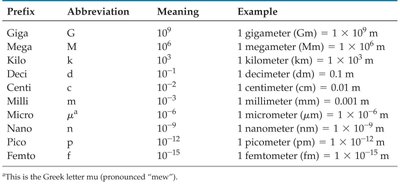
Example: 1 kilometer (km) = 1 × 10³ meters (m).
Temperature
Temperature Scales
Temperature is a measure of the average kinetic energy of particles in a sample. The most common scales in science are Celsius (°C), Kelvin (K), and Fahrenheit (°F).
Celsius (°C): Water freezes at 0°C and boils at 100°C.
Kelvin (K): The SI unit; absolute zero is 0 K. Water freezes at 273 K and boils at 373 K.
Fahrenheit (°F): Water freezes at 32°F and boils at 212°F.
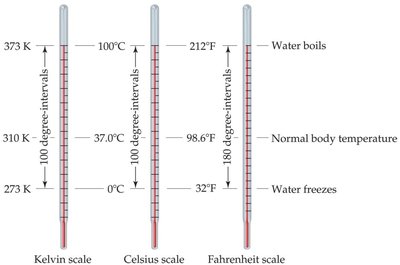
Key Equations:
Example: To convert 25°C to Kelvin: K.
Volume and Its Measurement
Metric Units of Volume
Volume is the amount of space occupied by a substance. The most common metric units are the liter (L) and milliliter (mL).
1 L = 1 dm3
1 mL = 1 cm3 = 1 cc
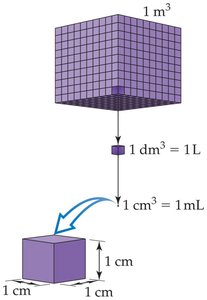
Equivalence Statements:
1 m3 = 1000 dm3
1 dm3 = 1000 cm3
1 m3 = 1,000,000 cm3
Measuring Volume in the Laboratory
Various glassware is used to measure volume, each with different levels of accuracy and precision.
Graduated cylinder: Used to deliver variable volumes with graduations for accuracy.
Syringe: Used to deliver variable volumes.
Burette: Used to deliver specific volumes, with a stopcock to control flow.
Pipette: Used to deliver a specific volume.
Volumetric flask: Used to hold a specific volume.
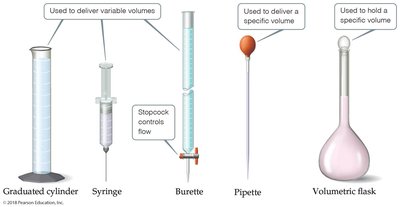
Key Point: The more graduations, the greater the accuracy of the measurement.
Density
Definition and Calculation
Density is a physical property defined as mass per unit volume. It is commonly expressed in grams per milliliter (g/mL) or grams per cubic centimeter (g/cm3).
Formula:
To solve for mass:
To solve for volume:
Example: If a liquid has a mass of 65.0 g and a density of 0.791 g/mL, its volume is mL.
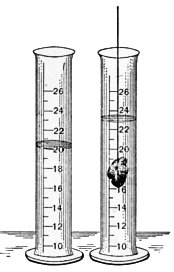
Volume by Displacement: The volume of an irregular object can be determined by the amount of liquid it displaces in a graduated cylinder.
Uncertainty in Measurement
Exact vs. Inexact Numbers
Exact numbers are known with complete certainty (e.g., 12 eggs in a dozen). Inexact numbers are obtained by measurement and have some degree of uncertainty.
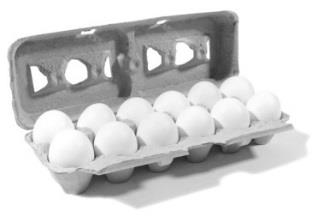
Key Point: All measurements have some uncertainty, typically in the last digit reported.
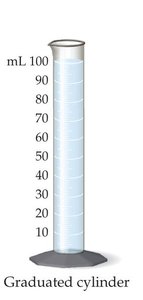
Accuracy vs. Precision
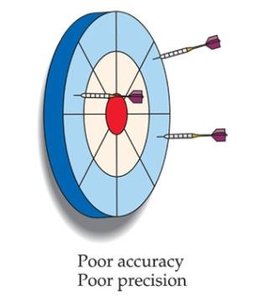
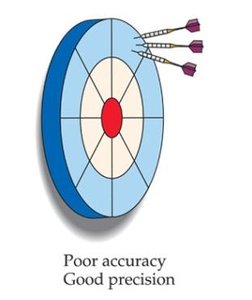
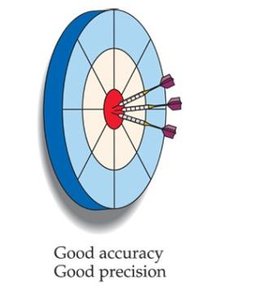
Accuracy refers to how close a measurement is to the true value. Precision refers to how close repeated measurements are to each other.
Good accuracy and good precision: Measurements are close to the true value and to each other.
Poor accuracy, good precision: Measurements are close to each other but not to the true value.
Poor accuracy, poor precision: Measurements are neither close to each other nor to the true value.
Significant Figures
Rules for Determining Significant Figures
All nonzero digits are significant.
Zeroes between significant digits are significant.
Leading zeroes are not significant.
Trailing zeroes are significant if a decimal point is present.
Example: 0.0057 (2 significant figures), 8000. (4 significant figures), 2.3900 (5 significant figures).
Significant Figures in Calculations
Addition/Subtraction: The result should have the same number of decimal places as the measurement with the fewest decimal places.
Multiplication/Division: The result should have the same number of significant figures as the measurement with the fewest significant figures.
Example (Addition): (rounded to 1 decimal place)
Example (Multiplication): (rounded to 1 significant figure)
Key Point: Do not round intermediate steps; round only the final answer.
Scientific Notation
Definition and Application
Scientific notation expresses numbers as a product of a number between 1 and 10 and a power of ten. It is used to simplify very large or very small numbers.
Example: 3820 =
Example: 0.0478 =
Dimensional Analysis
Unit Conversions
Dimensional analysis uses conversion factors to convert one unit to another. Conversion factors are derived from equivalence statements.
Example: 1 in = 2.54 cm can be written as or .
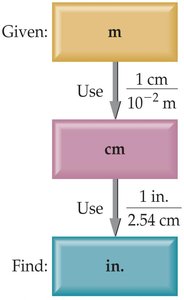
Example: To convert 8.00 m to inches:
Convert meters to centimeters:
Convert centimeters to inches:
Practice Problems and Applications
Sample Problems
Calculate the volume of 65.0 g of methanol (density = 0.791 g/mL): mL
Convert 3.5 Gbyte to kbyte: kbyte
Convert 1.36 × 10⁹ km3 of water to liters: L
Appendix: The Ladder Method
Visualizing Metric Conversions
The ladder method helps visualize moving between metric prefixes by shifting the decimal point or adjusting the exponent in scientific notation.
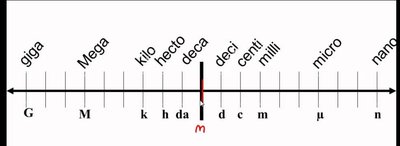
Key Point: Move the decimal to the left for larger units, to the right for smaller units.
