 Indietro
Chapter 1: Matter and Measurement – General Chemistry Study Notes
Guida di studio - Note intelligenti
 Appunti personalizzati basati sui tuoi materiali, ampliati con definizioni chiave, esempi e contesto.
Matter and Measurement
What is Chemistry?
Chemistry is the scientific study of matter, its composition, structure, properties, and the changes it undergoes. It provides explanations at the nanoscale (atomic and molecular level) for macroscale (observable) properties and behaviors.
Matter: Anything that has mass and occupies space (volume).
Atoms: Fundamental units of matter, often represented as spheres and denoted by letter symbols (e.g., C for carbon, He for helium).
Composition vs. Structure
The composition of a substance refers to the types of simple components it contains, while structure refers to both the components and their arrangement.
Composition: What a substance is made of (e.g., wood).
Structure: How those components are arranged (e.g., deck, canoe, baseball bat).

Classification of Matter: Pure Substances and Mixtures
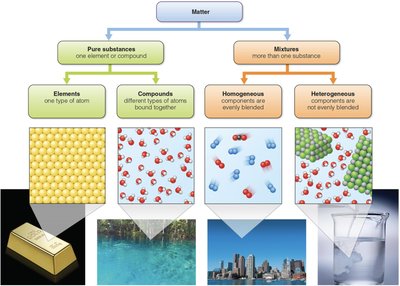
Matter can be classified as pure substances or mixtures. Pure substances include elements and compounds, while mixtures can be homogeneous or heterogeneous.
Element: A substance made of only one type of atom.
Compound: A substance made of more than one type of atom, with atoms bonded in a fixed ratio.
Molecule: A collection of atoms held together by chemical bonds.
Mixture: Two or more pure substances sharing the same space, not always in the same ratio.
Homogeneous mixture: Uniform throughout (e.g., salt water, air).
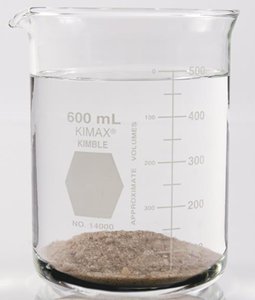
Heterogeneous mixture: Not uniform throughout (e.g., sand in water, gravel).
Monatomic vs. Diatomic Elements
Of the 118 elements, seven are found as diatomic molecules in their simplest form; the rest are monatomic.
Monatomic elements: Exist as single atoms (e.g., noble gases).
Diatomic elements: Exist as pairs of atoms (H2, N2, O2, F2, Cl2, Br2, I2).
Practice: Identifying Elements, Compounds, and Mixtures
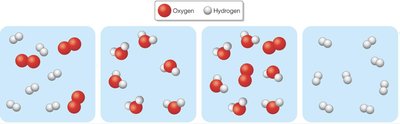
Visual representations help distinguish between elements, compounds, and mixtures based on the arrangement and types of atoms present.
Phases or States of Matter
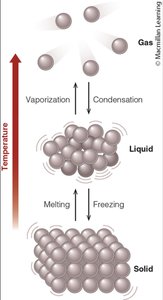
Matter exists in three primary states: solid, liquid, and gas. Each state has distinct properties regarding shape, volume, and particle interactions.
Solid: Definite shape and volume; particles are closely packed and ordered.
Liquid: Indefinite shape, definite volume; particles are less ordered and have more freedom of motion.
Gas: Indefinite shape and volume; particles are far apart and interact weakly.
Physical Properties and Changes
Physical properties can be measured without changing the identity of a substance. Physical changes alter the form or appearance but not the chemical identity.
Physical properties: Mass, length, volume, melting point, boiling point.
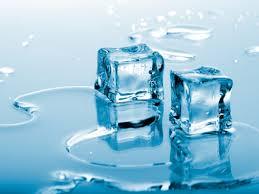
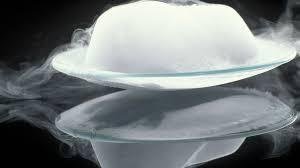
Physical changes: Changes in state (melting, freezing, vaporization, condensation, sublimation, deposition).
Chemical Properties and Changes
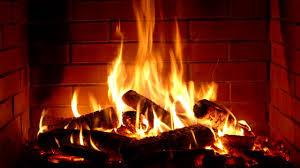
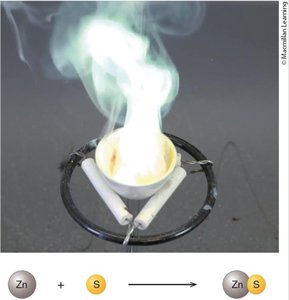
Chemical properties describe a substance's ability to undergo chemical changes, which alter its identity by breaking and forming new bonds.
Chemical properties: Flammability, oxidation (rusting).
Chemical changes: Formation of new substances, often indicated by color changes, bubbles, temperature changes, or new smells.
Potential and Kinetic Energy
Energy is the ability to do work. It exists as potential energy (stored) and kinetic energy (motion).
Potential energy: Energy due to position or arrangement.
Kinetic energy: Energy due to motion.

Energy Transfer: Heat
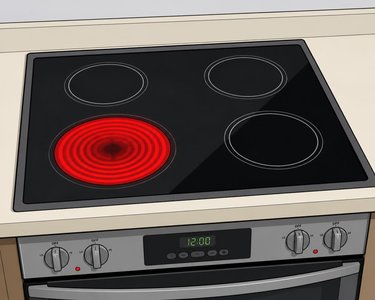
Energy is often transferred as heat, which involves the kinetic energy of particles. Heat naturally flows from hot objects to cold objects.
Heat transfer increases the kinetic energy (velocity) of atoms and molecules.
Releasing or Absorbing Energy
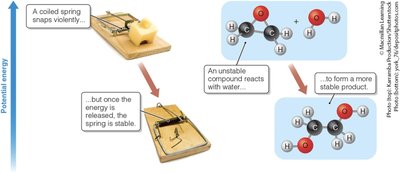
Physical and chemical changes involve energy changes. Systems tend to move toward lower energy states spontaneously.
Spontaneous processes: Move toward lower energy (e.g., ball rolling down a hill).
Nonspontaneous processes: Require energy input to move to higher energy.
Endothermic and Exothermic Reactions
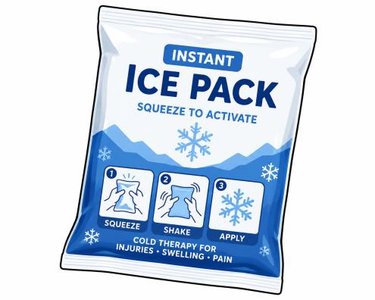
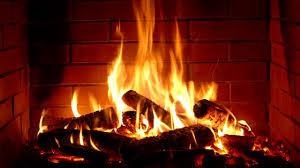
Chemical reactions can absorb or release heat energy.
Endothermic reactions: Absorb heat (e.g., cold packs).
Exothermic reactions: Release heat (e.g., combustion of firewood).
Units of Measurement
English and Metric Units
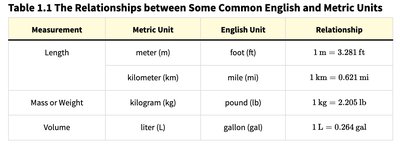
Measurements in chemistry use both English and metric units. Conversion factors relate these units.
Measurement | Metric Unit | English Unit | Relationship |
|---|---|---|---|
Length | meter (m) | foot (ft) | 1 m = 3.281 ft |
kilometer (km) | mile (mi) | 1 km = 0.621 mi | |
Mass or Weight | kilogram (kg) | pound (lb) | 1 kg = 2.205 lb |
Volume | liter (L) | gallon (gal) | 1 L = 0.264 gal |
SI Units of Measurement
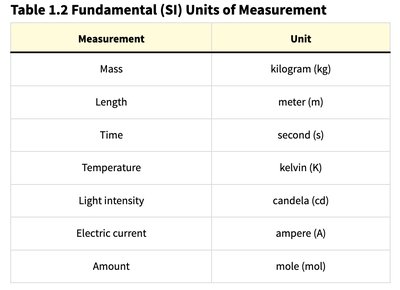
The International System of Units (SI) defines seven fundamental units.
Measurement | Unit |
|---|---|
Mass | kilogram (kg) |
Length | meter (m) |
Time | second (s) |
Temperature | kelvin (K) |
Light intensity | candela (cd) |
Electric current | ampere (A) |
Amount | mole (mol) |
Metric Prefixes
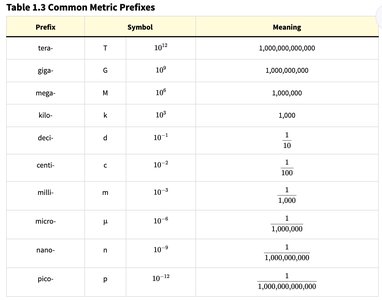
Metric prefixes indicate powers of ten for units, allowing for easy scaling of measurements.
Prefix | Symbol | Power of Ten | Meaning |
|---|---|---|---|
tera- | T | 1012 | 1,000,000,000,000 |
giga- | G | 109 | 1,000,000,000 |
mega- | M | 106 | 1,000,000 |
kilo- | k | 103 | 1,000 |
deci- | d | 10-1 | 1/10 |
centi- | c | 10-2 | 1/100 |
milli- | m | 10-3 | 1/1,000 |
micro- | μ | 10-6 | 1/1,000,000 |
nano- | n | 10-9 | 1/1,000,000,000 |
pico- | p | 10-12 | 1/1,000,000,000,000 |
Temperature Scales and Conversions
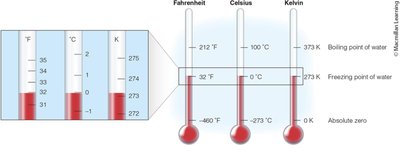
Temperature is measured in Celsius, Fahrenheit, and Kelvin. Conversion formulas are essential for laboratory work.
Celsius to Fahrenheit:
Celsius to Kelvin:
Scale | Boiling Point of Water | Freezing Point of Water |
|---|---|---|
Celsius | 100 ℃ | 0 ℃ |
Fahrenheit | 212 ℉ | 32 ℉ |
Kelvin | 373 K | 273 K |
Volume and Density
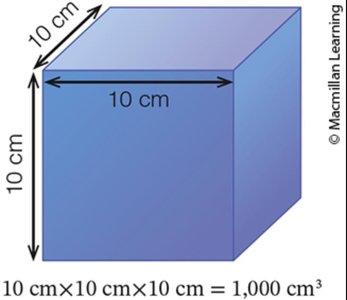
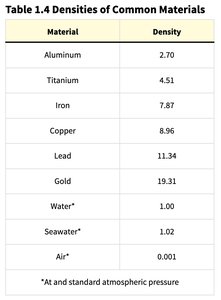
Volume is derived from length, width, and height. Density relates mass to volume and determines whether objects float or sink.
Volume formula (cube):
Density formula:
1 mL = 1 cm3
Material | Density (g/cm3) |
|---|---|
Aluminum | 2.70 |
Titanium | 4.51 |
Iron | 7.87 |
Copper | 8.96 |
Lead | 11.34 |
Gold | 19.31 |
Water* | 1.00 |
Seawater* | 1.02 |
Air* | 0.001 |
Conversion Factors
Conversion factors are ratios of equivalent values used to convert between units.
Example:
Common conversion factors: 12 inches = 1 foot, 60 minutes = 1 hour, 1000 g = 1 kg
Practice Problems
Practice converting units and calculating area, volume, and density using the provided formulas and conversion factors.
Convert 0.0129 inches to micrometers (1 inch = 2.54 cm).
Calculate the area of a football field in square meters (1 yard = 3 ft, 1 m = 3.281 ft).
Determine the volume of mercury given its density and mass.
Example: The volume of a cylinder is . If a cylinder has a length of 4.00 cm, radius of 1.00 cm, and mass of 23.0 g:
Calculate volume:
Calculate density:
Since density > water, the object will sink.
*Additional info: Practice problems reinforce understanding of unit conversions and density calculations, which are foundational skills in general chemistry.*
