 Indietro
Chapter 1: Matter, Energy, and Measurement – Study Notes
Guida di studio - Note intelligenti
 Appunti personalizzati basati sui tuoi materiali, ampliati con definizioni chiave, esempi e contesto.
Matter and Measurement
Introduction to Chemistry
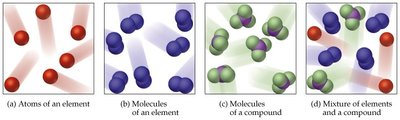
Chemistry is the study of the composition, structure, properties, and behavior of matter. It explores the macroscopic world of observable substances and the microscopic world of atoms and molecules, providing a bridge between these two realms.
Matter: Anything that has mass and occupies space.
Atoms: The smallest units of elements that retain the properties of the element.
Molecules: Groups of two or more atoms bonded together.
Elements: Pure substances consisting of only one type of atom.
Compounds: Substances composed of two or more different elements chemically combined.
Mixtures: Physical combinations of two or more substances where each retains its own identity.
States of Matter
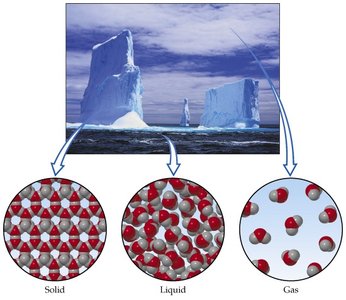
Matter exists in three primary states: solid, liquid, and gas. Each state is characterized by the arrangement and movement of its particles.
Solid: Particles are closely packed in a fixed arrangement; definite shape and volume.
Liquid: Particles are close but can move past one another; definite volume but no definite shape.
Gas: Particles are far apart and move freely; no definite shape or volume.
Physical and Chemical Changes
Changes in matter can be classified as physical or chemical:
Physical Change: Alters the state or appearance without changing composition (e.g., melting ice).
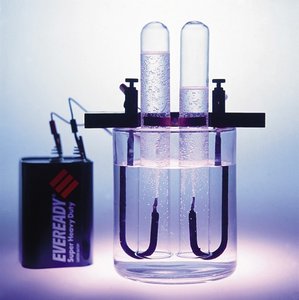
Chemical Change: Results in the formation of new substances with different compositions (e.g., electrolysis of water).
Properties of Matter
Properties of matter are classified as intensive or extensive:
Intensive Properties: Independent of the amount of substance (e.g., density, boiling point, color).
Extensive Properties: Depend on the amount of substance (e.g., mass, volume, energy).
Measurement and Units
SI Base Units
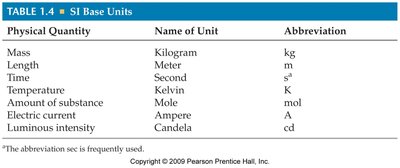
Scientists use the International System of Units (SI) for consistency in measurements. Each physical quantity has a standard unit.
Physical Quantity | Name of Unit | Abbreviation |
|---|---|---|
Mass | Kilogram | kg |
Length | Meter | m |
Time | Second | s |
Temperature | Kelvin | K |
Amount of substance | Mole | mol |
Electric current | Ampere | A |
Luminous intensity | Candela | cd |
Metric Prefixes
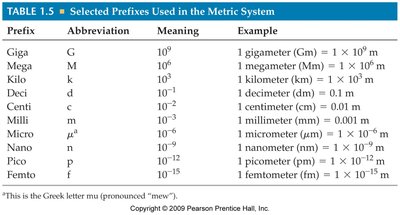
Prefixes are used to express multiples or fractions of base units, making measurements more convenient.
Prefix | Abbreviation | Meaning | Example |
|---|---|---|---|
Giga | G | 109 | 1 gigameter (Gm) = 1 × 10⁹ m |
Mega | M | 106 | 1 megameter (Mm) = 1 × 10⁶ m |
Kilo | k | 103 | 1 kilometer (km) = 1 × 10³ m |
Deci | d | 10-1 | 1 decimeter (dm) = 0.1 m |
Centi | c | 10-2 | 1 centimeter (cm) = 0.01 m |
Milli | m | 10-3 | 1 millimeter (mm) = 0.001 m |
Micro | μ | 10-6 | 1 micrometer (μm) = 1 × 10⁻⁶ m |
Nano | n | 10-9 | 1 nanometer (nm) = 1 × 10⁻⁹ m |
Pico | p | 10-12 | 1 picometer (pm) = 1 × 10-12 m |
Femto | f | 10-15 | 1 femtometer (fm) = 1 × 10-15 m |
Scientific Notation
Scientific notation expresses very large or very small numbers in the form , where and is an integer. This is essential for clarity and precision in scientific measurements.
Uncertainty in Measurement and Significant Figures
All measurements have some degree of uncertainty, reflected in the number of significant figures reported.
Significant Figures: Digits in a measurement that are known with certainty plus one estimated digit.
Rules for Counting Significant Figures:
All nonzero digits are significant.
Leading zeros are not significant.
Captive zeros (between nonzero digits) are significant.
Trailing zeros are significant only if there is a decimal point.
Exact numbers have an infinite number of significant figures.
Significant Figures in Calculations
Multiplication/Division: The result should have as many significant figures as the measurement with the fewest significant figures.
Addition/Subtraction: The result should have as many decimal places as the measurement with the fewest decimal places.
Rounding: Only round the final result, not intermediate steps.
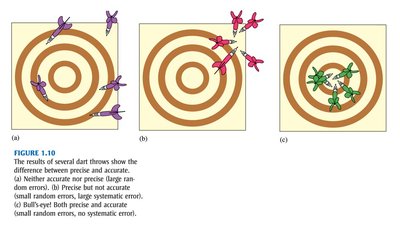
Precision and Accuracy
Definitions
Accuracy: How close a measurement is to the true value.
Precision: How close repeated measurements are to each other (reproducibility).
Lab Measurement Example
Comparing the accuracy and precision of a graduated cylinder and a buret in measuring 25 mL of water:
Trial | Volume Shown by Graduated Cylinder | Volume Shown by the Buret |
|---|---|---|
1 | 25 mL | 26.54 mL |
2 | 25 mL | 26.51 mL |
3 | 25 mL | 26.60 mL |
4 | 25 mL | 26.49 mL |
5 | 25 mL | 26.57 mL |
Average | 25 mL | 26.54 mL |
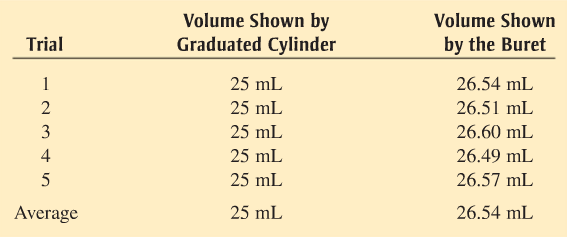
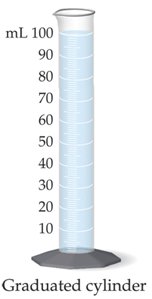
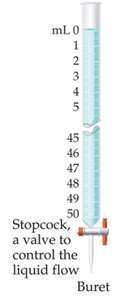
Conclusion: The buret provides more precise measurements (more decimal places, less variation), while the graduated cylinder is less precise but may be accurate if the true value is close to 25 mL.
Dimensional Analysis and Unit Conversions
Dimensional Analysis
Dimensional analysis (factor-label method) is used to convert between units using conversion factors. Units provide clues for solving problems and ensure correct calculations.
Example: Convert 7.00 inches to centimeters using .
Multiple Conversions: Chain conversion factors for complex conversions (e.g., km to miles).
Volume Conversions
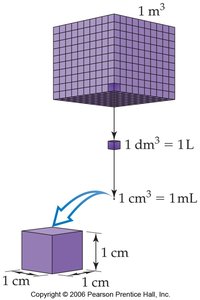
Volume conversions often require cubing both the unit and the conversion factor.
1 L = 1 dm3
1 mL = 1 cm3
Temperature Scales
Temperature Units and Conversions
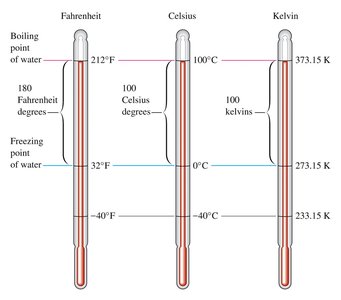
Temperature can be measured in Celsius (°C), Kelvin (K), or Fahrenheit (°F). The Kelvin scale is the SI unit for temperature.
Temperature and Molecular Motion
Temperature is a measure of the average kinetic energy of particles. As temperature increases, molecular motion increases. For example, nitrogen molecules move faster at higher temperatures.
Density
Definition and Calculation
Density is defined as mass per unit volume:
Common units: g/cm3 or g/mL
Density is an intensive property and can be used to identify substances.
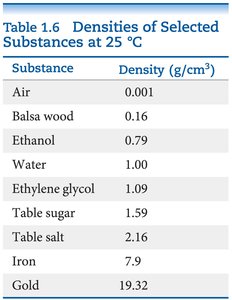
Substance | Density (g/cm3) |
|---|---|
Air | 0.001 |
Balsa wood | 0.16 |
Ethanol | 0.79 |
Water | 1.00 |
Ethylene glycol | 1.09 |
Table sugar | 1.59 |
Table salt | 2.16 |
Iron | 7.9 |
Gold | 19.32 |
Example Calculation
To find the mass of 1.00 gallon of water (density = 1.00 g/mL):
1 gal = 4 qt
1 qt = 0.946 L
1 L = 1000 mL
Mass = volume × density
Additional info: Always ensure units are consistent when performing calculations.
