 Indietro
Chapter 1: Matter, Energy, and Measurement – General Chemistry Study Notes
Guida di studio - Note intelligenti
 Appunti personalizzati basati sui tuoi materiali, ampliati con definizioni chiave, esempi e contesto.
Chapter 1: Matter, Energy, and Measurement
1.1 The Study of Chemistry
Chemistry is the central science, connecting and overlapping with many other scientific disciplines. It focuses on the composition, properties, and interactions of matter, which is anything that has mass and occupies space. Understanding chemistry helps explain everyday phenomena and the natural world.
Chemistry: The study of matter, its properties, and the changes it undergoes.
Matter: Anything that has mass and occupies space.
Domains of Chemistry:
Macroscopic: Observable phenomena (e.g., boiling water).
Microscopic: Atoms and molecules, not visible to the naked eye.
Symbolic: Chemical symbols and formulas representing substances and reactions.
Examples of Chemistry in Daily Life: Statue of Liberty's color, baking soda and vinegar reaction, sweating, food browning, and more.
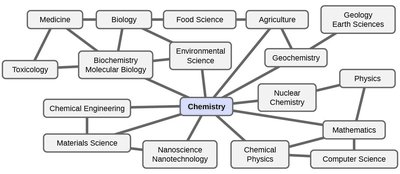
1.2 Classification of Matter
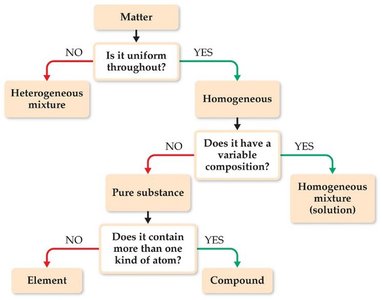
Matter can be classified based on its physical state and composition. Understanding these classifications is fundamental to studying chemistry.
States of Matter: Solid, liquid, and gas, each with distinct properties regarding shape, volume, and compressibility.
Types of Matter:
Pure Substances: Have a fixed composition and distinct properties. Cannot be separated by physical means. Subdivided into:
Elements: Cannot be decomposed into simpler substances. Composed of one kind of atom.
Compounds: Composed of two or more different elements chemically combined in fixed ratios.
Mixtures: Combinations of two or more substances where each retains its identity. Can be separated by physical means. Subdivided into:
Homogeneous (Solutions): Uniform composition throughout (e.g., salt water).
Heterogeneous: Non-uniform composition (e.g., pizza, sand and water).
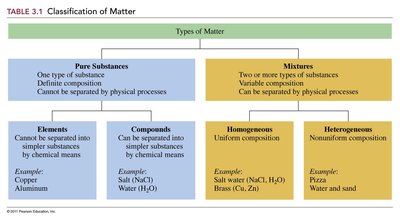
Type | Description | Example |
|---|---|---|
Element | Cannot be separated into simpler substances by chemical means | Copper (Cu), Aluminum (Al) |
Compound | Can be separated into elements by chemical means | Salt (NaCl), Water (H2O) |
Homogeneous Mixture | Uniform composition | Salt water, Brass |
Heterogeneous Mixture | Non-uniform composition | Pizza, Water and sand |
1.3 Properties of Matter
Properties of matter are used to distinguish between substances and to identify them. These properties can be physical or chemical, and further classified as intensive or extensive.
Physical Properties: Can be observed without changing the substance's identity (e.g., color, melting point, density).
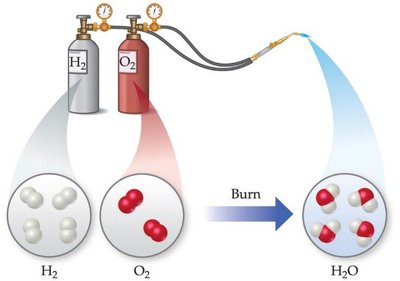
Chemical Properties: Describe a substance's ability to undergo chemical changes (e.g., flammability, reactivity).
Physical Change: Does not alter the composition (e.g., melting, boiling).
Chemical Change: Alters the composition, resulting in new substances (e.g., combustion, oxidation).
Intensive Properties: Independent of the amount of substance (e.g., density, boiling point).
Extensive Properties: Dependent on the amount of substance (e.g., mass, volume).
1.4 The Nature of Energy
Energy is the capacity to do work or transfer heat. In chemistry, energy changes accompany physical and chemical changes.
Kinetic Energy (KE): Energy of motion.
Potential Energy (PE): Energy due to position or arrangement.
Units of Energy: Joule (J), calorie (cal).
Energy in Chemistry: The state of matter depends on the balance between kinetic energy (motion) and potential energy (attractive forces).
1.5 Units of Measurement
Measurements in chemistry require standardized units. The International System of Units (SI) is used for consistency.
Base SI Units:
Length: meter (m)
Mass: kilogram (kg)
Time: second (s)
Temperature: kelvin (K)
Amount of substance: mole (mol)
Volume: 1 liter (L) = 1 dm3; 1 mL = 1 cm3
Metric Prefixes: Used to express multiples or fractions of units (e.g., kilo-, centi-, milli-).
Prefix | Symbol | Factor |
|---|---|---|
kilo- | k | 103 |
centi- | c | 10-2 |
milli- | m | 10-3 |
micro- | μ | 10-6 |
nano- | n | 10-9 |
1.6 Uncertainty in Measurement
All measurements have some degree of uncertainty, which is expressed using significant figures. Accuracy and precision are important concepts in evaluating measurements.
Accuracy: How close a measurement is to the true value.
Precision: How close repeated measurements are to each other.
Significant Figures (SF): Indicate the certainty in a measurement. Rules for counting SF include:
All nonzero digits are significant.
Zeros between nonzero digits are significant.
Leading zeros are not significant.
Trailing zeros are significant if a decimal point is present.
Calculations with Significant Figures:
Addition/Subtraction: Round to the least significant decimal place.
Multiplication/Division: Round to the least number of significant figures.
1.7 Dimensional Analysis
Dimensional analysis is a systematic approach to problem-solving that uses conversion factors to move from one unit to another. It ensures that units cancel appropriately, leading to the correct answer.
Conversion Factor: A ratio derived from the equality between two different units (e.g., 1 in = 2.54 cm).
Steps:
Identify the given quantity and unit.
Determine the desired unit.
Set up conversion factors so units cancel appropriately.
Perform the calculation.
Example: Convert 125 cm to inches using the conversion factor 1 in = 2.54 cm.
Practice Problems and Applications
Classify substances as elements, compounds, homogeneous mixtures, or heterogeneous mixtures.
Identify physical vs. chemical changes in everyday scenarios.
Apply significant figure rules to calculations.
Use dimensional analysis for unit conversions.
Key Terms and Definitions
Element: A substance that cannot be broken down into simpler substances by chemical means.
Compound: A substance composed of two or more elements chemically combined in a fixed ratio.
Molecule: Two or more atoms held together by chemical bonds.
Mixture: A combination of two or more substances in which each retains its own identity.
Solution: A homogeneous mixture at the molecular level.
Density: Mass per unit volume,
Significant Figures: Digits in a measurement that are known with certainty plus one that is estimated.
