 Indietro
Chapter 1: Matter, Energy, and Measurement – Structured Study Notes
Guida di studio - Note intelligenti
 Appunti personalizzati basati sui tuoi materiali, ampliati con definizioni chiave, esempi e contesto.
Chapter 1: Matter, Energy, and Measurement
Prefixes and Units of Measurement
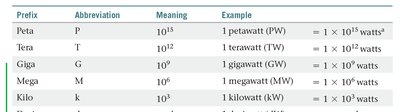
Understanding metric prefixes is essential for expressing quantities in chemistry. Prefixes indicate multiples or fractions of base units, allowing for concise representation of very large or small values.
Prefix: A syllable added to a unit to indicate a power of ten.
Abbreviation: The symbol used for the prefix.
Meaning: The power of ten associated with the prefix.
Example: How the prefix is used in practice.
Prefix | Abbreviation | Meaning | Example |
|---|---|---|---|
Peta | P | 1015 | 1 petawatt (PW) = 1 × 10¹⁵ watts |
Tera | T | 1012 | 1 terawatt (TW) = 1 × 10¹² watts |
Giga | G | 109 | 1 gigawatt (GW) = 1 × 10⁹ watts |
Mega | M | 106 | 1 megawatt (MW) = 1 × 10⁶ watts |
Kilo | k | 103 | 1 kilowatt (kW) = 1 × 10³ watts |
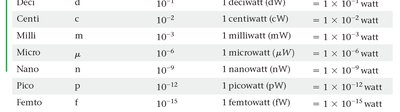
Deci | d | 10-1 | 1 deciwatt (dW) = 1 × 10⁻¹ watt |
Centi | c | 10-2 | 1 centiwatt (cW) = 1 × 10⁻² watt |
Milli | m | 10-3 | 1 milliwatt (mW) = 1 × 10⁻³ watt |
Micro | μ | 10-6 | 1 microwatt (μW) = 1 × 10⁻⁶ watt |
Nano | n | 10-9 | 1 nanowatt (nW) = 1 × 10⁻⁹ watt |
Pico | p | 10-12 | 1 picowatt (pW) = 1 × 10-12 watt |
Femto | f | 10-15 | 1 femtowatt (fW) = 1 × 10-15 watt |
Example: 3.1 × 10¹⁵ μg = 3.1 × 10⁹ g
Angstrom (Å): 1 Å = 1 × 10⁻¹⁰ m
Application: Prefixes are used in scientific notation to simplify calculations and express measurements efficiently.
Temperature Scales and Conversion
Temperature is a fundamental physical property measured in different scales. The three main scales are Kelvin, Celsius, and Fahrenheit. Understanding their relationships is crucial for laboratory and theoretical chemistry.
Kelvin (K): The absolute temperature scale; zero K is absolute zero.
Celsius (°C): Based on the freezing and boiling points of water.
Fahrenheit (°F): Commonly used in the United States.
Conversion:
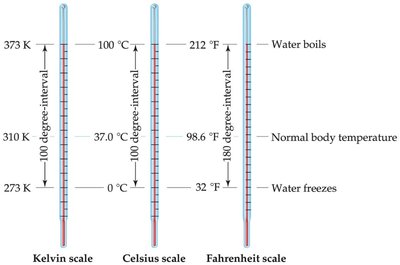
Water freezes: 0°C, 273 K, 32°F
Water boils: 100°C, 373 K, 212°F
Normal body temperature: 37°C, 310 K, 98.6°F
Example: To convert 25°C to Kelvin: K
Atoms, Molecules, Elements, and Compounds
Chemistry distinguishes between atoms, molecules, elements, and compounds. These terms describe the basic building blocks of matter and their combinations.
Atom: The smallest unit of an element, retaining its chemical properties.
Molecule: A group of atoms bonded together, representing the smallest unit of a compound or element with chemical properties.
Element: A substance consisting of only one type of atom.
Compound: A substance formed from two or more different types of atoms chemically bonded.
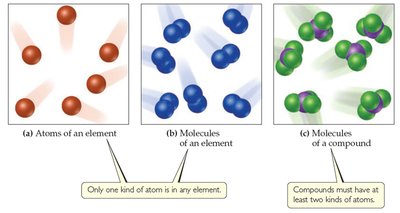
Example: Oxygen gas (O2) is a molecule of an element; water (H2O) is a molecule of a compound.
First 20 Elements: The periodic table begins with hydrogen (H), helium (He), lithium (Li), beryllium (Be), boron (B), carbon (C), nitrogen (N), oxygen (O), fluorine (F), neon (Ne), sodium (Na), magnesium (Mg), aluminum (Al), silicon (Si), phosphorus (P), sulfur (S), chlorine (Cl), argon (Ar), potassium (K), calcium (Ca).
Chemical Change vs. Physical Change
Changes in matter are classified as either chemical or physical. Understanding the distinction is fundamental in chemistry.
Chemical Change: A process in which substances are transformed into new substances with different molecular structures. Examples include burning, corrosion, and decomposition.
Physical Change: A process that alters the physical state or appearance of a substance without changing its chemical composition. Examples include changes in density, mass, volume, melting, freezing, and compression.
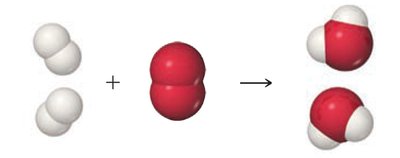
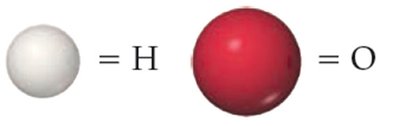
Example of Chemical Change: Formation of water from hydrogen and oxygen gases:
Example of Physical Change: Freezing of water, compression of oxygen gas.
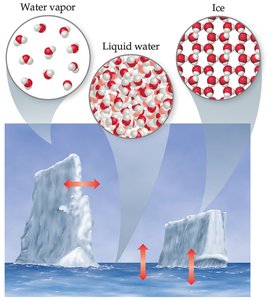
Application: Identifying whether a change is chemical or physical is important for predicting properties and behaviors of substances.
Classification of Changes: Examples
Below are examples of changes in matter, classified as chemical or physical:
Rusting of a nail: Chemical change (formation of iron oxide)
Freezing of water: Physical change (change of state)
Decomposition of water into hydrogen and oxygen gases: Chemical change (breaking chemical bonds)
Compression of oxygen gas: Physical change (change in volume and pressure)

Summary Table:
Process | Type of Change |
|---|---|
Rusting of a nail | Chemical |
Freezing of water | Physical |
Decomposition of water | Chemical |
Compression of oxygen gas | Physical |
Additional info: The distinction between chemical and physical changes is foundational for later topics such as chemical reactions, stoichiometry, and thermochemistry.
