 Indietro
Chapter 1 Student Notes
Guida di studio - Note intelligenti
 Appunti personalizzati basati sui tuoi materiali, ampliati con definizioni chiave, esempi e contesto.
Atoms and Molecules
Definition and Structure
Chemistry is the scientific study of matter, its properties, and the changes it undergoes. Atoms are the fundamental building blocks of matter, and molecules are groups of atoms bonded together in specific geometric arrangements. Understanding the structure and behavior of atoms and molecules is central to chemistry.
Atom: The smallest unit of an element that retains the properties of that element.
Molecule: A group of two or more atoms held together by chemical bonds.
Chemical formula: Represents the types and numbers of atoms in a molecule (e.g., H2O for water).
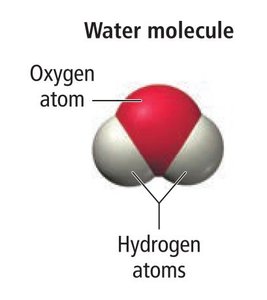
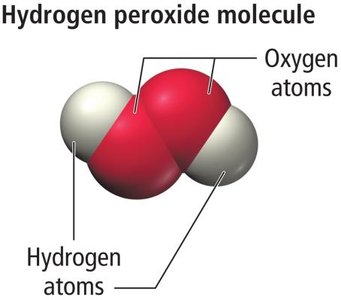
Example: Water (H2O) consists of two hydrogen atoms and one oxygen atom. Hydrogen peroxide (H2O2) contains the same elements in a different ratio, resulting in different properties.
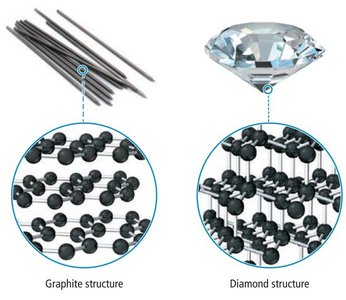
Graphite and diamond are both composed of carbon atoms, but their different atomic arrangements result in distinct physical properties.
The Scientific Approach to Knowledge
The Scientific Method
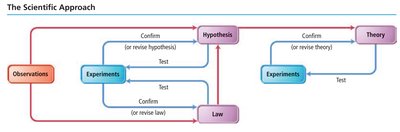
The scientific method is an empirical approach to understanding nature, based on observation, hypothesis formation, experimentation, and the development of laws and theories.
Observation: Gathering data about the natural world.
Hypothesis: A tentative explanation for observations, which must be testable and falsifiable.
Experiment: A controlled procedure to test a hypothesis.
Law: A statement summarizing consistent experimental observations (e.g., Law of Conservation of Mass).
Theory: A well-substantiated explanation of some aspect of the natural world that can incorporate laws, hypotheses, and facts.
The Classification of Matter
States of Matter
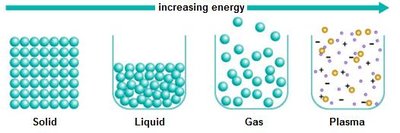
Matter can exist in several physical states, each with distinct properties:
Solid: Definite shape and volume; particles are closely packed in fixed positions.
Liquid: Definite volume but no definite shape; particles are close but can move past each other.
Gas: No definite shape or volume; particles are far apart and move freely.
Plasma: Ionized gas with free electrons and ions; found in stars and lightning.
Bose-Einstein Condensate: State of matter formed at temperatures near absolute zero, where particles behave as a single quantum entity.
Crystalline vs. Amorphous Solids
Solids can be further classified based on the arrangement of their particles:
Crystalline: Atoms or molecules are arranged in an orderly, repeating pattern (e.g., diamond, table salt).
Amorphous: Atoms or molecules lack long-range order (e.g., glass, plastic).
Classification by Composition
Matter can also be classified by its composition:
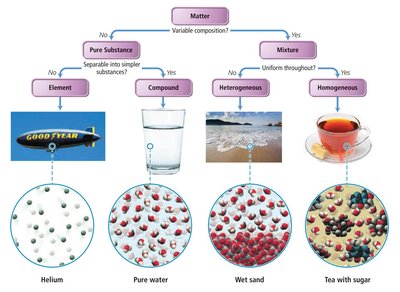
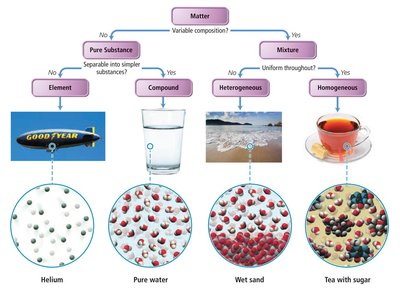
Pure Substance: Composed of only one type of particle; can be an element or a compound.
Element: Cannot be broken down into simpler substances (e.g., helium).
Compound: Composed of two or more elements in fixed proportions (e.g., water).
Mixture: Composed of two or more substances in variable proportions; can be separated by physical means.
Heterogeneous Mixture: Composition varies from one region to another (e.g., wet sand).
Homogeneous Mixture (Solution): Uniform composition throughout (e.g., tea with sugar).

Separation Techniques
Mixtures can be separated based on differences in physical or chemical properties:
Decanting: Pouring off a liquid from a solid-liquid mixture.
Filtration: Separating a solid from a liquid using filter paper.
Distillation: Separating substances based on differences in boiling points.
Physical and Chemical Changes & Properties
Physical Changes
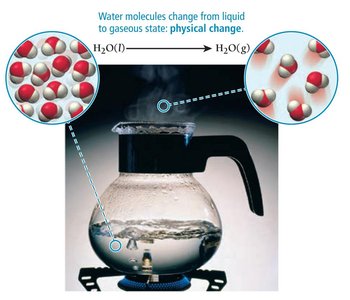
Physical changes alter the state or appearance of matter without changing its composition. Examples include melting, boiling, and dissolving.
Chemical Changes
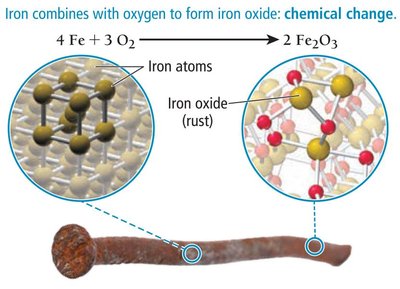
Chemical changes alter the composition of matter, resulting in the formation of new substances. Examples include rusting, burning, and reacting acids with bases.
Physical and Chemical Properties
Physical Property: Can be observed without changing the substance's composition (e.g., color, melting point, density).
Chemical Property: Can only be observed by changing the substance's composition (e.g., flammability, reactivity).
Energy in Physical and Chemical Changes
Types of Energy
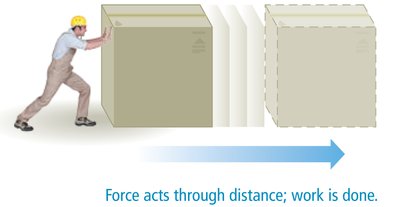
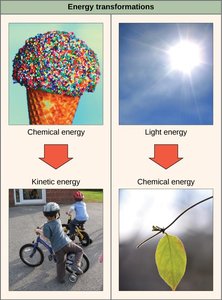
Energy is the capacity to do work. Work is the action of a force through a distance.
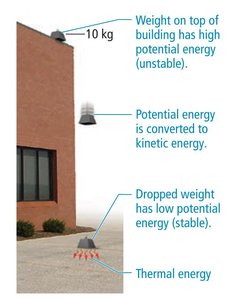
Kinetic Energy: Energy of motion.
Potential Energy: Energy due to position or composition.
Thermal Energy: Energy associated with temperature; a form of kinetic energy.
Principles of Energy
Law of Conservation of Energy: Energy cannot be created or destroyed, only transformed.
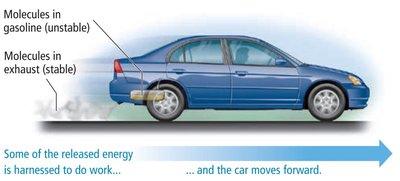
Systems tend to lower potential energy: Systems with high potential energy change to lower energy states, releasing energy to the surroundings.
The Units of Measurement
SI Units and Prefixes
The International System of Units (SI) is the standard for scientific measurements. There are seven base SI units:
Quantity | Unit | Symbol |
|---|---|---|
Length | meter | m |
Mass | kilogram | kg |
Time | second | s |
Temperature | kelvin | K |
Amount of substance | mole | mol |
Electric current | ampere | A |
Luminous intensity | candela | cd |
Common metric prefixes include kilo- (103), centi- (10-2), milli- (10-3), micro- (10-6), nano- (10-9), and mega- (106).
Temperature Scales
Celsius (°C): Water freezes at 0°C and boils at 100°C.
Kelvin (K): Absolute zero is 0 K; K = °C + 273.15.
Fahrenheit (°F): Water freezes at 32°F and boils at 212°F; °F = (9/5)°C + 32.
Derived Units: Volume and Density
Volume: (e.g., cm3, L)
Density: (e.g., g/cm3, g/mL)
Intensive vs. Extensive Properties
Intensive Property: Independent of the amount of substance (e.g., density, temperature).
Extensive Property: Dependent on the amount of substance (e.g., mass, volume).
The Reliability of a Measurement
Significant Figures
Significant figures reflect the precision of a measurement. The rules for determining significant figures are:
All nonzero digits are significant.
Interior zeros are significant.
Leading zeros are not significant.
Trailing zeros are significant if after a decimal point or before a decimal point and after a nonzero digit.
Exact numbers (from counting or definitions) have an unlimited number of significant figures.
Calculations with Significant Figures
Multiplication/Division: Result has the same number of significant figures as the factor with the fewest significant figures.
Addition/Subtraction: Result has the same number of decimal places as the quantity with the fewest decimal places.
Precision and Accuracy
Accuracy: How close a measurement is to the true value.
Precision: How close repeated measurements are to each other.
Random Error: Error that varies unpredictably.
Systematic Error: Error that is consistently too high or too low.
Solving Chemical Problems
Dimensional Analysis (Factor-Label Method)
Dimensional analysis is a systematic approach to problem-solving that uses conversion factors to move from one unit to another. Always include units in calculations and cancel them algebraically.
Conversion factor: A ratio that expresses how many of one unit are equal to another unit (e.g., 1 in = 2.54 cm).
General steps: Sort information, strategize (conceptual plan), solve, and check your answer.
Example: To convert 1.76 yards to centimeters, use the appropriate conversion factors for yards to inches and inches to centimeters.
Order of Magnitude Estimations: Approximating values to the nearest power of ten for quick calculations.
Using Density as a Conversion Factor: Density can be used to convert between mass and volume.
*Additional info: This guide covers all foundational aspects of matter, measurement, and problem solving as outlined in a typical first chapter of a General Chemistry textbook. It is suitable for exam preparation and as a reference for laboratory work.*
