 Indietro
Chapter 1: Matter, Measurement, and Problem Solving – Atoms, Molecules, and the Scientific Approach
Guida di studio - Note intelligenti
 Appunti personalizzati basati sui tuoi materiali, ampliati con definizioni chiave, esempi e contesto.
Chapter 1: Matter, Measurement, and Problem Solving
1.1 Atoms and Molecules
Chemistry is the study of matter and the changes it undergoes. At its core, chemistry focuses on understanding the structure, properties, and interactions of atoms and molecules, which are the fundamental building blocks of all substances.
Atoms are the smallest units of an element that retain the chemical properties of that element. Each atom consists of a nucleus (containing protons and neutrons) and electrons that orbit the nucleus.
Molecules are groups of two or more atoms bonded together. Molecules can consist of the same or different types of atoms.
Everything in the universe, from the air we breathe to the stars in the sky, is composed of atoms and molecules.
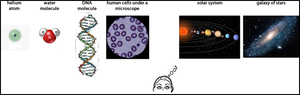
Example: A helium atom is a single atom, while a water molecule (H2O) consists of two hydrogen atoms and one oxygen atom bonded together.
Understanding the Scale of Chemistry
To study chemistry, we must "stretch our minds" to think about objects much smaller than what we can see with the naked eye. The scale ranges from atoms and molecules to much larger structures like cells and galaxies, but chemistry focuses on the atomic and molecular level.
Atoms vs. Molecules
It is essential to distinguish between atoms and molecules:
Atoms are single units of elements (e.g., a helium atom).
Molecules are combinations of atoms bonded together (e.g., a water molecule).

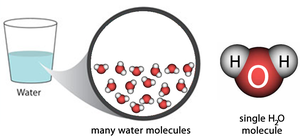
Example: In a glass of water, there are many water molecules, each made up of two hydrogen atoms and one oxygen atom.
How Atoms Combine: Chemical Formulas
Atoms can combine in different ratios to form different molecules, resulting in substances with distinct properties.
Water (H2O): Contains two hydrogen atoms and one oxygen atom.
Hydrogen Peroxide (H2O2): Contains two hydrogen atoms and two oxygen atoms.
Even though both molecules contain hydrogen and oxygen, their different ratios and structures give them very different properties.
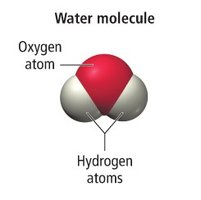
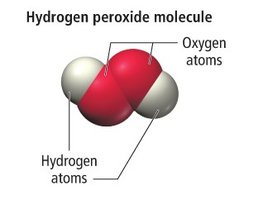
Example: Drinking water is essential for life, but drinking hydrogen peroxide is dangerous, even though both are made from hydrogen and oxygen atoms.
Allotropes: Different Forms of the Same Element
Allotropes are different structural forms of the same element, where atoms are connected in different ways, resulting in distinct physical properties.
Graphite: Carbon atoms are bonded in 2-dimensional sheets. These sheets can slide over each other, making graphite soft and useful as pencil lead.
Diamond: Carbon atoms are bonded in a 3-dimensional network, making diamond extremely hard.
Both graphite and diamond are pure carbon but have different structures and properties due to the arrangement of their atoms.
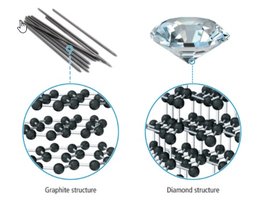
Example: The difference between writing with a pencil (graphite) and the hardness of a diamond is due to their atomic arrangements, not the type of atom.
1.2 The Scientific Approach to Knowledge
Hypothesis vs. Theory
The scientific method is a systematic approach to understanding the natural world. Two important terms in this process are hypothesis and theory:
Hypothesis: A tentative explanation or prediction that can be tested by experiments. It is an educated guess based on observations.
Theory: A well-substantiated explanation of some aspect of the natural world, based on a body of evidence and repeated testing. A theory is broader and more comprehensive than a hypothesis.
Example: If you observe that plants grow faster in sunlight, you might hypothesize that "plants need sunlight to grow." After many experiments and supporting evidence, this idea could contribute to the broader theory of photosynthesis.
Key Point: In science, a theory is not a guess; it is a thoroughly tested and confirmed explanation.
Homework and Study Recommendations
Read the textbook sections 1.1 (Atoms and Molecules) and 1.2 (The Scientific Approach to Knowledge).
Complete the Aktiv Chemistry online homework assignment for these sections.
Ensure you have access to the course textbook (eText or printed version) for in-class activities.
