 Indietro
Chapter 1: Matter, Measurement, and Problem Solving – General Chemistry Study Notes
Guida di studio - Note intelligenti
 Appunti personalizzati basati sui tuoi materiali, ampliati con definizioni chiave, esempi e contesto.
Matter, Atoms, and Molecules
Atoms and Molecules: The Building Blocks of Matter
Chemistry is the science that seeks to understand the behavior of matter by studying the behavior of atoms and molecules. Atoms are the submicroscopic particles that constitute the fundamental building blocks of ordinary matter. Free atoms are rare in nature; instead, they bind together in specific geometrical arrangements to form molecules. For example, carbon monoxide (CO) is a molecule composed of one carbon atom and one oxygen atom held together by a chemical bond.
Atom: The smallest unit of an element that retains the properties of that element.
Molecule: Two or more atoms bonded together in a specific arrangement.
Chemical bond: The force that holds atoms together in a molecule.
Example: Carbon monoxide (CO) consists of one carbon atom and one oxygen atom.
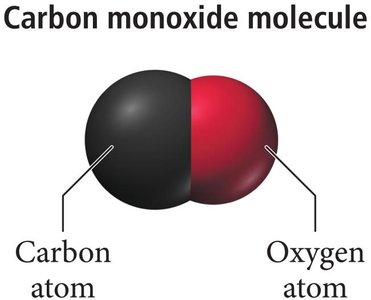
Understanding the structure and behavior of atoms and molecules is central to chemistry, as it explains the properties and transformations of all substances.
Atoms, Molecules, and Life
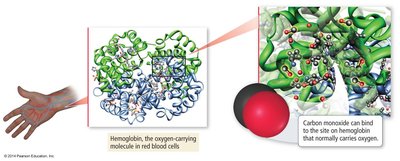
Atoms and molecules are not only the basis of inanimate matter but also play a crucial role in biological systems. For example, hemoglobin, the oxygen-carrying molecule in red blood cells, can bind to carbon monoxide, which prevents oxygen transport and can be fatal.
The Scientific Approach to Knowledge
The Scientific Method
The scientific method is a systematic approach to understanding nature through observation, hypothesis formation, experimentation, and the development of laws and theories. This empirical approach ensures that scientific knowledge is based on evidence and can be tested and refined.
Observation: Gathering data about the natural world.
Hypothesis: A tentative explanation for an observation that can be tested by experiments.
Experiment: A controlled procedure to test a hypothesis.
Law: A statement that summarizes a series of related observations and predicts future ones (e.g., Law of Conservation of Mass).
Theory: A well-established explanation for a set of observations, explaining why nature behaves as it does (e.g., Dalton’s atomic theory).
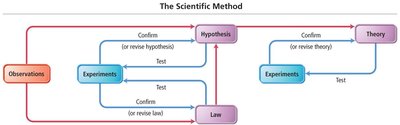
Additional info: Theories can never be conclusively proven; new evidence may always refine or challenge them.
The Classification of Matter
States of Matter: Solid, Liquid, and Gas
Matter is anything that occupies space and has mass. It can exist in three primary states: solid, liquid, and gas. The state of matter depends on the arrangement and movement of its atoms or molecules.
Solid: Atoms or molecules are closely packed in fixed positions; solids have a fixed shape and volume.
Liquid: Atoms or molecules are close but can move past each other; liquids have a fixed volume but take the shape of their container.
Gas: Atoms or molecules are far apart and move freely; gases are compressible and take both the shape and volume of their container.
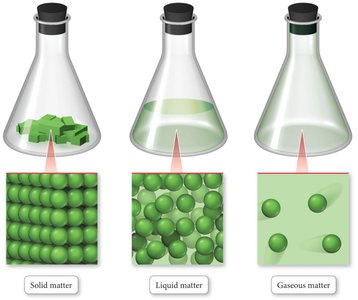
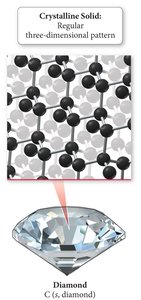
Crystalline solids have atoms or molecules arranged in a regular, repeating pattern (e.g., diamond), while amorphous solids lack long-range order (e.g., glass).
Compressibility of Solids and Gases
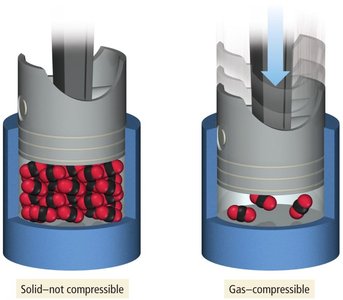
Solids are not compressible due to tightly packed particles, while gases are compressible because of the large spaces between particles.
Classification by Composition: Elements, Compounds, and Mixtures
Matter can also be classified based on its composition:
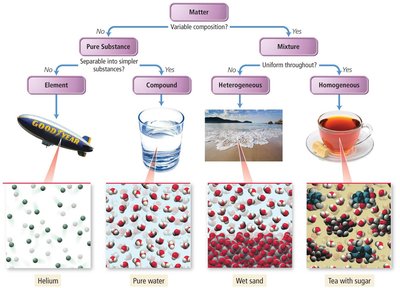
Pure Substance: Composed of only one type of particle; includes elements and compounds.
Element: Cannot be broken down into simpler substances (e.g., helium).
Compound: Composed of two or more elements in fixed proportions (e.g., water).
Mixture: Composed of two or more substances in variable proportions; can be homogeneous (uniform, e.g., tea with sugar) or heterogeneous (non-uniform, e.g., wet sand).
Separation of Mixtures
Physical Separation Techniques
Mixtures can be separated into their components by exploiting differences in physical properties:
Decanting: Pouring off a liquid to separate it from a solid.
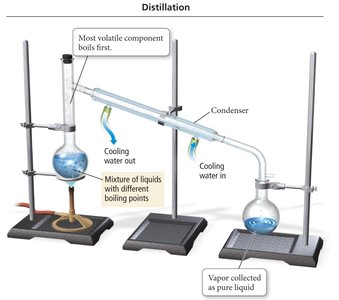
Distillation: Separating components based on differences in volatility (boiling points).
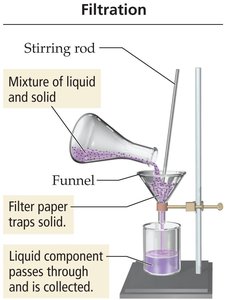
Filtration: Separating a solid from a liquid using filter paper.
Physical and Chemical Changes
Physical Changes
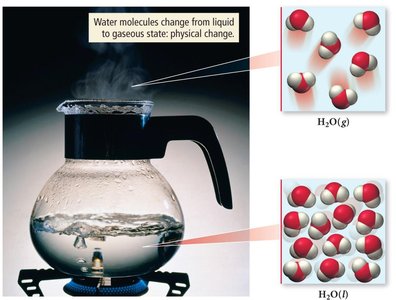
Physical changes alter only the state or appearance of a substance, not its composition. The identity of the atoms or molecules remains unchanged.
Example: Boiling water changes it from liquid to gas, but it remains H2O.
Chemical Changes
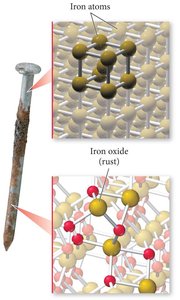
Chemical changes alter the composition of matter, resulting in the formation of new substances. Atoms rearrange during chemical changes.
Example: Rusting of iron forms iron oxide from iron and oxygen.
Physical vs. Chemical Change
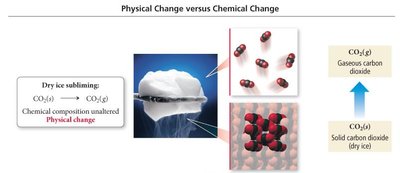
Physical changes do not alter the chemical composition, while chemical changes result in new substances. For example, sublimation of dry ice (CO2) is a physical change, while burning propane is a chemical change.
Properties of Matter
Physical and Chemical Properties
Properties of matter can be classified as physical or chemical:
Physical property: Observed without changing the substance’s composition (e.g., odor, color, melting point, density).
Chemical property: Observed only by changing the substance’s composition (e.g., flammability, acidity, toxicity).
Energy in Physical and Chemical Changes
Types of Energy
Energy is the capacity to do work. It is always conserved in physical and chemical changes (law of conservation of energy). Energy can be classified as:
Kinetic energy: Energy of motion.
Potential energy: Energy due to position or composition.
Thermal energy: A type of kinetic energy arising from the motion of atoms or molecules.
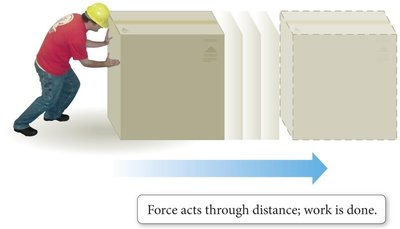
Systems with high potential energy tend to change in a direction that lowers their potential energy, releasing energy into the surroundings.
Measurement and Units
SI Units and Measurement
Measurements in chemistry require standard units. The International System of Units (SI) is used globally and is based on the metric system.
Quantity | Unit | Symbol |
|---|---|---|
Length | Meter | m |
Mass | Kilogram | kg |
Time | Second | s |
Temperature | Kelvin | K |
Amount of substance | Mole | mol |
Electric current | Ampere | A |
Luminous intensity | Candela | cd |
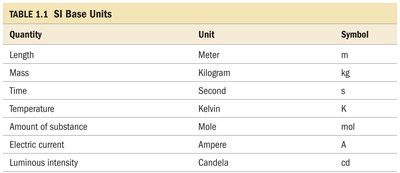
Length, Mass, and Temperature
Meter (m): The SI unit of length.
Kilogram (kg): The SI unit of mass; 1 kg = 1000 g.
Kelvin (K): The SI unit of temperature; absolute zero (0 K) is the lowest possible temperature.
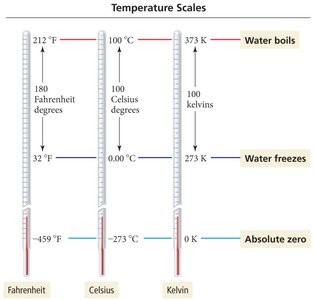
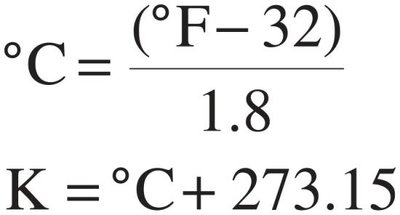
Temperature conversions:
SI Prefix Multipliers
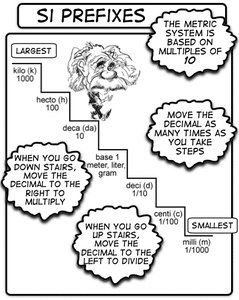
SI units use prefix multipliers to represent powers of ten. For example, kilo- means 1000, centi- means 0.01, and milli- means 0.001.
Prefix | Symbol | Multiplier |
|---|---|---|
kilo | k | 103 |
centi | c | 10-2 |
milli | m | 10-3 |
micro | μ | 10-6 |
nano | n | 10-9 |
Derived Units: Volume and Density
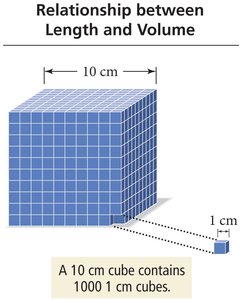
Derived units are combinations of base units. Volume is measured in cubic meters (m3), liters (L), or milliliters (mL). Density is mass per unit volume.
Volume of a cube:
Density:
Intensive property: Independent of the amount of substance (e.g., density). Extensive property: Dependent on the amount of substance (e.g., mass).
Measurement Precision, Accuracy, and Significant Figures
Precision and Accuracy
Accuracy refers to how close a measured value is to the true value. Precision refers to how close a series of measurements are to one another. Measurements can be precise without being accurate, and vice versa.
Significant Figures
Significant figures reflect the precision of a measurement. The rules for counting significant figures are:
All nonzero digits are significant.
Interior zeroes (between nonzero digits) are significant.
Leading zeroes (before the first nonzero digit) are not significant.
Trailing zeroes after a decimal point are significant.
Trailing zeroes before an implied decimal point are ambiguous.
Exact numbers (from counting or definitions) have an unlimited number of significant figures.
Significant Figures in Calculations
Multiplication/Division: Result has the same number of significant figures as the factor with the fewest significant figures.
Addition/Subtraction: Result has the same number of decimal places as the quantity with the fewest decimal places.
Rounding: Round only the final answer in multistep calculations to avoid rounding errors.
Dimensional Analysis and Problem Solving
Dimensional Analysis
Dimensional analysis is a method for solving problems using conversion factors to change units. A conversion factor is a ratio of equivalent quantities expressed in different units.
Example: To convert 1.76 yards to centimeters, use the relationships 1 yard = 36 inches and 1 inch = 2.54 cm.
For units raised to a power, raise both the number and the unit (e.g., (2.54 cm/in)2 for area conversions).
Additional info: Always include units in calculations and cancel them algebraically.
Using Density as a Conversion Factor
Density can be used to convert between mass and volume. For example, to find the mass of a substance given its volume and density:
Additional info: When solving problems, organize the information, plan the steps, and check that units cancel appropriately.
