 Indietro
Chapter 1: Matter, Measurement, and Problem Solving – Study Notes
Guida di studio - Note intelligenti
 Appunti personalizzati basati sui tuoi materiali, ampliati con definizioni chiave, esempi e contesto.
Chapter 1: Matter, Measurement, and Problem Solving
1.3 The Classification of Matter
Matter is defined as anything that occupies space and has mass. All physical objects, substances, and materials are forms of matter. Understanding how matter is classified is fundamental to chemistry.
Matter includes everything you can touch and see, from air to water to rocks.
Matter can be classified based on its physical state and composition.

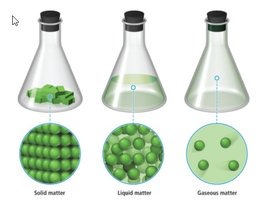
States of Matter: Solid, Liquid, and Gas
The state of matter depends on the arrangement and motion of its atoms and molecules. The three primary states are solid, liquid, and gas.
Solids: Atoms and molecules vibrate but do not pass each other. Solids have a fixed shape and volume.
Liquids: Atoms and molecules are closely packed but can flow past each other. Liquids have a definite volume but take the shape of their container.
Gases: Atoms and molecules move freely and are far apart. Gases have neither a fixed shape nor a fixed volume.
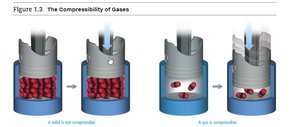
Compressibility of Gases
Gases are unique among the states of matter because their particles are spread out, making them compressible. Solids and liquids are not easily compressed due to the close packing of their particles.
Compressibility is a key property of gases, allowing them to be squeezed into smaller volumes.
This property is important in many practical applications, such as in car engines and gas storage.
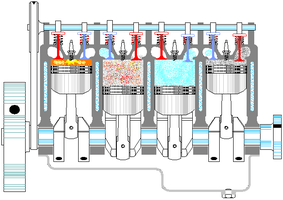
Application: Gas Expansion and Compression in Engines
The expansion and compression of gases are central to the operation of internal combustion engines, such as those found in automobiles. The movement of pistons compresses the gas, which then expands rapidly during combustion, producing mechanical work.
This process demonstrates the practical importance of gas properties in technology.
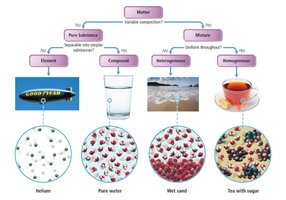
Elements, Compounds, and Mixtures
Matter can be further classified based on its composition into elements, compounds, and mixtures.
Element: A pure substance that cannot be broken down into simpler substances by chemical means (e.g., helium).
Compound: A pure substance composed of two or more elements chemically combined in fixed proportions (e.g., water).
Mixture: A combination of two or more substances that are not chemically bonded. Mixtures can be homogeneous (uniform composition, e.g., tea with sugar) or heterogeneous (non-uniform composition, e.g., wet sand).
Separating Mixtures: Distillation
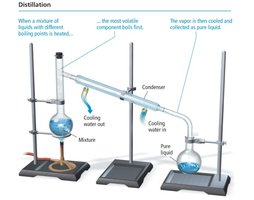
Mixtures can be separated into their components by physical methods. Distillation is a common technique used to separate mixtures of liquids based on differences in their boiling points.
During distillation, the most volatile component vaporizes first, is condensed, and collected as pure liquid.
This method is widely used in laboratories and industry to purify liquids.
1.4 Physical Change
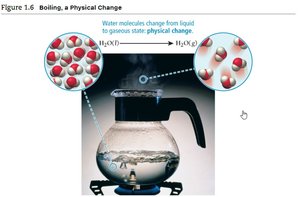
A physical change is a change in the state or appearance of matter that does not alter its chemical composition. Examples include melting, freezing, and boiling.
Physical changes are usually reversible and do not produce new substances.
For example, boiling water changes it from liquid to gas, but it remains H2O.
1.4 Chemical Change
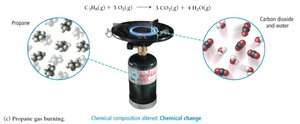
A chemical change (or chemical reaction) results in the formation of one or more new substances with different chemical properties. Chemical changes are often accompanied by energy changes, color changes, or the production of gas.
For example, burning propane gas produces carbon dioxide and water, substances with different properties from the original propane and oxygen.
Chemical changes are usually not easily reversible.
Homework and Further Study
To reinforce your understanding of these concepts, read the relevant textbook sections and complete the assigned problems. Practice classifying matter, identifying physical and chemical changes, and understanding separation techniques.
Read: Chapter 1, Sections 1.3–1.5
Practice: Problems 37–47 odd (Tro, 6th or 5th edition)
Complete: Aktiv Chemistry online homework for Chapter 1
