 Indietro
Chapter 1: Matter, Measurement, and Problem Solving – Units of Measurement & Absolute Zero
Guida di studio - Note intelligenti
 Appunti personalizzati basati sui tuoi materiali, ampliati con definizioni chiave, esempi e contesto.
Chapter 1: Matter, Measurement, and Problem Solving
Section 1.6: Units of Measurement
Understanding units of measurement is fundamental in chemistry, as all measured values must include a unit. The Système International (SI) units provide a standardized system for scientific measurements, ensuring consistency and accuracy across disciplines.
Length: The SI unit for length is the meter (m). Length measurements are essential for describing the size and dimensions of objects and distances in chemical experiments.
Mass: The SI unit for mass is the kilogram (kg). Mass quantifies the amount of matter in a sample and is crucial for stoichiometric calculations.
Time: The SI unit for time is the second (s). Time measurements are used to track reaction rates and durations of processes.
Importance of Units: Always include units with measured values to avoid ambiguity and ensure proper interpretation of data.
Example: Measuring the time it takes for a chemical reaction to complete using a stopwatch (seconds), or measuring the height of a child (meters).


The Absolute Zero Temperature Scale
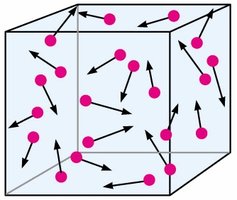
Temperature is a measure of the kinetic energy of atoms and molecules. The SI base unit for temperature is the Kelvin (K). As substances cool, their particles move more slowly. At absolute zero, all atomic and molecular motion theoretically ceases.
Kelvin Scale: The Kelvin scale starts at absolute zero (0 K), which is equivalent to -273.15 °C. It is used in scientific contexts because it avoids negative values and is directly proportional to the energy of particles.
Absolute Zero: Absolute zero is the lowest possible temperature, where the motion of particles is minimal. It is a fundamental concept in thermodynamics and chemistry.
Temperature Conversion: To convert between Celsius and Kelvin, use the formula:
Example: If a sample is at 25 °C, its temperature in Kelvin is K.
Sample Problem: Temperature Conversion
Temperature conversions are common in chemistry. The relationship between Celsius and Kelvin is linear, making calculations straightforward.
Formula:
Example: Convert 100 °C to Kelvin: K

Metric Prefixes and Scientific Notation
Metric prefixes are used to express quantities that are much larger or smaller than the base unit. Scientific notation is a method for writing very large or very small numbers efficiently.
Common Metric Prefixes:
Kilo- (k):
Milli- (m):
Micro- (\mu):
Nano- (n):
Scientific Notation: Numbers are written as , where is a coefficient and is an exponent.
Example: 0.00056 can be written as .
Density and Water Displacement
Density is a physical property defined as mass per unit volume. Water displacement is a technique used to measure the volume of irregularly shaped objects.
Density Formula:
Water Displacement: The volume of water displaced by an object equals the volume of the object.
Example: If a melon is submerged in water and the water level rises by 250 mL, the melon’s volume is 250 mL.

Homework and Practice
To reinforce understanding, students are encouraged to read the textbook and complete assigned problems. Practice is essential for mastering unit conversions, metric prefixes, and scientific notation.
Assigned Problems: Chapter 1: 53-63 odd (Tro, 6th edition) or 51-61 odd (Tro, 5th edition).
Online Homework: Aktiv Chemistry assignments for Chapter 1.
Application: Apply concepts learned in this section to solve real-world chemistry problems.
