 Indietro
Chapter 1 Study Notes: Matter, Energy, and Measurement
Guida di studio - Note intelligenti
 Appunti personalizzati basati sui tuoi materiali, ampliati con definizioni chiave, esempi e contesto.
Chapter 1: Matter, Energy, and Measurement
1.1 Matter, Measuring, and Work
This section introduces the foundational concepts of chemistry, focusing on the nature of matter, the importance of measurement, and the scientific approach to understanding the physical world.
Matter: Anything that has mass and occupies space.
Energy: The capacity to do work or produce heat.
Measurement: The process of quantifying physical properties using units and tools.
Chemistry: The study of matter, its properties, and the changes it undergoes.
Example: Measuring the mass of a sample using a balance.
1.2 Chemistry: Physical & Properties, the Science of Investigation
Chemistry is defined as the science that investigates the properties, composition, and changes of matter. It is a central science that connects physics, biology, and earth sciences.
Physical Properties: Characteristics that can be observed or measured without changing the substance's identity (e.g., color, density, melting point).
Chemical Properties: Characteristics that describe a substance's ability to undergo chemical changes (e.g., flammability, reactivity).
Example: Water's boiling point is a physical property; its ability to react with sodium is a chemical property.
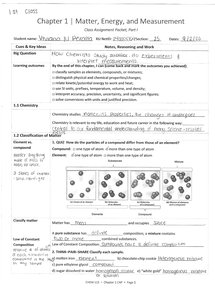
1.3 Classification of Matter
Matter can be classified based on its composition and properties. The main categories are pure substances and mixtures.
Pure Substances: Have a fixed composition and distinct properties. Includes elements and compounds.
Mixtures: Consist of two or more substances physically combined. Can be homogeneous (uniform) or heterogeneous (non-uniform).
Example: Salt (NaCl) is a compound; air is a homogeneous mixture.
1.4 Properties of Matter
Matter exhibits various properties that can be classified as physical or chemical, and as intensive or extensive.
Physical Change: Alters the form or appearance of matter but does not change its composition (e.g., melting, boiling).
Chemical Change: Results in the formation of new substances with different properties (e.g., burning, rusting).
Intensive Properties: Do not depend on the amount of matter present (e.g., density, color).
Extensive Properties: Depend on the amount of matter present (e.g., mass, volume).
Example: Cutting a piece of metal is a physical change; burning it is a chemical change.
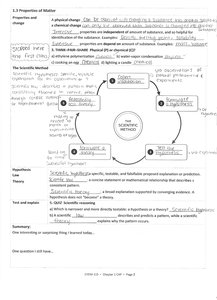
1.5 The Scientific Method
The scientific method is a systematic approach used in chemistry to investigate phenomena, acquire new knowledge, and correct previous understanding. It involves observation, hypothesis formation, experimentation, and analysis.
Observation: Gathering information using senses or instruments.
Hypothesis: A tentative explanation or prediction based on observations.
Experiment: A controlled procedure to test the hypothesis.
Analysis: Interpreting data to draw conclusions.
Theory: A well-substantiated explanation of some aspect of the natural world.
Law: A statement describing a consistent relationship observed in nature.
Example: Testing the effect of temperature on the rate of a chemical reaction.
Summary
Chapter 1 establishes the basic concepts of matter, energy, and measurement, and introduces the scientific method as the foundation for chemical investigation.
