 Indietro
Chapter 11: Liquids and Intermolecular Forces (IMFs) – General Chemistry Study Notes
Guida di studio - Note intelligenti
 Appunti personalizzati basati sui tuoi materiali, ampliati con definizioni chiave, esempi e contesto.
Liquids and Intermolecular Forces
States of Matter
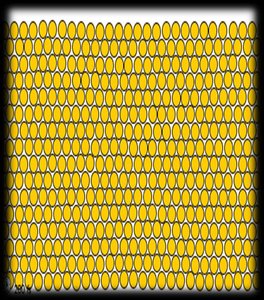
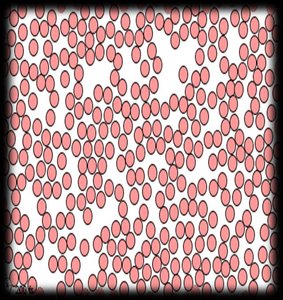
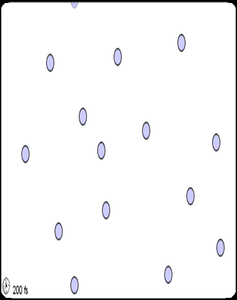
The three primary states of matter—solid, liquid, and gas—are distinguished by the strength of the attractions between their constituent particles. Solids have the strongest interparticle attractions, liquids have intermediate attractions, and gases have the weakest.
Solid: Particles are closely packed in a fixed arrangement.
Liquid: Particles are close but can move past each other.
Gas: Particles are far apart and move freely.
Intermolecular vs Intramolecular Forces
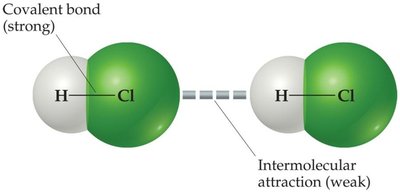
Intermolecular forces (IMFs) are the forces that exist between molecules, while intramolecular forces are the forces that hold atoms together within a molecule. IMFs are much weaker than intramolecular bonds, but they are strong enough to control physical properties such as boiling and melting points, vapor pressures, and viscosities.
Intramolecular forces: Covalent, ionic, or metallic bonds within a molecule.
Intermolecular forces: Attractions between separate molecules.
Types of Intermolecular Forces
Overview
All intermolecular interactions are electrostatic, involving attractions between positive and negative species. The main types of IMFs are:
London dispersion forces
Dipole-dipole interactions
Hydrogen bonding
Ion-dipole interactions
London Dispersion Forces
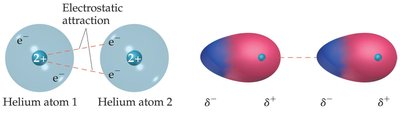
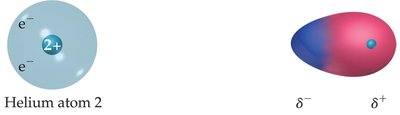
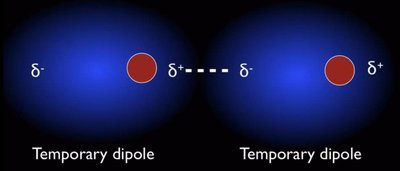
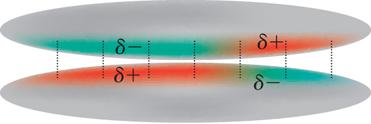
London dispersion forces are temporary attractive forces that result when electrons in two adjacent atoms occupy positions that make the atoms form temporary dipoles. These forces are present in all molecules, whether polar or nonpolar, but are the only IMFs in nonpolar molecules.
Polarizability: The tendency of an electron cloud to distort, increasing with molecular mass.
Dispersion forces: Increase with molecular mass and contact surface area.
Shape and Surface Area Effects
The shape of a molecule affects the strength of dispersion forces. Rod-like molecules have greater surface area and more contact points, leading to stronger dispersion forces than spherical molecules.
Example: n-pentane (rod-like) vs. neopentane (spherical)

Boiling Point Trends
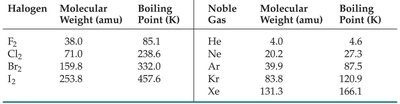
The strength of dispersion forces tends to increase with increasing molecular weight. Larger atoms have larger electron clouds, which are easier to polarize, resulting in higher boiling points.
Dipole-Dipole Interactions
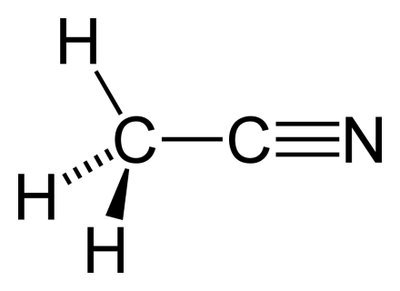
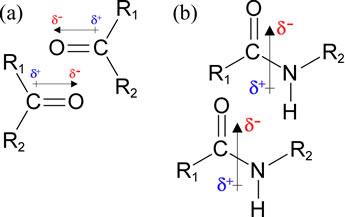
Dipole-dipole interactions occur between polar molecules, where the partially negative portion of one molecule is attracted to the partially positive portion of another. The more polar the molecule, the higher its boiling point due to stronger dipole-dipole forces.
Example: Acetonitrile (polar, high boiling point) vs. Propane (nonpolar, low boiling point)

Hydrogen Bonding
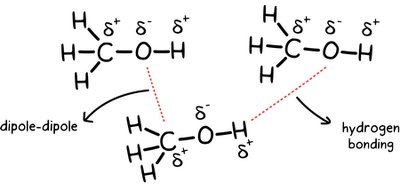
Hydrogen bonding is a special type of intermolecular attraction between the hydrogen atom in a polar bond (such as H–F, H–O, or H–N) and a nonbonding electron pair on a nearby electronegative atom. Hydrogen bonds are much stronger than other dipole-dipole interactions and significantly affect boiling points.
Example: Water (H2O) and methanol (CH3OH) exhibit hydrogen bonding.
Ion-Dipole Interactions
Ion-dipole interactions are electrostatic attractions between a charged ion and a polar molecule. These forces are important in solutions of ions and are responsible for the solubility of ionic substances in polar solvents.
Example: Dissolving NaCl in water involves ion-dipole interactions.
Effects of Intermolecular Forces
Boiling Point, Vapor Pressure, Viscosity, and Capillary Action
IMFs influence several physical properties:
Boiling Point: Stronger IMFs lead to higher boiling points.
Vapor Pressure: Stronger IMFs result in lower vapor pressure.
Viscosity: Stronger IMFs increase viscosity; viscosity decreases with temperature.
Capillary Action: The rise of a liquid in narrow tubes due to adhesive and cohesive forces.
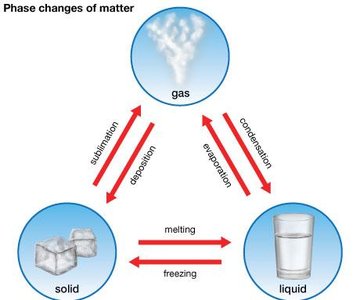
Phase Changes of Matter
Phase changes involve the conversion between solid, liquid, and gas states. These changes are associated with enthalpy changes:
Sublimation: (endothermic)
Vaporization: (endothermic)
Melting/Fusion: (endothermic)
Deposition: (exothermic)
Condensation: (exothermic)
Freezing: (exothermic)
Phase Diagrams
A phase diagram is a graphical representation of the physical states of a substance under different conditions of temperature and pressure. Key features include:
Triple Point: Temperature and pressure at which all three phases are in equilibrium.
Critical Point: The highest temperature and pressure at which a liquid can exist.
Supercritical Fluid: A state above the critical temperature and pressure where gases and liquids coexist.
Liquid Crystals
Properties and Criteria
Liquid crystals are a state of matter with properties between those of conventional liquids and solid crystals. They flow like liquids but have some orientation order like crystals. The liquid crystal phase exists between solid and liquid states and is important in display technology.
Criteria: Molecules must be elongated, have rigidity in the central region, and flexible ends.
Applications: Liquid crystal displays (LCDs) and organic electronics.
Summary Table: Types of Intermolecular Forces
Type of Force | Occurs Between | Relative Strength | Example |
|---|---|---|---|
London Dispersion | All molecules (especially nonpolar) | Weakest | CH4, CCl4 |
Dipole-Dipole | Polar molecules | Intermediate | SO2, PCl3 |
Hydrogen Bonding | H bonded to F, O, or N | Strong | H2O, HF |
Ion-Dipole | Ions and polar molecules | Strongest | Na+ in H2O |
Key Equations
Vapor Pressure: is the pressure exerted by a vapor in equilibrium with its liquid or solid phase at a given temperature.
Enthalpy of Fusion: is the heat required to melt one gram of substance at its melting point.
Enthalpy of Vaporization: is the heat required to convert one gram of liquid to gas.
Examples of Intermolecular Forces in Substances
Substance | Types of Forces Present |
|---|---|
H2O | LDF, dipole-dipole, H-bonds |
CCl4 | LDF |
SO2 | LDF, dipole-dipole |
LiF (solid) | Ionic bonds |
Ca(NO3)2 (aqueous) | Ion-dipole forces |
HF | LDF, dipole-dipole, H-bonds |
PCl3 | LDF, dipole-dipole |
Additional info: These notes expand on the original content by providing definitions, examples, and academic context for each type of intermolecular force, as well as their effects on physical properties and phase changes. The summary tables and equations are inferred for completeness and clarity.
