Indietro
Chapter 13: Solutions – Structure, Properties, and Colligative Effects
Guida di studio - Note intelligenti
 Appunti personalizzati basati sui tuoi materiali, ampliati con definizioni chiave, esempi e contesto.
Solutions and Their Properties
Introduction to Solutions
Solutions are homogeneous mixtures composed of two or more substances. The major component is called the solvent, and the minor component is the solute. Solutions can involve different phases, such as solids dissolved in liquids, gases in liquids, or gases mixed with other gases.
Solute: The substance being dissolved.
Solvent: The substance in which the solute is dissolved.
Example: Salt (NaCl) dissolved in water.
Biological Example: Antifreeze in Frogs
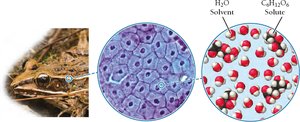
Wood frogs survive freezing temperatures by flooding their blood with glucose, forming a concentrated solution that lowers the freezing point of their blood, preventing ice formation and cellular damage.
Nature’s Tendency Toward Mixing: Entropy
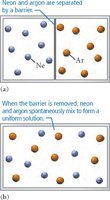
Mixing is driven by entropy, the measure of energy dispersal in a system. Even when potential energy does not decrease, mixing occurs spontaneously due to the increase in entropy.
Example: Two gases (Ne and Ar) mix spontaneously when a barrier is removed.
Solubility
Solubility is the maximum amount of solute that can dissolve in a given amount of solvent. Solubility depends on the tendency toward mixing and the types of intermolecular forces present.
Soluble: Solute dissolves in solvent (e.g., NaCl in water).
Insoluble: Solute does not dissolve (e.g., oil in water).
Miscible: Two liquids that are mutually soluble (e.g., alcohol and water).
Immiscible: Two liquids that do not mix (e.g., oil and water).
Intermolecular Forces and Solution Formation
Types of Intermolecular Forces
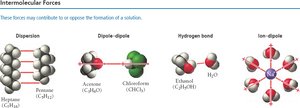
The formation of solutions depends on the interaction between solute and solvent particles. The main types of intermolecular forces are:
Dispersion forces (London forces)
Dipole-dipole interactions
Hydrogen bonding
Ion-dipole interactions
Solution Interactions
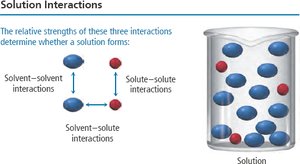
To form a solution, the following interactions must be considered:
Solute-solute interactions: Must be overcome (endothermic).
Solvent-solvent interactions: Must be partially overcome (endothermic).
Solvent-solute interactions: New attractions formed (exothermic).
Energetics of Solution Formation
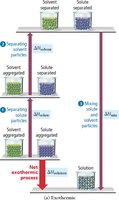
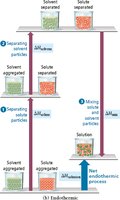
The overall enthalpy change () depends on the balance between the energy required to break solute and solvent interactions and the energy released when new solute-solvent interactions are formed.
Exothermic process: Energy released is greater than energy required.
Endothermic process: Energy required is greater than energy released.
Solution Equilibrium and Saturation
Dynamic Equilibrium
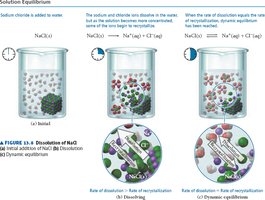
When a solute dissolves, it eventually reaches a point where the rate of dissolution equals the rate of deposition. This is called dynamic equilibrium, and the solution is saturated.
Saturated solution: No more solute will dissolve.
Unsaturated solution: More solute can dissolve.
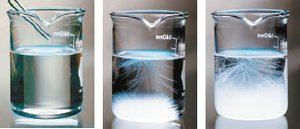
Supersaturated solution: Contains more solute than saturation; unstable.
Temperature Dependence of Solubility
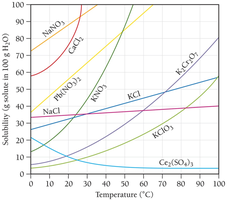
For most solids, solubility increases with temperature. For gases, solubility decreases as temperature increases. Solubility curves help predict saturation levels.
Pressure Dependence of Gas Solubility
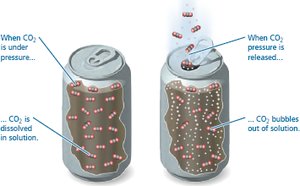
The solubility of gases in liquids increases with increasing partial pressure, described by Henry’s Law:
Where is concentration, is Henry’s law constant, and is partial pressure.
Expressing Solution Concentration
Concentration Units
Concentration describes the amount of solute in a given amount of solution. Common units include:
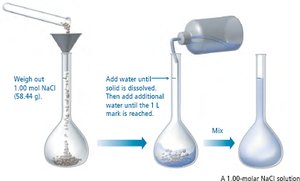
Molarity (M): Moles of solute per liter of solution.
Molality (m): Moles of solute per kilogram of solvent.
Percent by mass: (mass of solute / mass of solution) × 100%
Mole fraction: Moles of solute / total moles in solution.
Mole percent: Mole fraction × 100%
Preparing Solutions
To prepare a solution from a solid, calculate the mass of solute needed for a desired concentration and volume, then dissolve in solvent.
Colligative Properties
Definition and Importance
Colligative properties depend only on the number of solute particles, not their identity. These include vapor pressure lowering, boiling point elevation, freezing point depression, and osmotic pressure.
Vapor Pressure Lowering
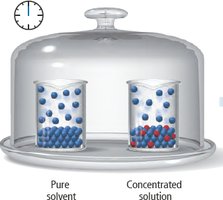
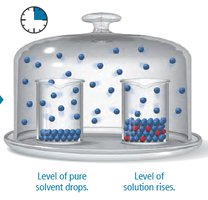
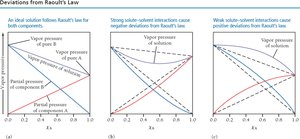
The vapor pressure of a solvent above a solution is lower than that of the pure solvent. This is explained by Raoult’s Law:
Where is vapor pressure of the solution, is mole fraction of solvent, and is vapor pressure of pure solvent.
Deviations from Raoult’s Law
Non-ideal solutions occur when solute-solvent interactions are stronger or weaker than the sum of solute-solute and solvent-solvent interactions, causing deviations from Raoult’s Law.
Freezing Point Depression and Boiling Point Elevation
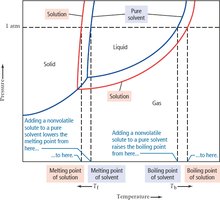
Adding a solute lowers the freezing point and raises the boiling point of a solvent. The changes are proportional to the molal concentration of solute particles:
Where and are constants, is molality, and is the van’t Hoff factor.
Osmosis and Osmotic Pressure
Osmosis
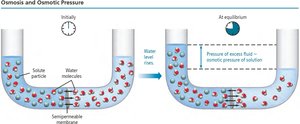
Osmosis is the flow of solvent from a region of low solute concentration to high solute concentration through a semipermeable membrane. The pressure required to stop this flow is osmotic pressure ():
Where is molarity, is the gas constant, and is temperature in Kelvin.
Van’t Hoff Factor and Electrolyte Solutions
Van’t Hoff Factor (i)
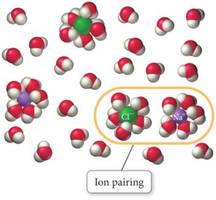
The van’t Hoff factor () is the ratio of moles of particles in solution to moles of formula units dissolved. For ionic compounds, $i$ is greater than 1, but often less than theoretical due to ion pairing.
Colligative Properties and Medical Solutions
Osmotic Effects on Cells
Medical solutions are classified based on their osmotic pressure relative to cells:
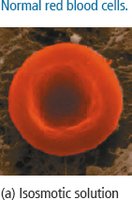
Isosmotic (isotonic): No net flow of water; cells remain normal.
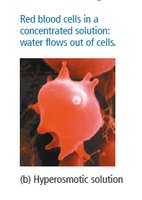
Hyperosmotic (hypertonic): Water flows out; cells shrivel.
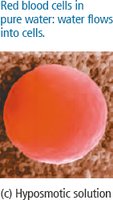
Hyposmotic (hypotonic): Water flows in; cells swell.