 Indietro
Chapter 14: Introduction to Solutions and Solubility
Guida di studio - Note intelligenti
 Appunti personalizzati basati sui tuoi materiali, ampliati con definizioni chiave, esempi e contesto.
Solution Terminology
Definition and Components
A solution is a homogeneous mixture of two or more substances. The components of a solution are classified as:
Solute: The substance present in a smaller amount.
Solvent: The substance present in a larger amount.
Solutions can exist in the same or different phases (e.g., two liquids, a gas and a liquid). Most solutions in general chemistry involve a solid solute and a liquid solvent.
Solubility and Compatibility
The solubility of a solute in a solvent depends on:
The tendency toward spontaneous mixing.
Intermolecular attractive forces between solute and solvent.
Solvents and solutes must be compatible for a solution to form. The principle "like dissolves like" means:
Polar molecules and ionic compounds are more soluble in polar solvents.
Nonpolar molecules are more soluble in nonpolar solvents.
Miscible, Immiscible, and Ionization
Miscible: Solute dissolves completely in the solvent without ionizing.
Immiscible: Solute and solvent do not form a solution.
Ionization: Solute dissolves by breaking into ions (e.g., NaCl in water).
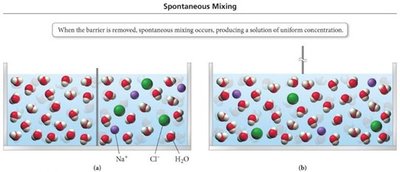
Example: Sodium chloride (NaCl) dissolving in water, forming Na+ and Cl- ions surrounded by water molecules.
Solubility Terminology
Factors Affecting Solubility
The ability of a solute to dissolve in a solvent is influenced by:
Temperature
Pressure (for gaseous solutes)
Ratio of solute amount (mass or moles) to solvent volume
Solubility is typically expressed as grams of solute per 100 grams of water.
Saturated, Unsaturated, and Supersaturated Solutions
Unsaturated: Contains less solute than the maximum possible at a given temperature.
Saturated: Contains the maximum amount of solute that can dissolve at a given temperature.
Supersaturated: Contains more solute than is normally possible; unstable and will precipitate excess solute when disturbed.
Solubility Curves
Solubility curves graphically represent the solubility of various compounds as a function of temperature. They help predict whether a solution is saturated, unsaturated, or supersaturated.
On the curve: Saturated solution
Above the curve: Supersaturated solution
Below the curve: Unsaturated solution
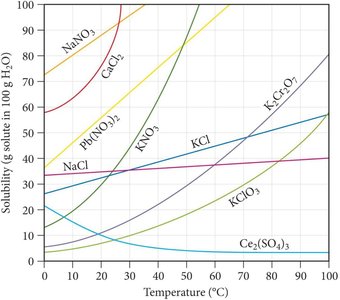
Example: At 50°C, 50 g KNO3 in 100 g H2O is saturated; 10 g KClO3 in 100 g H2O at 30°C is unsaturated.
Solubility of Gases
Temperature Effect
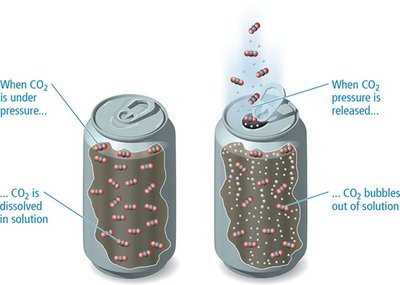
The solubility of gases in liquids decreases as temperature increases. This is because higher temperatures provide more kinetic energy, allowing gas molecules to escape from the solvent.
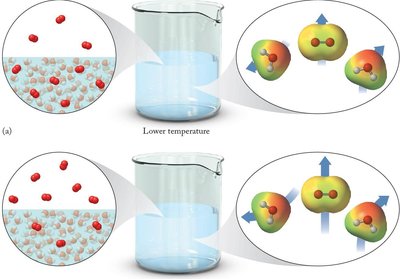
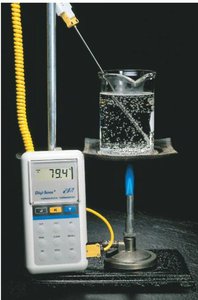
Example: Dissolved air is released from water as it is heated, even below boiling point.
Henry's Law
Henry's Law states that the concentration of a sparingly soluble, chemically unreactive gas in a liquid is proportional to the partial pressure of the gas:
= concentration of the gas in solution (usually in molarity, M)
= Henry's law constant (depends on intermolecular forces between gas and solvent)
= partial pressure of the gas
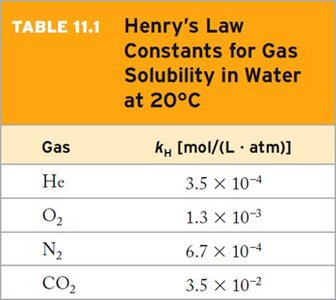
Example: If a can of soda contains 2.2 g CO2 in 355 mL solution, use Henry's Law to calculate the partial pressure required to keep the soda carbonated at 20°C.
Enthalpy of Solution
Energy Changes During Dissolution
The enthalpy of solution () is the energy required for dissolution of ionic solids in water. It depends on:
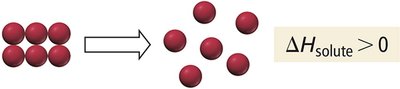
Energy to separate solute ions in the crystal lattice ()
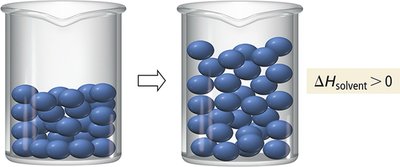
Energy to separate solvent molecules ()
Energy released when solute and solvent mix ()
The overall enthalpy change is:
can be endothermic or exothermic and is measured using calorimetry.
Steps in Solution Formation
Step 1: Separating the solute into its constituent particles ()
Step 2: Separating solvent particles to make room for solute ()
Step 3: Mixing solute and solvent particles ()
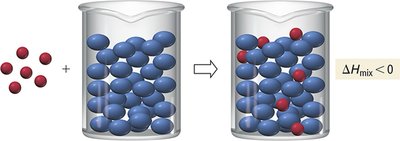
Exothermic Solution Formation: If the energy released in mixing is greater than the energy required to separate solute and solvent, the process is exothermic and the surroundings warm up.
Endothermic Solution Formation: If the energy required to separate solute and solvent is greater than the energy released in mixing, the process is endothermic and the surroundings cool down.
Example: Dissolving NaOH in water is exothermic; dissolving NH4NO3 in water is endothermic (used in cold packs).
Summary Table: Henry's Law Constants
Gas | kH [mol/(L·atm)] |
|---|---|
He | 3.5 × 10⁻⁴ |
O2 | 1.3 × 10⁻³ |
N2 | 6.7 × 10⁻⁴ |
CO2 | 3.5 × 10⁻² |
Additional info: Table recreated from image_5 for clarity and completeness.
