 Indietro
Chapter 17: Applications of Aqueous Equilibria – Buffers, Titrations, and Solubility
Guida di studio - Note intelligenti
 Appunti personalizzati basati sui tuoi materiali, ampliati con definizioni chiave, esempi e contesto.
Applications of Aqueous Equilibria
Neutralization Reactions
Neutralization reactions occur when an acid reacts with a base to produce a salt and water. The nature of the acid and base (strong or weak) determines the pH of the resulting solution after neutralization.
Strong Acid + Strong Base: Complete dissociation; pH = 7 after neutralization.
Weak Acid + Strong Base: Complete neutralization; pH > 7 after reaction.
Strong Acid + Weak Base: Complete neutralization; pH < 7 after reaction.
Weak Acid + Weak Base: Does not proceed 100% to completion; pH depends on relative values of Ka and Kb.
The Common-Ion Effect
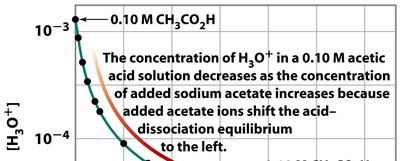
The common-ion effect describes the shift in equilibrium when a substance providing an ion already present in the equilibrium is added. This effect is governed by Le Châtelier’s Principle and is important in buffer and solubility calculations.
Example: Adding acetate ions to acetic acid solution suppresses acid dissociation, decreasing [H3O+] and increasing pH.
Buffer Solutions
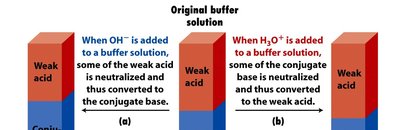
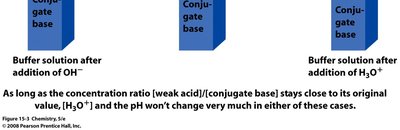
Buffer solutions consist of a weak acid and its conjugate base (or a weak base and its conjugate acid). They resist drastic changes in pH when small amounts of acid or base are added.
Mechanism: Addition of OH- is neutralized by the weak acid; addition of H3O+ is neutralized by the conjugate base.
Examples: CH3COOH/CH3COO-, NH4+/NH3, HF/F-
The Henderson-Hasselbalch Equation
The Henderson-Hasselbalch equation relates the pH of a buffer solution to the concentrations of the acid and its conjugate base:
Equation:
Relationship: ;
Buffer Capacity
Buffer capacity is a measure of how much acid or base a buffer can absorb without significant change in pH. It depends on the concentrations of the acid and base components; higher concentrations yield greater capacity.
Key Points: Buffer pH does not depend on solution volume, only on the ratio and amounts of acid/base.
Titration Curves and Equivalence Point
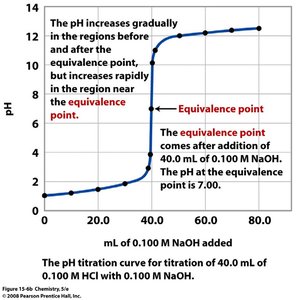
Titration is used to determine the concentration of an unknown solution by reacting it with a standard solution. The equivalence point is where stoichiometrically equivalent amounts of acid and base have reacted.
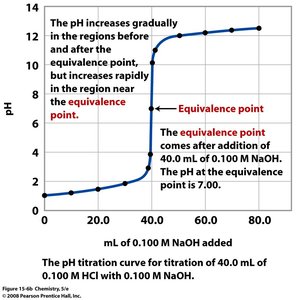
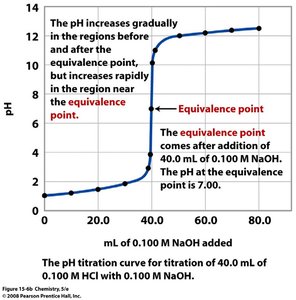
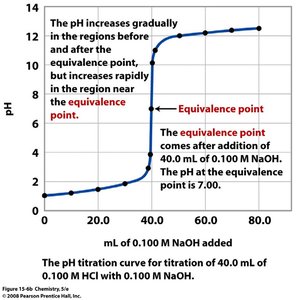
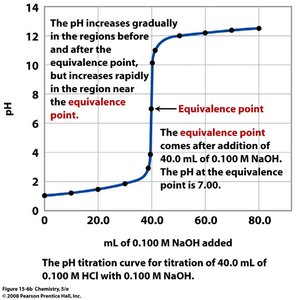
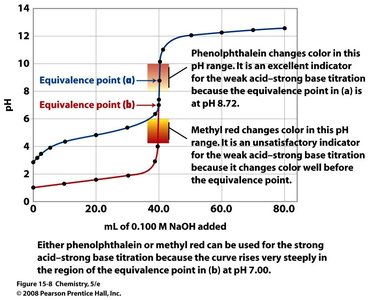
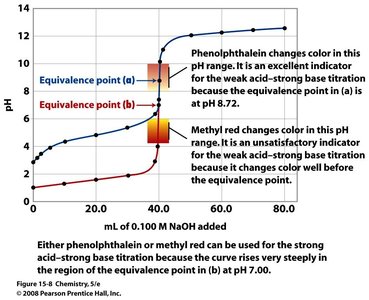
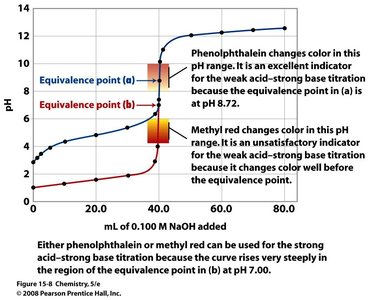
Strong Acid–Strong Base Titration: pH rises sharply near equivalence point; pH at equivalence is 7.
Weak Acid–Strong Base Titration: pH at equivalence point > 7 due to basic salt formation.
Strong Acid–Weak Base Titration: pH at equivalence point < 7 due to acidic salt formation.
Sample Results Table
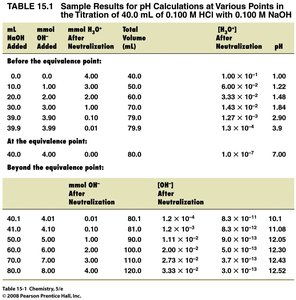
The following table summarizes pH calculations at various points in the titration of 40.0 mL of 0.100 M HCl with 0.100 M NaOH:
mL NaOH Added | mmol H3O+ After Neutralization | Total Volume (mL) | [OH-] After Neutralization (mol/L) | pH |
|---|---|---|---|---|
0.0 | 4.00 | 40.0 | 1.00 x 10⁻² | 1.00 |
20.0 | 2.00 | 60.0 | 3.33 x 10⁻³ | 1.48 |
39.9 | 0.01 | 79.9 | 1.25 x 10⁻⁴ | 2.90 |
40.0 | 0.00 | 80.0 | 1.0 x 10⁻⁷ | 7.00 |
41.0 | 4.01 | 81.0 | 8.3 x 10⁻³ | 10.1 |
Indicators in Titration
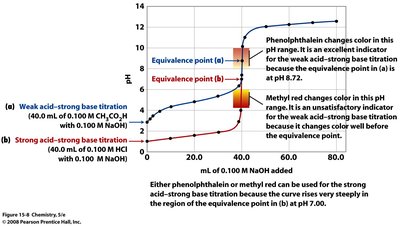
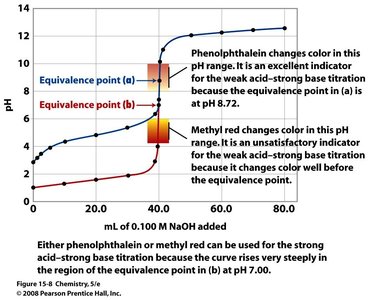
Indicators are used to detect the equivalence point in titrations. The choice of indicator depends on the expected pH at equivalence.
Phenolphthalein: Suitable for weak acid–strong base titrations (equivalence at pH ~8.7).
Methyl Red: Suitable for strong acid–strong base titrations (equivalence at pH ~7).
Solubility Equilibria
Solubility Product Constant (Ksp)
The solubility product constant, Ksp, describes the equilibrium between a solid and its ions in a saturated solution. It is used to predict solubility and precipitation.
General Expression:
Example: For CaF2:
Calculating Solubility from Ksp
Solubility can be calculated by setting up the equilibrium expression and solving for the concentration of ions.
Example: For MgF2: If , then M (molar solubility).
Factors Affecting Solubility
Common Ion Effect: Addition of a common ion decreases solubility due to Le Châtelier’s Principle.
pH: Solubility of salts containing basic anions increases as solution acidity increases.
Formation of Complex Ions: Complex formation can increase solubility.
Amphoterism: Some compounds (e.g., Al(OH)3) are soluble in both strong acid and strong base.
Precipitation and Ion Product (Qc)
Precipitation occurs when the ion product (Qc) exceeds Ksp. If Qc = Ksp, the solution is saturated; if Qc < Ksp, no precipitation occurs.
Key Points: Compare Qc to Ksp to predict precipitation.
Summary Table: Titration Types and pH at Equivalence
Titration Type | pH at Equivalence | Major Species at Equivalence |
|---|---|---|
Strong Acid + Strong Base | 7 | Neutral salt + water |
Weak Acid + Strong Base | >7 | Basic salt + water |
Strong Acid + Weak Base | <7 | Acidic salt + water |
Key Equations
Additional info: These notes expand on the original content by providing full academic context, definitions, and examples for each topic, ensuring completeness and clarity for exam preparation.
