 Indietro
Chapter 2 Practice: Electron Configurations, Quantum Numbers, and Periodic Trends
Guida di studio - Note intelligenti
 Appunti personalizzati basati sui tuoi materiali, ampliati con definizioni chiave, esempi e contesto.
Q1. Write the electron configuration for oxygen. For each of the four electrons in the 2p subshell, give an allowed set of quantum numbers (n, l, ml, ms).
Background
Topic: Electron Configuration & Quantum Numbers
This question tests your understanding of how electrons are arranged in atoms and how quantum numbers describe their properties.
Key Terms and Formulas:
Electron configuration: The arrangement of electrons in an atom's orbitals.
Quantum numbers: n (principal), l (angular momentum), ml (magnetic), ms (spin).
Allowed values for quantum numbers in the 2p subshell:
(second energy level)
(p orbital)
(three possible orientations)
(two possible spins)
Step-by-Step Guidance
Write the full electron configuration for oxygen (atomic number 8).
Identify the electrons in the 2p subshell (there are four).
Assign quantum numbers to each of the four 2p electrons, making sure no two electrons have the same set.
Remember that each orbital (ml value) can hold two electrons with opposite spins.
Try solving on your own before revealing the answer!
Final Answer:
Electron configuration for oxygen:
Quantum numbers for the four 2p electrons:
Electron 1:
Electron 2:
Electron 3:
Electron 4:
Each electron has a unique set of quantum numbers, as required by the Pauli exclusion principle.
Q2. Write condensed electron configurations for the following elements:
a. Rubidium
b. Sulfur
c. Copper
Background
Topic: Condensed Electron Configurations
This question tests your ability to use noble gas notation to write electron configurations for elements.
Key Terms and Formulas:
Condensed electron configuration: Uses the previous noble gas in brackets to simplify notation.
Noble gas core: The electron configuration of the nearest noble gas before the element.
Step-by-Step Guidance
Identify the atomic number and position of each element on the periodic table.
Find the noble gas that precedes each element.
Write the condensed configuration by starting with the noble gas in brackets, then add the remaining electrons.
For transition metals (like copper), pay attention to possible exceptions in electron filling.
Try solving on your own before revealing the answer!
Final Answer:
Rubidium:
Sulfur:
Copper:
Copper is a special case where the 4s and 3d subshells are filled in a way that maximizes stability.
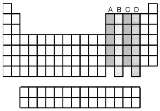
Q3. Which of the labeled groups of elements, indicated by letter on the periodic table, would have two unpaired p electrons in their valence shell? Briefly explain.
Background
Topic: Periodic Table & Electron Configuration
This question tests your understanding of how electron configurations relate to the periodic table and the concept of unpaired electrons in p orbitals.
Key Terms and Formulas:
Valence shell: The outermost electron shell of an atom.
Unpaired electrons: Electrons in orbitals that are not paired with another electron of opposite spin.
p block: Groups 13–18 on the periodic table.
Step-by-Step Guidance
Examine the labeled groups (A, B, C, D) on the periodic table image.
Recall that elements with two unpaired p electrons have a p configuration in their valence shell.
Identify which group corresponds to elements with a p configuration (e.g., Group 14).
Explain why these elements have two unpaired electrons based on Hund's rule.
Try solving on your own before revealing the answer!
Final Answer:
Group C (Group 14) would have two unpaired p electrons in their valence shell.
Elements in Group 14 have a valence configuration of , so the two p electrons occupy separate orbitals and remain unpaired according to Hund's rule.
Q4. Which orbital-filling diagram violates the Pauli exclusion principle? Explain why.
Background
Topic: Pauli Exclusion Principle & Orbital Filling
This question tests your understanding of the Pauli exclusion principle, which states that no two electrons in an atom can have the same set of quantum numbers.
Key Terms and Formulas:
Pauli exclusion principle: Each electron in an atom must have a unique set of quantum numbers.
Orbital-filling diagram: Visual representation of electron arrangement in orbitals.
Step-by-Step Guidance
Review each orbital-filling diagram (A, B, C, D).
Check for any orbitals containing two electrons with the same spin (both up or both down).
Recall that each orbital can hold two electrons, but they must have opposite spins.
Identify which diagram violates this rule.
Try solving on your own before revealing the answer!
Final Answer:
The diagram that violates the Pauli exclusion principle is the one where an orbital contains two electrons with the same spin.
This is not allowed because both electrons would have identical quantum numbers, which is forbidden by the principle.
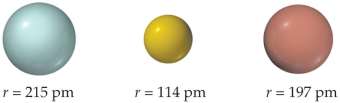
Q5. These three spheres represent atoms of strontium, calcium, and bromine. Which is which and how do you know?
Background
Topic: Atomic Radius & Periodic Trends
This question tests your understanding of how atomic radius changes across periods and down groups in the periodic table.
Key Terms and Formulas:
Atomic radius: The distance from the nucleus to the outermost electron shell.
Periodic trends: Atomic radius increases down a group and decreases across a period.
Step-by-Step Guidance
Compare the atomic radii: 215 pm, 114 pm, and 197 pm.
Recall that strontium (Sr) is below calcium (Ca) in Group 2, so Sr should have a larger radius than Ca.
Bromine (Br) is a halogen and typically has a smaller radius than Sr but larger than Ca.
Assign each radius to the correct element based on these trends.
Try solving on your own before revealing the answer!
Final Answer:
215 pm: Strontium (Sr)
197 pm: Bromine (Br)
114 pm: Calcium (Ca)
Strontium has the largest radius because it is further down the group. Calcium is smaller, and bromine falls in between.
