 Indietro
Chapter 2 Study Guide: The Quantum-Mechanical Model of the Atom
Guida di studio - Note intelligenti
 Appunti personalizzati basati sui tuoi materiali, ampliati con definizioni chiave, esempi e contesto.
Chapter 2: The Quantum-Mechanical Model of the Atom
Introduction to Quantum Mechanics
The quantum-mechanical model describes the behavior of electrons in atoms, highlighting their dual wave-particle nature. This chapter explores foundational concepts such as electromagnetic radiation, quantization, and the mathematical models that explain atomic structure.
Wave-Particle Duality
Electrons as Waves and Particles
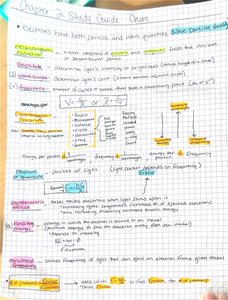
Wave-Particle Duality: Electrons exhibit both particle-like and wave-like properties, a concept fundamental to quantum mechanics.
Light as a Wave: Light is an electromagnetic wave characterized by its wavelength (λ), frequency (ν), and amplitude.
Light as a Particle: Light can also behave as a stream of particles called photons, each carrying a quantum of energy.
Properties of Light
Wavelength, Frequency, and Energy
Wavelength (λ): The distance between two consecutive peaks of a wave (measured in meters).
Frequency (ν): The number of wave cycles that pass a point per second (measured in Hz).
Amplitude: The height of the wave, related to the intensity of the light.
Speed of Light (c): All electromagnetic waves travel at the speed of light in a vacuum, m/s.
Relationship:
Electromagnetic Spectrum
Types of Electromagnetic Radiation
The electromagnetic spectrum includes radio waves, microwaves, infrared, visible light, ultraviolet, X-rays, and gamma rays.
Visible light is only a small portion of the spectrum, ranging from approximately 400 nm (violet) to 700 nm (red).
Energy increases with frequency and decreases with wavelength.
Quantization of Energy
Planck's Hypothesis and the Photoelectric Effect
Planck's Constant (h): J·s
Energy of a Photon:
Photoelectric Effect: Electrons are ejected from a metal surface when light of sufficient frequency shines on it, demonstrating the particle nature of light.
Atomic Models
Bohr Model
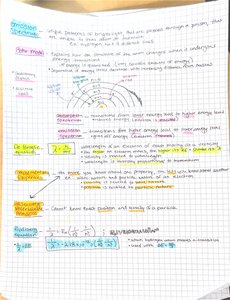
Electrons orbit the nucleus in quantized energy levels (shells).
Energy is absorbed or emitted when an electron transitions between levels.
Energy difference: J
De Broglie Wavelength
Wave Nature of Matter
All matter exhibits wave-like properties, described by the de Broglie equation.
de Broglie wavelength:
Where is mass (kg) and is velocity (m/s).
Heisenberg Uncertainty Principle
Limits of Measurement
It is impossible to know both the exact position and momentum of a particle simultaneously.
Uncertainty principle:
Schrödinger Equation
Quantum Mechanical Model
The behavior of electrons in atoms is described by the Schrödinger equation.
Wave functions () describe the probability distribution of an electron.
Quantum numbers arise from solutions to the Schrödinger equation, defining energy levels and shapes of orbitals.
Summary Table: Key Equations and Concepts
Concept | Equation | Description |
|---|---|---|
Speed of Light | Relates wavelength and frequency | |
Photon Energy | Energy of a photon | |
de Broglie Wavelength | Wave nature of matter | |
Bohr Energy Levels | Energy change in electron transitions | |
Heisenberg Uncertainty | Limits of measurement |
Additional info: These notes synthesize key points from handwritten study guides, expanding on definitions, equations, and models for clarity and completeness.
