 Indietro
Chapter 20: Nuclear Chemistry – Radioactive Isotopes and Nuclear Reactions
Guida di studio - Note intelligenti
 Appunti personalizzati basati sui tuoi materiali, ampliati con definizioni chiave, esempi e contesto.
Radioactive Isotopes
Definition and Types of Isotopes
An element is defined by the number of protons in its nucleus. However, the number of neutrons can vary, resulting in different isotopes of the same element. Isotopes can be stable or unstable (radioactive). Some elements have only stable isotopes, some have both stable and unstable isotopes, and some have only unstable isotopes.
Stable Isotopes: Do not undergo radioactive decay (e.g., Magnesium-24, Iodine-127).
Radioactive Isotopes: Undergo spontaneous decay, emitting radiation (e.g., Magnesium-23, Iodine-125, Uranium-235).
Natural Radioactivity
Unstable Nuclei and Types of Radiation
Nearly all naturally occurring elements have isotopes that are unstable. An unstable nucleus is radioactive and emits small particles or energy (radiation) to become more stable. This process is called radioactive decay. The main types of radioactive decay are:
Alpha (𝛼) decay
Beta (𝛽) decay
Positron (𝛽+) emission
Gamma (𝛾) ray emission
Electron capture (E.C.)
Radioactive decay often changes the number of protons in the nucleus, converting the atom into a different element.
Nuclear Reactions
Radioactive Decay and Nuclear Equations
Unstable nuclei spontaneously break down, emitting radiation in a process called radioactive decay. Nuclear equations represent these changes, showing the original nucleus (reactant) and the new nucleus plus emitted radiation (products). The sum of mass numbers and atomic numbers must be equal on both sides, adhering to the law of conservation of mass.
General form:
Radioactive Decay: Alpha (𝛼) Particles
Properties and Symbolism
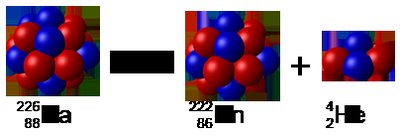
An alpha particle is identical to a helium nucleus, containing two protons and two neutrons. It has a mass number of 4, atomic number of 2, and a charge of 2+.
Symbol: or
Alpha Decay Equations
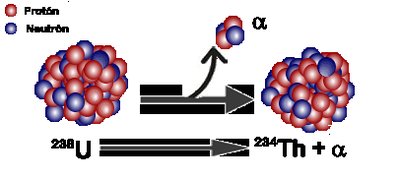
When an unstable nucleus emits an alpha particle, its mass number decreases by 4 and atomic number by 2. For example, uranium-238 decays via alpha emission:
Radioactive Decay: Beta (𝛽) Particles
Properties and Symbolism
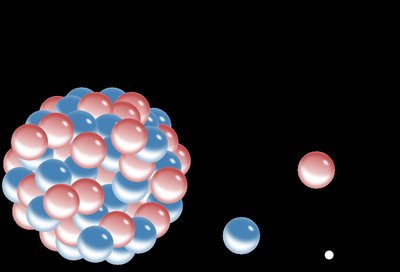
A beta particle is a high-energy electron formed when a neutron in an unstable nucleus changes into a proton, emitting a beta particle. It has a charge of -1 and a mass number of 0.
Symbol: or
Beta Decay Equations
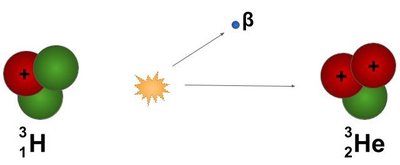
In beta decay, a neutron is converted into a proton and an electron (beta particle). The proton remains in the nucleus, increasing the atomic number by 1 and decreasing the number of neutrons by 1. For example, tritium (hydrogen-3) undergoes beta decay:
Radioactive Decay: Positron (𝛽+) Emission
Properties and Symbolism
A positron is generated when a proton in an unstable nucleus is converted into a neutron, emitting a high-energy, positively charged electron. It has a charge of +1 and a mass number of 0.
Symbol: or
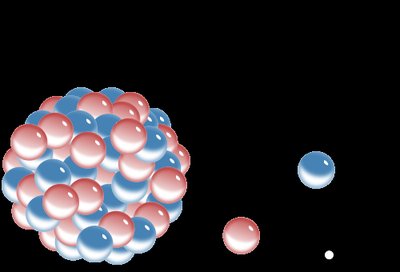
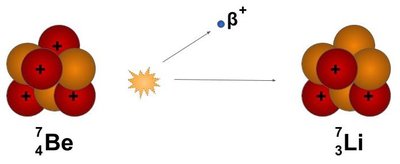
Positron Emission Equations
In positron emission, a proton is converted into a neutron and a positron is emitted. The atomic number decreases by 1, and the number of neutrons increases by 1. For example, beryllium-7 undergoes positron emission:
Electron Capture
Process and Equation
Electron capture occurs when an unstable nucleus captures one of its own electrons, converting a proton into a neutron. This process does not emit radiation but changes the atomic number and neutron count.
Example equation:
Radioactive Decay: Gamma (𝛾) Rays
Properties and Symbolism
Gamma radiation is the highest energy form of ionizing radiation, often emitted alongside other types of decay or directly from an unstable nucleus. Gamma rays are pure energy, with no mass or charge, and can penetrate most materials.
Symbol:
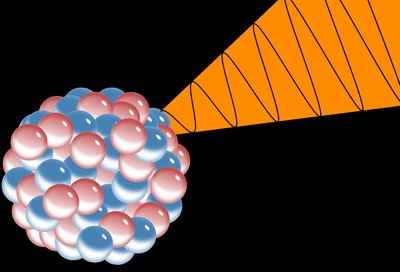
Gamma Emission Equations
Pure gamma emitters are rare; gamma radiation is usually emitted with alpha or beta decay. For example, technetium-99m decays by emitting gamma rays:
Gamma emission is important in medical diagnostics because gamma rays can pass through the body to detection equipment.
What Makes a Nucleus Unstable?
Neutron-to-Proton Ratio
The stability of a nucleus depends on its neutron-to-proton (N/Z) ratio:
Lighter stable elements have a ratio close to 1:1.
Heavier stable elements require more neutrons than protons.
Unstable nuclei undergo radioactive decay to adjust their N/Z ratio to a stable range.
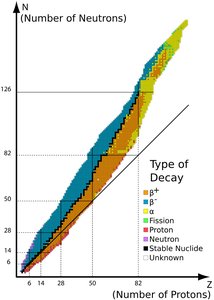
Details on Radioactive Decay
Decay Modes and Neutron/Proton Ratio Adjustment
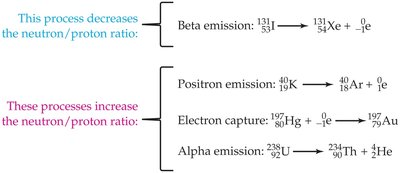
Different types of radioactive decay adjust the neutron/proton ratio in different ways. The following table summarizes how each process affects the ratio and provides example equations:
Process | Effect on N/Z Ratio | Example Equation |
|---|---|---|
Beta emission | Decreases N/Z ratio | |
Positron emission | Increases N/Z ratio | |
Electron capture | Increases N/Z ratio | |
Alpha emission | Increases N/Z ratio |
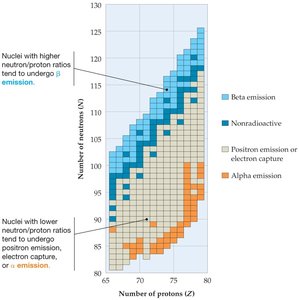
Graphical Representation of Decay Modes
The following chart shows the regions of the periodic table where different types of decay are favored, based on the neutron/proton ratio:
Example Problems
Write the balanced nuclear equation for manganese-49, which decays by emitting a positron.
Write a balanced nuclear equation for the beta decay of chromium-51.
Write the balanced nuclear equation for the alpha decay of polonium-241.
Additional info: Understanding the types of radioactive decay and their effects on the nucleus is essential for predicting the stability of isotopes and their behavior in nuclear reactions. These principles are foundational for applications in nuclear medicine, energy, and radiometric dating.
