 Indietro
Chapter 3: Molecules and Compounds – Structure, Bonding, and Nomenclature
Guida di studio - Note intelligenti
 Appunti personalizzati basati sui tuoi materiali, ampliati con definizioni chiave, esempi e contesto.
Chapter 3: Molecules and Compounds
Overview of Molecules and Compounds
Molecules and compounds are fundamental chemical entities formed by the combination of elements. Understanding their structure, bonding, and nomenclature is essential for mastering general chemistry.
Chemical Bonds
Types of Chemical Bonds
Chemical bonds are the attractive forces that hold atoms together in compounds. They are classified into two main types:
Ionic Bonds: Formed by the transfer of electrons from a metal to a nonmetal, resulting in the formation of cations and anions.
Covalent Bonds: Formed by the sharing of electrons between two or more nonmetals, resulting in the formation of molecules.
Chemical bonds arise from the attractions between charged particles (electrons and protons) in atoms.
Mixtures vs. Compounds
Proportions of Elements
Elements can combine in different ways:
Mixtures: Elements can mix in any proportion without forming new substances.
Compounds: Elements combine in fixed, definite proportions to form new substances with unique properties.
Properties of Hydrogen, Oxygen, and Water
When elements combine to form compounds, the resulting substance often has properties very different from the constituent elements.
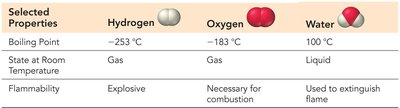
Example: Hydrogen and oxygen are both gases at room temperature, but when combined in a 2:1 ratio, they form water, a liquid with very different properties.
Chemical Formulas
Representing Compounds
Chemical formulas indicate the elements present in a compound and the relative number of atoms of each element. Subscripts are used to show the number of atoms; a subscript of 1 is omitted by convention.

Types of Chemical Formulas
Empirical Formula: Shows the simplest whole-number ratio of atoms in a compound.
Molecular Formula: Shows the actual number of atoms of each element in a molecule.
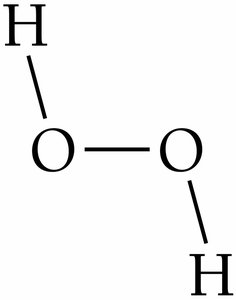
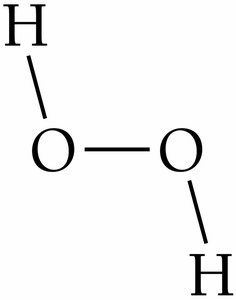
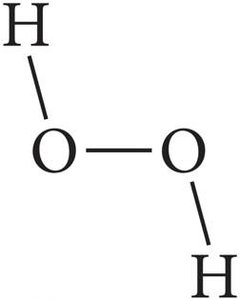
Structural Formula: Shows how atoms are connected or bonded in a molecule, sometimes indicating geometry.
Example: The empirical formula for hydrogen peroxide (H2O2) is HO, while the molecular formula is H2O2.

Ionic Compounds
Formation of Ionic Compounds
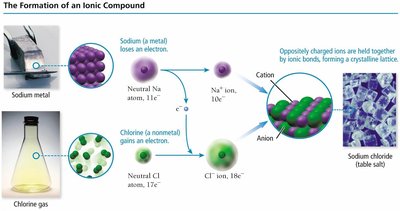
Ionic compounds are formed when metals transfer electrons to nonmetals, resulting in the formation of a lattice of alternating cations and anions.
Formulas and Names of Ionic Compounds
Ionic compounds always contain both positive (cation) and negative (anion) ions.
The sum of the charges in the formula must be zero.
The formula reflects the smallest whole-number ratio of ions.
Predicting Charges
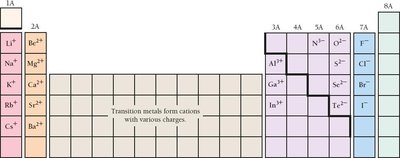
The charges of representative elements can often be predicted from their group numbers, while transition metals may form multiple charges.

Naming Ionic Compounds
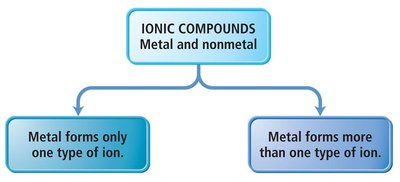
Type I: Metal forms only one type of ion. Name = metal + nonmetal base + "-ide".
Type II: Metal forms more than one type of ion. Name = metal + (charge in Roman numerals) + nonmetal base + "-ide".

Covalent (Molecular) Compounds
Formation and Naming
Covalent bonds occur between nonmetals, where atoms share electrons to form molecules. Molecular compounds are named using prefixes to indicate the number of each atom present.
First element: more metal-like element (to the left and bottom of the periodic table).
Prefixes: mono-, di-, tri-, tetra-, penta-, etc.
Polyatomic Ions and Compounds
Polyatomic Ions
Polyatomic ions are groups of covalently bonded atoms with an overall charge. Many common ionic compounds contain polyatomic ions.
Oxyanions: Polyatomic ions containing oxygen and another element. Naming depends on the number of oxygen atoms (e.g., nitrate, nitrite, sulfate, sulfite).
Prefixes: "per-" (more oxygen), "hypo-" (less oxygen).
Hydrated Ionic Compounds
Hydrates are ionic compounds with a specific number of water molecules associated with each formula unit. Prefixes (mono-, di-, tri-, etc.) indicate the number of water molecules.
Acids
Types and Naming
Binary Acids: Composed of hydrogen and a nonmetal (e.g., HCl).
Oxyacids: Composed of hydrogen and an oxyanion (e.g., HNO3).
Naming rules depend on the ending of the polyatomic ion:
-ate → -ic acid (e.g., nitrate → nitric acid)
-ite → -ous acid (e.g., nitrite → nitrous acid)
Composition of Compounds
Molar Mass and Formula Mass
The molar mass of a compound (g/mol) is numerically equivalent to its formula mass (amu). It is used to convert between mass and moles of a compound.
Mass Percent Composition
Mass percent composition shows the mass ratio of each element in a compound and can be used as a conversion factor between the mass of an element and the mass of the compound.
Determining Empirical and Molecular Formulas
The empirical formula gives the simplest whole-number ratio of atoms in a compound. It can be determined from percent composition or mass data. The molecular formula is a whole-number multiple of the empirical formula and requires knowledge of the compound's molar mass.
Combustion Analysis
Combustion analysis is a technique used to determine the empirical formula of organic compounds by burning a known mass and analyzing the products.
Ways of Representing Compounds
Chemical, Structural, and Molecular Models
Compounds can be represented in several ways:
Chemical Formula: Indicates the types and numbers of atoms.
Structural Formula: Shows how atoms are bonded.
Ball-and-Stick Model: Atoms as balls, bonds as sticks, showing geometry.
Space-Filling Model: Atoms as spheres that fill space, approximating actual molecular size and shape.
Organic Compounds
Hydrocarbons
Hydrocarbons are organic compounds containing only carbon and hydrogen. They are classified by the types of bonds present:
Alkanes: Only single bonds (-ane suffix).
Alkenes: At least one double bond (-ene suffix).
Alkynes: At least one triple bond (-yne suffix).
Base names for hydrocarbons are derived from the number of carbon atoms (meth-, eth-, prop-, etc.).
Functionalized Hydrocarbons
Functional groups are specific atoms or groups of atoms that impart characteristic chemical properties to organic compounds. Families of organic compounds are defined by their functional groups (e.g., alcohols, ethers, aldehydes, ketones, carboxylic acids, esters, amines).
Family | Ending | General Formula | Example Name | Occurrence/Use |
|---|---|---|---|---|
Alcohols | -ol | R-OH | Ethanol | Alcohol in beverages |
Ethers | ether | R-O-R' | Diethyl ether | Anesthetic, solvent |
Aldehydes | -al | R-CHO | Ethanal | Perfumes, flavors |
Ketones | -one | R-CO-R' | Propanone | Nail polish remover |
Carboxylic acids | acid | R-COOH | Acetic acid | Vinegar |
Esters | -ate | R-COO-R' | Methyl acetate | Solvent |
Amines | amine | R-NH2 | Ethyl amine | Odor of fish |
Additional info: This summary includes expanded academic context and examples to ensure completeness and clarity for exam preparation.
