 Indietro
Chapter 3: Molecules and Compounds – Study Notes for General Chemistry
Guida di studio - Note intelligenti
 Appunti personalizzati basati sui tuoi materiali, ampliati con definizioni chiave, esempi e contesto.
Chapter 3: Molecules and Compounds
Introduction to Molecules and Compounds
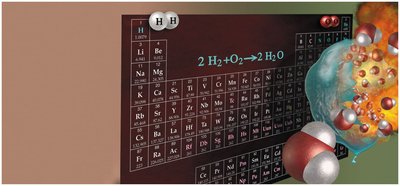
When elements combine, they form compounds with properties distinct from their constituent elements. For example, hydrogen and oxygen gases react to form water, a compound with unique characteristics. Understanding the types of chemical bonds, chemical formulas, and nomenclature is essential for describing and predicting the behavior of compounds.
Properties of Hydrogen, Oxygen, and Water
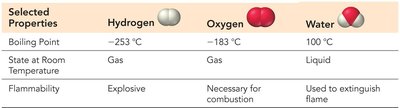
The physical and chemical properties of compounds differ significantly from those of the elements that compose them. For instance, hydrogen and oxygen are both gases at room temperature, while water is a liquid. Hydrogen is explosive, oxygen is necessary for combustion, and water is used to extinguish flames.
Selected Properties | Hydrogen | Oxygen | Water |
|---|---|---|---|
Boiling Point | -253 °C | -183 °C | 100 °C |
State at Room Temperature | Gas | Gas | Liquid |
Flammability | Explosive | Necessary for combustion | Used to extinguish flame |
Mixtures vs. Compounds
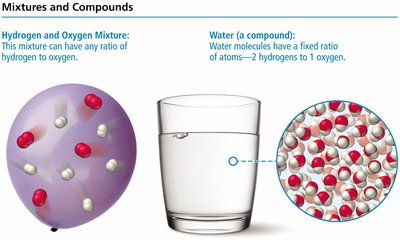
Mixtures contain substances in variable ratios, while compounds have fixed ratios of elements. For example, a mixture of hydrogen and oxygen can have any proportion, but water always contains two hydrogen atoms for every oxygen atom.
Types of Chemical Bonds
Ionic and Covalent Bonds
Chemical bonds hold atoms together in compounds due to attractions between charged particles. There are two main types:
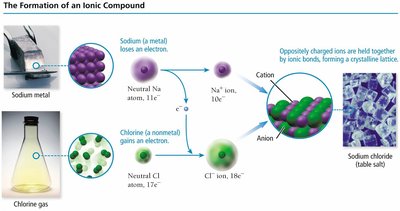
Ionic bonds: Occur between metals and nonmetals, involving the transfer of electrons. The resulting species is an ionic compound.
Covalent bonds: Occur between nonmetals, involving the sharing of electrons. The resulting species is a molecular compound.
Chemical Formulas and Molecular Models
Types of Chemical Formulas
Chemical formulas indicate the elements present and their ratios in a compound. The main types are:
Empirical formula: Shows the simplest whole-number ratio of atoms.
Molecular formula: Shows the actual number of atoms of each element.
Structural formula: Shows how atoms are connected.
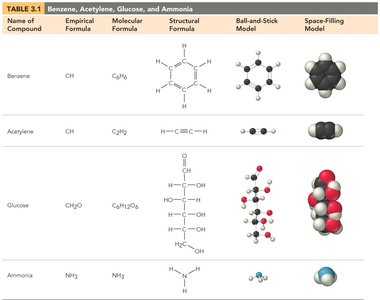
Molecular models provide visual representations:
Ball-and-stick model: Atoms as balls, bonds as sticks, showing shape.
Space-filling model: Shows the relative sizes and how atoms fill space.
Name of Compound | Empirical Formula | Molecular Formula | Structural Formula | Ball-and-Stick Model | Space-Filling Model |
|---|---|---|---|---|---|
Benzene | CH | C6H6 | Hexagonal ring | Model | Model |
Acetylene | CH | C2H2 | Linear | Model | Model |
Glucose | CH2O | C6H12O6 | Ring/chain | Model | Model |
Ammonia | NH3 | NH3 | Pyramidal | Model | Model |
Atomic-Level View of Elements and Compounds
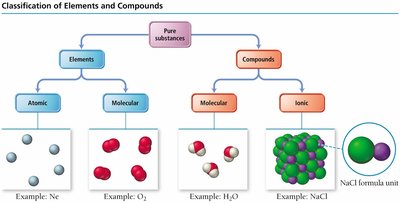
Classification of Pure Substances
Pure substances are classified as elements or compounds. Elements can be atomic (e.g., Ne) or molecular (e.g., O2). Compounds can be molecular (e.g., H2O) or ionic (e.g., NaCl).
Molecular Elements
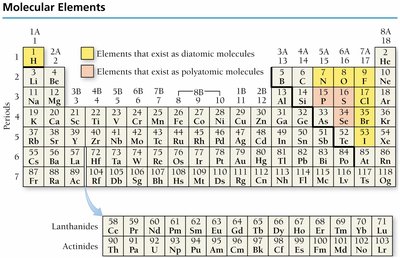
Some elements exist as molecules rather than single atoms. Most molecular elements are diatomic (e.g., H2, N2, O2, F2, Cl2, Br2, I2), while some are polyatomic (e.g., P4, S8).
Molecular vs. Ionic Compounds
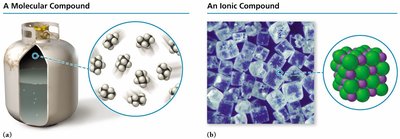
Molecular compounds are composed of nonmetals bonded covalently, while ionic compounds consist of metals and nonmetals bonded ionically. The basic unit of an ionic compound is the formula unit.
Writing and Naming Ionic Compounds
Formation of Ions and Ionic Compounds
Main group metals lose electrons to form cations, and nonmetals gain electrons to form anions. The charges are predictable based on their position in the periodic table.
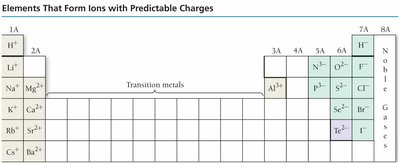
Rules for Writing Ionic Formulas
To write the formula for an ionic compound:
Write the symbol for the metal cation and nonmetal anion.
Balance the charges by adjusting subscripts.
Ensure the smallest whole-number ratio of ions.
Naming Ionic Compounds
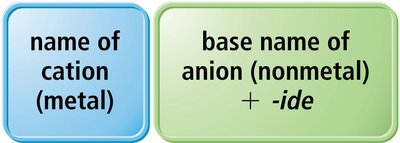
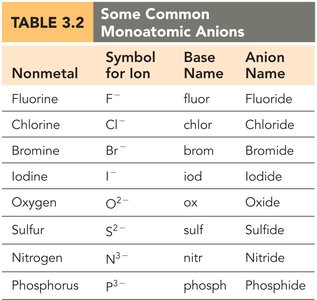
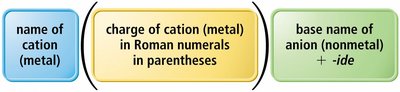
Ionic compounds are named by stating the cation (metal) first, followed by the base name of the anion (nonmetal) with the suffix -ide.
Nonmetal | Symbol for Ion | Base Name | Anion Name |
|---|---|---|---|
Fluorine | F- | fluor | Fluoride |
Chlorine | Cl- | chlor | Chloride |
Bromine | Br- | brom | Bromide |
Iodine | I- | iod | Iodide |
Oxygen | O2- | ox | Oxide |
Sulfur | S2- | sulf | Sulfide |
Nitrogen | N3- | nitr | Nitride |
Phosphorus | P3- | phosph | Phosphide |
Naming Ionic Compounds with Polyatomic Ions
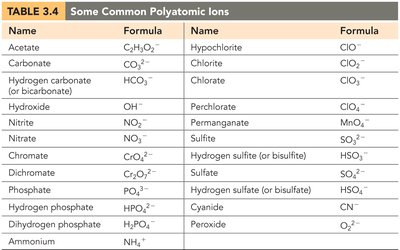
Polyatomic ions are ions composed of two or more atoms. Their names must be memorized and are used directly in compound names.
Name | Formula | Name | Formula |
|---|---|---|---|
Acetate | C2H3O2- | Hypochlorite | ClO- |
Carbonate | CO32- | Chlorite | ClO2- |
Nitrate | NO3- | Sulfate | SO42- |
Phosphate | PO43- | Ammonium | NH4+ |
Naming Ionic Compounds with Metals of Variable Charge
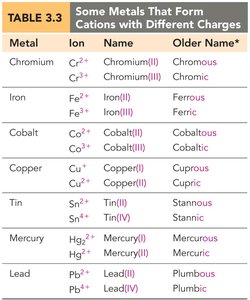
Some metals form more than one type of cation. Their charge is indicated in Roman numerals in parentheses after the metal name.
Metal | Ion | Name | Older Name |
|---|---|---|---|
Iron | Fe2+ | Iron(II) | Ferrous |
Iron | Fe3+ | Iron(III) | Ferric |
Copper | Cu+ | Copper(I) | Cuprous |
Copper | Cu2+ | Copper(II) | Cupric |
Naming Hydrated Ionic Compounds
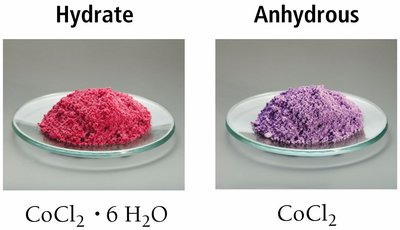
Hydrates are ionic compounds containing a specific number of water molecules. Prefixes indicate the number of water molecules (e.g., hexahydrate for six).
Naming Molecular Compounds
Rules for Naming Molecular Compounds
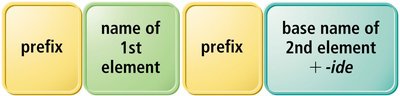
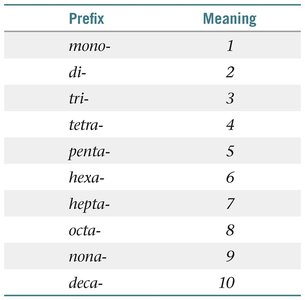
Molecular compounds are named using prefixes to indicate the number of each atom. The first element is named fully; the second element uses the base name plus -ide. The prefix mono- is not used for the first element.
Prefix | Meaning |
|---|---|
mono- | 1 |
di- | 2 |
tri- | 3 |
tetra- | 4 |
penta- | 5 |
hexa- | 6 |
hepta- | 7 |
octa- | 8 |
nona- | 9 |
deca- | 10 |
Naming Acids
Binary Acids and Oxyacids
Acids are compounds that release H+ in water. Binary acids consist of hydrogen and a nonmetal; their names begin with hydro- and end with -ic acid (e.g., HCl is hydrochloric acid). Oxyacids contain hydrogen and an oxyanion; if the oxyanion ends in -ite, the acid ends in -ous acid; if it ends in -ate, the acid ends in -ic acid.
Organic Compounds and Hydrocarbons
Classification of Organic Compounds
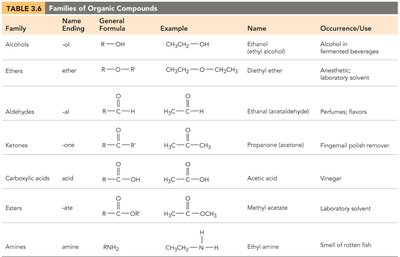
Organic compounds contain carbon and hydrogen, often with other elements. They are classified as hydrocarbons (alkanes, alkenes, alkynes) or functionalized hydrocarbons (alcohols, ethers, etc.).
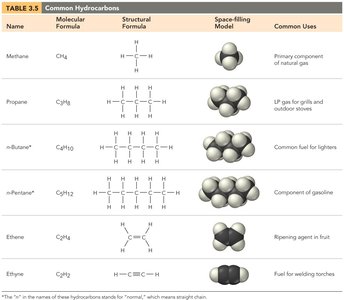
Families of Organic Compounds
Family | Name Ending | General Formula | Example | Name | Occurrence/Use |
|---|---|---|---|---|---|
Alcohols | -ol | R–OH | CH3CH2OH | Ethanol | Alcohol in beverages |
Ethers | ether | R–O–R' | CH3CH2OCH2CH3 | Diethyl ether | Laboratory solvent |
Aldehydes | -al | R–CHO | CH3CHO | Ethanal | Perfumes, flavors |
Ketones | -one | R–CO–R' | CH3COCH3 | Propanone | Nail polish remover |
Carboxylic acids | -oic acid | R–COOH | CH3COOH | Acetic acid | Vinegar |
Amines | -amine | RNH2 | CH3CH2NH2 | Ethyl amine | Smell of rotten fish |
Formula Mass and Molar Mass
Definitions and Calculations
The formula mass is the average mass of a molecule or formula unit in atomic mass units (amu). The molar mass is the mass of one mole of a substance in grams per mole (g/mol). These values are essential for converting between mass and number of particles.
Using Molar Mass to Count Molecules
Molar mass allows chemists to count molecules by weighing a sample. For example, the number of CO2 molecules in a given mass can be calculated using the molar mass and Avogadro's number.
Composition of Compounds
Mass Percent Composition
Mass percent composition expresses the proportion of each element in a compound by mass. It is calculated as:
Conversion Factors from Chemical Formulas
Chemical formulas provide relationships between the amounts of elements and compounds, allowing for stoichiometric calculations.
Determining Chemical Formulas from Experimental Data
Empirical and Molecular Formulas
The empirical formula gives the simplest ratio of atoms, while the molecular formula gives the actual number. To determine these from experimental data:
Find the mass of each element.
Convert masses to moles.
Write a pseudoformula based on mole ratios.
Divide by the smallest subscript to get whole numbers.
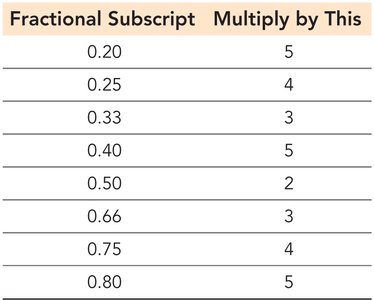
If necessary, multiply to obtain whole-number subscripts.
Fractional Subscript | Multiply by This |
|---|---|
0.20 | 5 |
0.25 | 4 |
0.33 | 3 |
0.40 | 5 |
0.50 | 2 |
0.66 | 3 |
0.75 | 4 |
0.80 | 5 |
Combustion Analysis
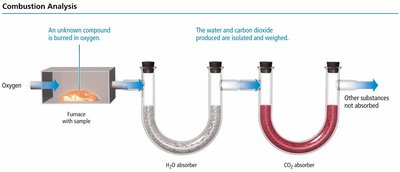
Combustion analysis is used to determine the empirical formula of organic compounds by burning a sample and measuring the masses of CO2 and H2O produced.
Summary
Compounds have fixed ratios of elements and unique properties.
Chemical bonds can be ionic or covalent.
Chemical formulas and models represent compounds in various ways.
Naming conventions differ for ionic, molecular, and acid compounds.
Empirical and molecular formulas can be determined from experimental data.
Organic compounds are classified by functional groups and structure.
