 Indietro
Chapter 4: Basic Chemical Bonding – Compounds, Bond Types, and Lewis Structures
Guida di studio - Note intelligenti
 Appunti personalizzati basati sui tuoi materiali, ampliati con definizioni chiave, esempi e contesto.
Basic Chemical Bonding
Introduction to Chemical Bonds
Chemical bonds are the forces that hold atoms together in compounds and molecules. They are fundamental to the structure and properties of all substances, influencing everything from the hardness of minerals to the energy stored in food.
Formation of Substances: Bonds join atoms to form molecules and compounds, such as water (H2O) and sodium chloride (NaCl). Biological macromolecules like proteins and DNA also depend on chemical bonds.
Energy Storage and Release: The making and breaking of bonds are central to chemical reactions and biological energy cycles.
Material Properties: The type and strength of bonds determine whether a material is hard, soft, flexible, soluble, or conductive.



Why Do Chemical Bonds Matter?
Substance Formation: Bonds create the diversity of substances in the universe.
Energy: Chemical bonds are involved in energy transformations.
Properties: Bonds determine the physical and chemical properties of materials.
Allotropes of Carbon: Diamond vs. Graphite
Diamond and graphite are both made of carbon atoms, but their different bonding arrangements give them distinct properties.
Diamond: Each carbon atom forms four strong covalent bonds in a tetrahedral structure, making diamond extremely hard and transparent.
Graphite: Each carbon atom forms three covalent bonds in flat layers, with weak forces between layers, making graphite soft and slippery.


Electrostatic Forces in Bonding
Nature of Bonding
Bonding is governed by electrostatic attractions and repulsions:
Nucleus-to-nucleus repulsion
Electron-to-electron repulsion
Nucleus-to-electron attraction
Bonding occurs to lower the potential energy between charged particles.
Valence Electrons and the Octet Rule
Valence Electrons
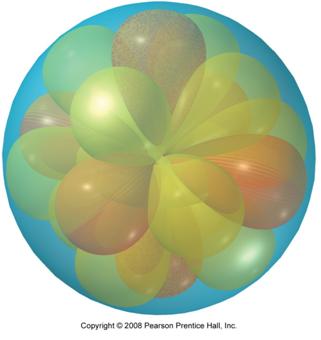
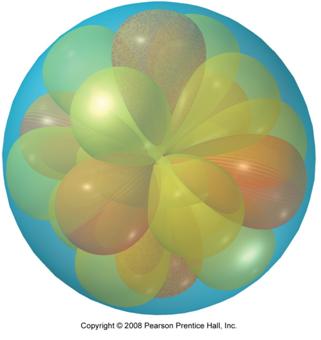
Valence electrons are the outermost electrons of an atom and are responsible for chemical bonding and reactivity. The periodic table helps determine the number of valence electrons for main-group elements.
Group 1A: 1 valence electron
Group 2A: 2 valence electrons
Group 3A: 3 valence electrons
Group 7A: 7 valence electrons
Helium: 2 valence electrons (exception)
Transition elements have variable numbers of valence electrons.
The Octet Rule
Most atoms form bonds to achieve eight valence electrons (the octet rule), which is associated with the stability of noble gases. Hydrogen is an exception, following the duet rule (2 electrons).
Types of Chemical Bonds
Ionic, Covalent, and Metallic Bonds
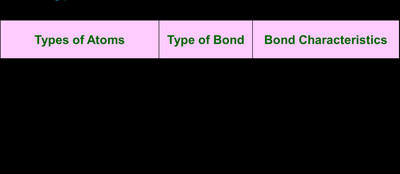
There are three primary types of chemical bonds, each with distinct characteristics:
Types of Atoms | Type of Bond | Bond Characteristics |
|---|---|---|
Metal + Nonmetal | Ionic | Transfer of electrons; forms ions; strong electrostatic attraction |
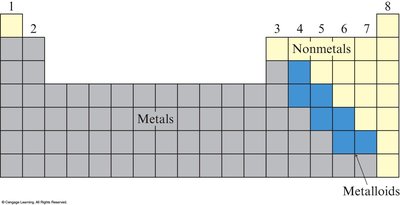
Nonmetal + Nonmetal | Covalent | Sharing of electrons; forms molecules; directional bonds |
Metal + Metal | Metallic | Electron sea; delocalized electrons; conductive, malleable |
Ionic Bonds
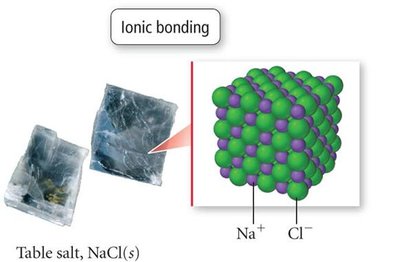
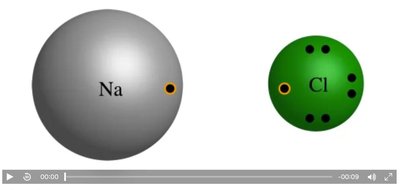
Ionic bonds form when electrons are transferred from metals (low ionization energy) to nonmetals (high electron affinity), resulting in oppositely charged ions that attract each other.
Example: Na (sodium) loses an electron to become Na+; Cl (chlorine) gains an electron to become Cl-.
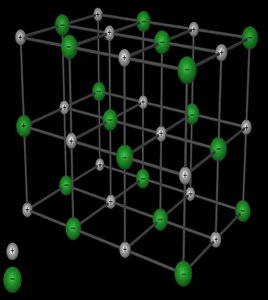
Ionic compounds form crystalline lattices, not discrete molecules.
Covalent Bonds
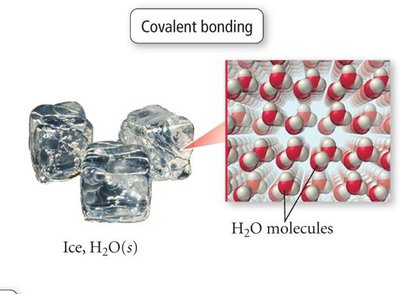
Covalent bonds involve the sharing of electron pairs between nonmetal atoms. The resulting molecules can be elements (e.g., O2) or compounds (e.g., H2O).
Bonding is directional and leads to the formation of discrete molecules.
Physical states can be solid, liquid, or gas at room temperature.
Metallic Bonds
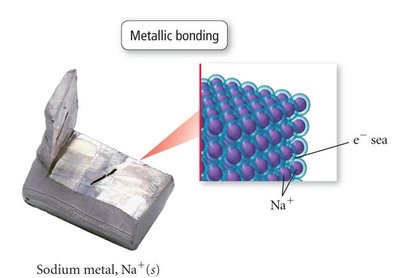
Metallic bonds occur between metal atoms, where valence electrons are delocalized and shared in an 'electron sea.' This explains properties such as conductivity, malleability, and ductility.
Properties of Ionic Compounds
Hard, rigid, and brittle with high melting points
Do not conduct electricity in the solid state (ions are fixed in place)
Conduct electricity when melted or dissolved in water (ions are free to move)

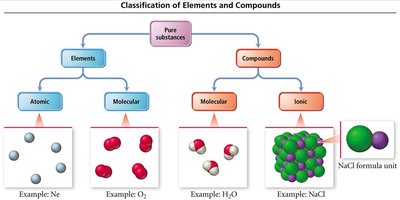
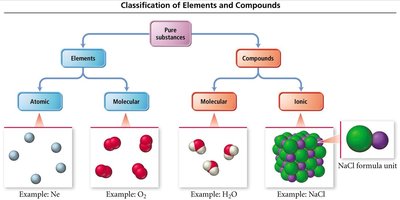
Classification of Elements and Compounds
Pure substances can be classified as elements (atomic or molecular) or compounds (molecular or ionic).
Chemical Formulas
Types of Chemical Formulas
Empirical Formula: Simplest whole-number ratio of atoms (e.g., CH for benzene).
Molecular Formula: Actual number of atoms in a molecule (e.g., C6H6 for benzene).
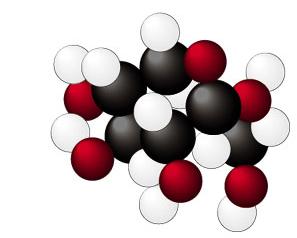
Structural Formula: Shows the arrangement of atoms and bonds.
Condensed Structural Formula: Shows connections in a compact form (e.g., CH3CH2OH).
Naming Compounds (Nomenclature)
Binary Ionic Compounds
Type I: Metal forms only one type of cation. Name = metal + nonmetal root + 'ide' (e.g., NaCl = sodium chloride).
Type II: Metal forms more than one cation (usually transition metals). Name = metal (Roman numeral) + nonmetal root + 'ide' (e.g., FeCl2 = iron(II) chloride).
Binary Covalent Compounds (Type III)
Formed between two nonmetals.
Prefixes indicate the number of each atom (e.g., CO2 = carbon dioxide).
First element uses its full name; second element uses root + 'ide'.
Polyatomic Ions
Charged entities composed of several atoms bound together (e.g., SO42-, NH4+).
Names must be memorized; endings like '-ate', '-ite', 'per-', and 'hypo-' indicate oxygen content.
Naming Acids
If the anion does not contain oxygen: prefix 'hydro-' and suffix '-ic' (e.g., HCl = hydrochloric acid).
If the anion contains oxygen: '-ate' becomes '-ic' (e.g., HNO3 = nitric acid); '-ite' becomes '-ous' (e.g., HNO2 = nitrous acid).
Lewis Dot Structures
Drawing Lewis Structures
Lewis structures represent valence electrons as dots around atomic symbols. They help visualize bonding and lone pairs in molecules and ions.
Follow the octet rule (or duet for hydrogen).
Steps: count valence electrons, choose central atom, connect with single bonds, complete octets, add lone pairs, make double/triple bonds if needed, calculate formal charges.
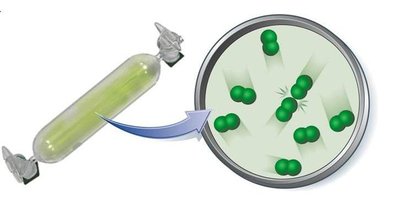
Bond Length:
Bond Polarity and Electronegativity
Electronegativity: The ability of an atom to attract shared electrons. Increases across a period and decreases down a group.
Bond Polarity: Determined by the difference in electronegativity (ΔEN):
ΔEN = 0 to 0.4: Nonpolar covalent
ΔEN = 0.4 to 2.0: Polar covalent
ΔEN ≥ 2.0: Ionic
Resonance Structures and Formal Charge
Some molecules can be represented by more than one valid Lewis structure (resonance forms).
The actual structure is a resonance hybrid, an average of all forms.
Formal Charge: Used to determine the most stable Lewis structure. Calculated as:
The best structure has the smallest formal charges and places negative charges on the most electronegative atoms.
Exceptions to the Octet Rule
Hydrogen (2 electrons), Beryllium (4 electrons), and Boron (6 electrons) often have fewer than eight electrons.
Elements in period 3 and beyond can have expanded octets (more than eight electrons).
Molecules with an odd number of electrons are called radicals.
Summary
Chemical bonds are essential for the structure and properties of matter.
Ionic, covalent, and metallic bonds differ in electron behavior and resulting properties.
Naming and writing formulas for compounds follow systematic rules based on composition and bonding.
Lewis structures, resonance, and formal charge analysis are key tools for understanding molecular structure.
Exceptions to the octet rule exist and must be considered for certain elements and molecules.
