 Indietro
Chapter 4: Chemical Reactions and Chemical Quantities – Study Notes
Guida di studio - Note intelligenti
 Appunti personalizzati basati sui tuoi materiali, ampliati con definizioni chiave, esempi e contesto.
Chemical Reactions and Chemical Quantities
Introduction to Chemical Reactions
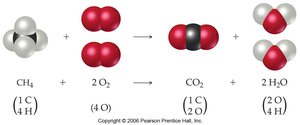
Chemical reactions are processes in which one or more substances are transformed into different substances. These changes involve the rearrangement of atoms and the making or breaking of chemical bonds. Chemical reactions are fundamental to chemistry and are represented using chemical equations.
Chemical reaction: A process where reactants are converted into products, involving chemical changes in matter.
Combustion reaction: A specific type of reaction where a substance reacts with oxygen to form one or more oxygen-containing compounds, often releasing heat.
Example: Methane combustion:
Chemical Equations
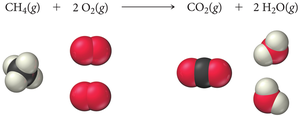
Chemical equations provide a concise way to represent chemical reactions. They show the reactants, products, and their physical states.
Reactants: Substances present before the reaction (left side of the equation).
Products: Substances formed by the reaction (right side of the equation).
States: Indicated by (s) for solid, (l) for liquid, (g) for gas, and (aq) for aqueous solution.
Subscripts: Indicate the number of atoms of each element in a molecule.
Coefficients: Indicate the number of molecules or formula units involved.
Balancing Chemical Equations
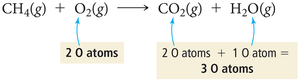
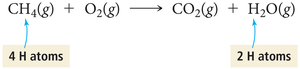
Balancing chemical equations ensures the law of conservation of mass is obeyed. The number of atoms of each element must be the same on both sides of the equation.
Only coefficients are changed to balance equations; subscripts must not be altered.
Balance more complex substances first, then simpler ones, and elements in their free form last.
Check your work to confirm the equation is balanced.
Steps to Balance Chemical Equations
Write the unbalanced equation with coefficients of 1.
Balance atoms in complex substances first.
Balance atoms that occur as free elements last.
Simplify coefficients if possible.
Check that all elements are balanced.
Stoichiometry: Quantitative Relationships in Chemical Reactions
Stoichiometry is the study of the numerical relationships between the amounts of reactants and products in a chemical reaction. It is based on the coefficients of a balanced chemical equation.
Stoichiometric ratio: The ratio of coefficients from the balanced equation, used as a conversion factor between substances.
Example:
2 moles of octane react with 25 moles of oxygen to produce 16 moles of carbon dioxide and 18 moles of water.
Mole-to-Mole and Mass-to-Mass Conversions
Stoichiometric calculations often require converting between mass and moles using molar mass, and then using the stoichiometric ratio to find the amount of another substance.
Mole-to-mole conversion: Use the stoichiometric ratio from the balanced equation.
Mass-to-mass conversion: Convert mass to moles, use the stoichiometric ratio, then convert back to mass.

Limiting Reactant and Theoretical Yield
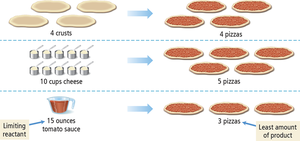
In reactions with more than one reactant, the limiting reactant is the one that is completely consumed first, thus limiting the amount of product formed. The theoretical yield is the maximum amount of product that can be formed from the limiting reactant.
Limiting reactant: The reactant that determines the maximum amount of product possible.
Theoretical yield: The calculated maximum amount of product, based on the limiting reactant.
Excess reactant: Any reactant that remains after the limiting reactant is used up.

Actual Yield and Percent Yield
The actual yield is the amount of product actually obtained from a reaction, which is often less than the theoretical yield due to losses or incomplete reactions. Percent yield expresses the efficiency of a reaction.
Actual yield: The measured amount of product obtained from a reaction.
Percent yield:
B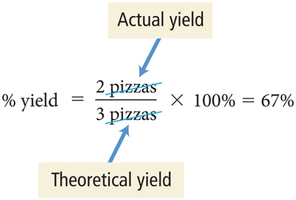
Combustion Reactions and Analysis
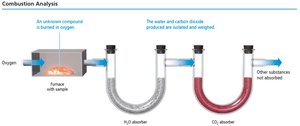
Combustion reactions involve a substance reacting with oxygen to form one or more oxygen-containing compounds, often releasing heat. Combustion analysis is a technique used to determine the empirical formula of compounds containing carbon, hydrogen, and oxygen.
By measuring the amounts of CO2 and H2O produced, the amounts of C and H in the original sample can be determined.
Oxygen is found by difference.
Alkali Metal and Halogen Reactions
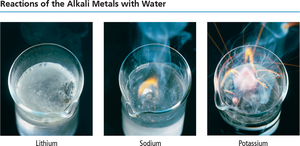
Alkali metals react vigorously with nonmetals and water, often producing heat and light. The reactivity increases down the group. Halogens react with metals to form metal halides, with hydrogen to form hydrogen halides, and with each other to form interhalogen compounds.
Example: Alkali metals with water produce hydrogen gas and a metal hydroxide.
Example: Halogens with sodium produce sodium halides (e.g., NaCl).
Summary Table: Key Stoichiometric Concepts
Concept | Definition | Key Equation/Example |
|---|---|---|
Limiting Reactant | Reactant that is completely consumed first | Smallest calculated product amount |
Theoretical Yield | Maximum possible product from limiting reactant | Based on stoichiometry |
Actual Yield | Measured product obtained | Experimental value |
Percent Yield | Efficiency of reaction |
