 Indietro
Chapter 4: Reactions in Aqueous Solution – Study Notes
Guida di studio - Note intelligenti
 Appunti personalizzati basati sui tuoi materiali, ampliati con definizioni chiave, esempi e contesto.
Reactions in Aqueous Solution
Introduction to Solutions and Aqueous Chemistry
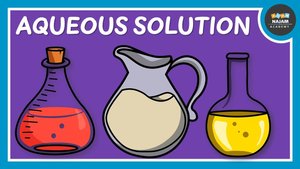
A solution is a homogeneous mixture of two or more substances. An aqueous solution is a solution in which water acts as the solvent. Many important chemical reactions occur in aqueous solutions, making their study essential for understanding general chemistry.
Electrolytes and Nonelectrolytes
Substances dissolved in water can be classified based on their ability to conduct electricity:
Electrolytes: Substances that dissociate into ions in water, allowing the solution to conduct electricity.
Nonelectrolytes: Substances that dissolve in water but do not form ions, so the solution does not conduct electricity.
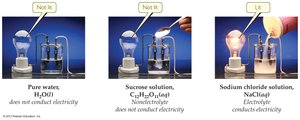
Strong electrolytes dissociate completely in water (e.g., soluble ionic compounds, strong acids, and strong bases), while weak electrolytes only partially dissociate.
Dissociation of Ionic Compounds
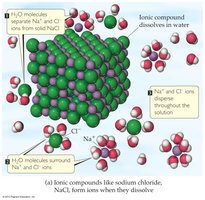
When ionic compounds dissolve in water, they separate into their constituent ions. For example, sodium chloride (NaCl) dissociates into Na+ and Cl− ions.
Nonelectrolytes: Molecular Compounds
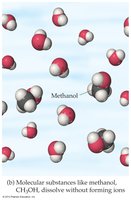
Molecular compounds, except for acids and bases, typically do not dissociate into ions when dissolved in water. For example, methanol (CH3OH) dissolves without forming ions.
Strong and Weak Electrolytes
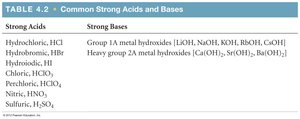
Strong electrolytes include soluble ionic salts, strong acids, and strong bases. Weak electrolytes only partially ionize in solution.
Strong acids: HCl, HBr, HI, HNO3, H2SO4, HClO3, HClO4
Strong bases: Group 1A metal hydroxides (e.g., NaOH, KOH), heavy Group 2A metal hydroxides (e.g., Ca(OH)2, Sr(OH)2, Ba(OH)2)
Precipitation Reactions and Solubility
Precipitation Reactions
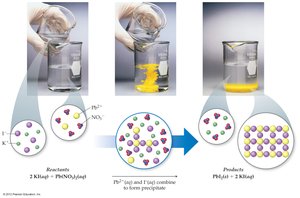
A precipitation reaction occurs when two solutions are mixed and an insoluble compound (precipitate) forms. The formation of a precipitate can be predicted using solubility rules.
Solubility Rules
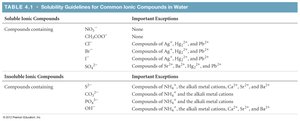
Solubility rules help predict whether an ionic compound will dissolve in water. Key rules include:
Salts containing Group I elements and NH4+ are soluble.
Nitrates (NO3−) are generally soluble.
Chlorides, bromides, and iodides are soluble except with Ag+, Pb2+, and Hg22+.
Sulfates are generally soluble, with exceptions (e.g., BaSO4, PbSO4).
Most hydroxides, carbonates, chromates, phosphates, and fluorides are insoluble, with some exceptions.
Types of Chemical Equations in Solution
Molecular, Ionic, and Net Ionic Equations
Chemical reactions in solution can be represented in three ways:
Molecular equation: Shows all reactants and products as compounds.
Ionic equation: Shows all strong electrolytes as dissociated ions.
Net ionic equation: Shows only the species that actually change during the reaction (spectator ions are omitted).
Example: For the reaction AgNO3(aq) + KCl(aq) → AgCl(s) + KNO3(aq):
Molecular: AgNO3(aq) + KCl(aq) → AgCl(s) + KNO3(aq)
Ionic: Ag+(aq) + NO3−(aq) + K+(aq) + Cl−(aq) → AgCl(s) + K+(aq) + NO3−(aq)
Net ionic: Ag+(aq) + Cl−(aq) → AgCl(s)
Acids, Bases, and Neutralization
Acids and Bases
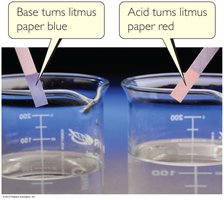
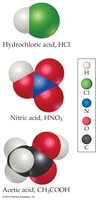
Acids are substances that ionize in aqueous solution to produce H+ ions (proton donors). Bases accept H+ ions and often produce OH− ions in water.
Acids can be classified as monoprotic (one ionizable hydrogen, e.g., HCl) or polyprotic (more than one, e.g., H2SO4).
Strong and Weak Acids and Bases
Strong acids and bases dissociate completely in water, while weak acids and bases only partially dissociate. There are only seven strong acids commonly encountered in general chemistry.
Neutralization Reactions
When an acid reacts with a base, a neutralization reaction occurs, producing a salt and water. For strong acids and bases, the net ionic equation is:
Gas-Forming Reactions
Gas Evolution in Metathesis Reactions
Some double displacement (metathesis) reactions produce a gas as a product. Common examples include reactions of carbonates, bicarbonates, sulfites, and ammonium compounds with acids.
Carbonate + acid:
Bicarbonate + acid:
Sulfite + acid:
Ammonium + hydroxide:
Oxidation-Reduction (Redox) Reactions
Oxidation and Reduction
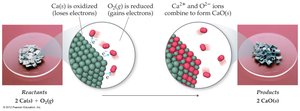
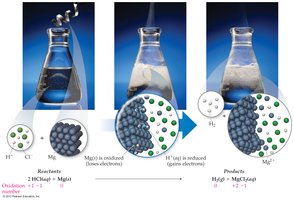
Oxidation is the loss of electrons, while reduction is the gain of electrons. These processes always occur together in a redox reaction.
Assigning Oxidation Numbers
Oxidation numbers help track electron transfer in redox reactions. Key rules include:
Elements in their elemental form: 0
Monatomic ions: equal to their charge
Oxygen: usually −2 (except in peroxides: −1)
Hydrogen: +1 (with nonmetals), −1 (with metals)
Fluorine: always −1
Sum in a neutral compound: 0; in a polyatomic ion: equals the ion's charge
Types of Redox Reactions
Combination: A + B → C
Decomposition: C → A + B
Displacement: An element replaces another in a compound (e.g., metal, hydrogen, or halogen displacement)
Concentration of Solutions
Molarity
Molarity (M) is a measure of solution concentration, defined as moles of solute per liter of solution:
Preparing Solutions
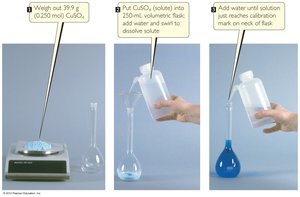
To prepare a solution of known molarity, a measured mass of solute is dissolved in a volumetric flask and diluted to the desired volume.
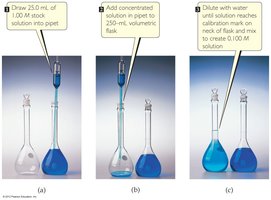
Dilution of Solutions
Solutions can be diluted using the equation:
where Mc and Vc are the molarity and volume of the concentrated solution, and Md and Vd are those of the diluted solution.
Titration
Principles of Titration
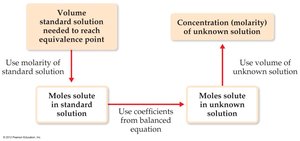
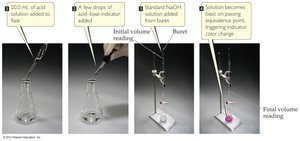
Titration is a technique used to determine the concentration of an unknown solution by reacting it with a solution of known concentration. The point at which the reaction is complete is called the equivalence point.
Additional info: These notes cover the essential concepts of reactions in aqueous solution, including solution types, electrolytes, precipitation, acid-base and redox reactions, and laboratory techniques such as dilution and titration. Mastery of these topics is foundational for further study in general chemistry.
