 Indietro
Chapter 4: Reactions in Aqueous Solution – General Chemistry Study Notes
Guida di studio - Note intelligenti
 Appunti personalizzati basati sui tuoi materiali, ampliati con definizioni chiave, esempi e contesto.
Chapter 4: Reactions in Aqueous Solution
Solutions and Their Components
Solutions are homogeneous mixtures composed of two or more pure substances. The substance present in the greatest amount is called the solvent, while all other substances are solutes. When water is the solvent, the solution is termed an aqueous solution.
Homogeneous mixture: Uniform composition throughout.
Solvent: The component in the largest quantity.
Solute: The component(s) present in lesser quantity.
Aqueous solution: A solution where water is the solvent.
Aqueous Solutions and Solvation
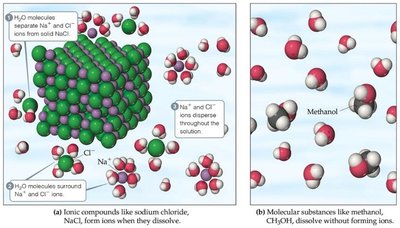
All substances dissolve by solvation, the process where solvent molecules surround solute particles. The manner in which substances dissolve in water depends on their nature:
Ionic compounds: Dissolve by dissociation, where water molecules surround and separate the ions.
Molecular compounds: Disperse in water, but most remain as intact molecules.
Some molecular substances: Form ions in water upon dissolving (e.g., acids).
Electrolytes and Nonelectrolytes
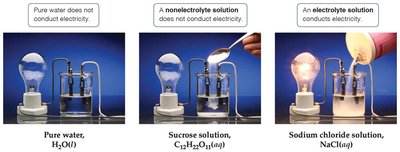
Substances that dissolve in water can be classified based on their ability to conduct electricity:
Strong electrolytes: Completely dissociate into ions; solutions conduct electricity well.
Weak electrolytes: Partially dissociate; solutions conduct electricity weakly.
Nonelectrolytes: Do not dissociate into ions; solutions do not conduct electricity.
Strong vs. Weak Electrolytes – Chemical Equilibrium
A strong electrolyte dissociates completely, represented by a single arrow in equations. A weak electrolyte only partially dissociates, and its equation uses a double arrow (⇌) to indicate equilibrium.
Example (strong):
Example (weak):
Electrolytes and Nonelectrolytes: Examples
Electrolyte: NaCl(s) forms and
Electrolyte: CH3CO2H(aq) forms and
Nonelectrolyte: Glucose (C6H12O6) and sucrose (C12H22O11) dissolve but do not form ions.
Precipitation Reactions
Formation of Precipitates
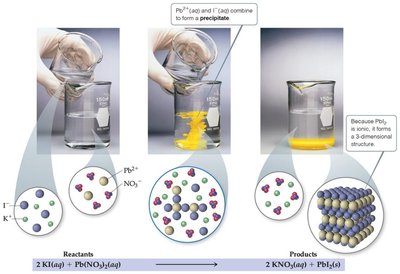
Precipitation reactions occur when two solutions containing soluble salts are mixed and an insoluble salt (precipitate) forms.
Precipitate: The solid product formed in the reaction.
Solubility Rules for Ionic Compounds
Not all ionic compounds dissolve in water. Solubility rules help predict which combinations of ions will form soluble or insoluble compounds.
Soluble Ionic Compounds | Important Exceptions |
|---|---|
NO3-, CH3COO- | None |
Cl-, Br-, I- | Ag+, Hg22+, Pb2+ |
SO42- | Sr2+, Ba2+, Hg22+, Pb2+ |
Insoluble Ionic Compounds | Important Exceptions |
|---|---|
S2-, OH- | NH4+, alkali metals, Ca2+, Sr2+, Ba2+ |
CO32-, PO43- | NH4+, alkali metals |
Predicting Precipitate Formation
To predict if a precipitate forms when strong electrolytes are mixed:
Identify the ions present in the reactants.
Consider all possible cation-anion combinations.
Use solubility rules to determine if any combination is insoluble.
Metathesis (Exchange) Reactions
Metathesis reactions involve the exchange of ions between two compounds:
General form:
Example:
Completing and Balancing Metathesis Equations
Steps:
Determine ions present in reactants.
Write formulas for products using cation from one reactant and anion from the other.
Check solubility rules for precipitate formation.
Balance the equation.
Net Ionic Equations
To derive the net ionic equation:
Write the molecular equation (balanced overall reaction).
Write the complete ionic equation (all strong electrolytes as ions).
Cancel out spectator ions (ions unchanged on both sides) to get the net ionic equation.
Example:
Acids, Bases, and Neutralization
Acids
Acids are substances that ionize in aqueous solution to form H+ ions (proton donors).
Bases
Bases are substances that react with or accept H+ ions, increasing the concentration of OH- ions in water. Not all bases contain OH- (e.g., NH3).
Strong and Weak Acids and Bases
Strong acids and bases dissociate completely in water, while weak acids and bases only partially dissociate.
Strong Acids | Strong Bases |
|---|---|
HCl, HBr, HI, HClO3, HClO4, HNO3, H2SO4 (first proton) | Group 1A hydroxides (LiOH, NaOH, etc.), heavy Group 2A hydroxides (Ca(OH)2, Sr(OH)2, Ba(OH)2) |
Electrolytic Behavior of Compounds
Strong Electrolyte | Weak Electrolyte | Nonelectrolyte | |
|---|---|---|---|
Ionic | All | None | None |
Molecular | Strong acids | Weak acids, weak bases | All other compounds |
Neutralization Reactions
Neutralization reactions occur when an acid reacts with a base, typically producing water and a salt. These can be represented as molecular, complete ionic, or net ionic equations.
Example (molecular):
Example (net ionic):
Neutralization with Gas Formation
Some neutralization reactions produce a gas, such as CO2 or H2S, instead of water.
Example:
Applications: Antacids
Antacids neutralize excess stomach acid. Common antacid ingredients include NaHCO3, Al(OH)3, Mg(OH)2, and CaCO3.
Oxidation–Reduction (Redox) Reactions
Oxidation and Reduction
Oxidation is the loss of electrons, while reduction is the gain of electrons. These processes always occur together in redox reactions.
Oxidation Numbers
Assigning oxidation numbers helps determine if redox reactions have occurred. The rules are as follows:
Atoms in elemental form: 0
Monatomic ions: equal to their charge
Nonmetals: usually negative, but can be positive in some compounds
Sum in a neutral compound: 0; in a polyatomic ion: equals the ion's charge
Displacement Reactions and Activity Series
In displacement reactions, ions oxidize an element, displacing another ion. The activity series ranks metals by their reactivity; elements above hydrogen react with acids to produce H2 gas.
Concentration and Molarity
Definition of Molarity
Molarity (M) is a measure of solution concentration, defined as moles of solute per liter of solution:
Preparing Solutions
To prepare a solution of known molarity, weigh the solute, add it to a volumetric flask, and add solvent up to the calibration mark.
Dilution of Solutions
Solutions can be diluted by adding solvent. The number of moles of solute remains constant:
and are the molarity and volume of the concentrated solution.
and are the molarity and volume after dilution.
Solution Stoichiometry and Chemical Analysis
Titration
Titration is an analytical technique to determine the concentration of a solute in solution. A standard solution of known concentration is added to react with the analyte until the reaction reaches the equivalence point, often indicated by a color change (end point).
