 Indietro
Chapter 5: Introduction to Solutions and Aqueous Reactions – General Chemistry Study Notes
Guida di studio - Note intelligenti
 Appunti personalizzati basati sui tuoi materiali, ampliati con definizioni chiave, esempi e contesto.
Solutions and Solution Concentration
Definition and Types of Solutions
Solutions are homogeneous mixtures composed of two or more substances. The substance present in the greatest amount is called the solvent, while the substance(s) present in lesser amounts are called solute(s). When water is the solvent, the solution is termed an aqueous solution.
Solvent: The major component of a solution.
Solute: The minor component(s) dissolved in the solvent.
Aqueous solution: A solution where water is the solvent.
Concentrated vs. Dilute Solutions
The concentration of a solution describes the relative amount of solute compared to solvent. A dilute solution contains a small amount of solute, while a concentrated solution contains a large amount of solute.
Dilute solution: Small amount of solute relative to solvent.
Concentrated solution: Large amount of solute relative to solvent.
M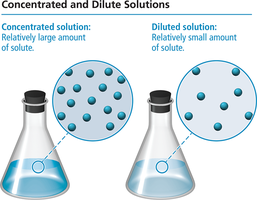
Quantifying Solution Concentration: Molarity
Molarity (M)
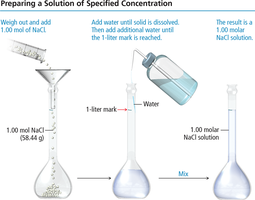
Molarity is a common unit for expressing solution concentration. It is defined as the number of moles of solute per liter of solution.
Formula:
Example: A 1.0 M NaCl solution contains 1.0 mole of NaCl in 1 liter of solution.
Calculations Involving Molarity
Molarity can be used as a conversion factor between moles of solute and volume of solution. This is useful for stoichiometric calculations in reactions involving solutions.
Conversion from volume to moles:
Conversion from moles to volume:


Solution Dilution
To prepare a solution of lower concentration from a stock solution, solvent is added to decrease the concentration without changing the amount of solute. The relationship is given by:
Formula: (moles of solute before and after dilution are equal)
Equation:
Solution Stoichiometry
Using Molarity in Stoichiometric Calculations
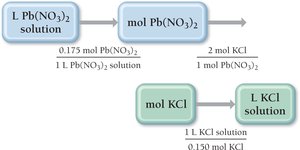
Molarity allows us to relate the volume of solution to the number of moles of solute, which is essential for stoichiometric calculations in reactions involving solutions.
Example: Calculating the volume of KCl solution needed to react with a given volume of Pb(NO3)2 solution.
Solubility and Dissolution
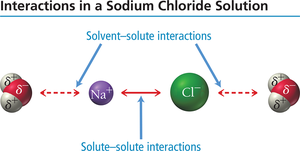
Solute-Solvent Interactions
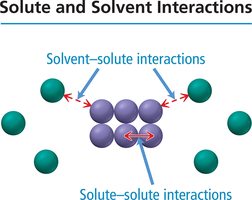
When a solute dissolves in a solvent, attractive forces between solute particles and solvent molecules play a crucial role. If these interactions are strong enough, the solute will dissolve.
Solute-solute interactions: Forces between solute particles.
Solvent-solvent interactions: Forces between solvent molecules.
Solute-solvent interactions: Forces between solute and solvent molecules.
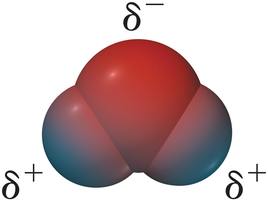
Charge Distribution in Water Molecule
Water is a polar molecule with an uneven distribution of charge. The oxygen atom has a partial negative charge (δ−), while the hydrogen atoms have partial positive charges (δ+).
Solute and Solvent Interactions in Sodium Chloride Solution
When NaCl dissolves in water, the Na+ and Cl− ions are attracted to water molecules, which compete with the attraction between the ions themselves.
Dissolution of Ionic Compounds
Each ion in an ionic compound is attracted to water molecules and becomes hydrated. The result is a solution with free-moving ions that can conduct electricity.
L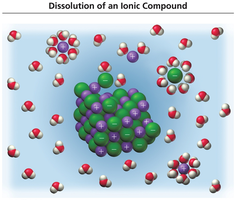
Electrolyte and Nonelectrolyte Solutions
Definitions
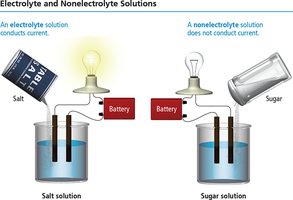
Electrolytes are substances that dissolve in water to form ions and conduct electricity. Nonelectrolytes dissolve without forming ions and do not conduct electricity.
Electrolyte: Conducts electricity due to presence of ions.
Nonelectrolyte: Does not conduct electricity; no ions present.
Strong and Weak Electrolytes
Strong electrolytes dissociate completely into ions, while weak electrolytes dissociate only partially. Nonelectrolytes do not dissociate into ions at all.
Strong Electrolyte | Weak Electrolyte | Nonelectrolyte | |
|---|---|---|---|
Ionic | All | None | None |
Molecular | Strong acids | Weak acids, weak bases | All other compounds |

Solubility of Salts and Solubility Rules
Solubility of Salts
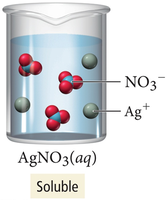
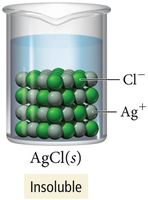
Not all substances dissolve in water. A substance is termed soluble if it dissolves to a large degree, and insoluble if it does not.
Solubility Rules
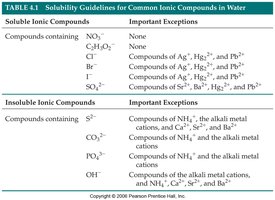
Solubility rules help predict whether an ionic compound will dissolve in water. These rules are based on the ions present in the compound.
Soluble Ionic Compounds | Important Exceptions |
|---|---|
Compounds containing NO3−, C2H3O2− | None |
Compounds containing Cl−, Br−, I− | Compounds of Ag+, Hg22+, and Pb2+ |
Compounds containing SO42− | Compounds of Sr2+, Ba2+, Hg22+, and Pb2+ |
Insoluble Ionic Compounds | Important Exceptions |
Compounds containing CO32−, PO43−, OH− | Compounds of NH4+, alkali metal cations, and Ba2+ (for OH−) |
Precipitation Reactions
Definition and Process
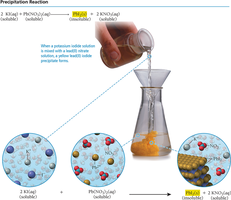
Precipitation reactions occur when two solutions are mixed and an insoluble product (precipitate) forms. The reaction is commonly observed with aqueous ionic solutions.
Precipitate: The insoluble product formed in the reaction.
Predicting and Writing Precipitation Reactions
To predict precipitation reactions:
Identify the ions in each reactant.
Determine possible products by exchanging ions.
Use solubility rules to determine if any product is insoluble.
Write the formulas of products, indicating (s) for solids and (aq) for aqueous.
Balance the equation.
Representing Aqueous Reactions
Molecular, Complete Ionic, and Net Ionic Equations
There are three ways to represent aqueous reactions:
Molecular equation: Shows complete neutral formulas for each compound.
Complete ionic equation: Shows all species as they are actually present in solution (strong electrolytes as ions).
Net ionic equation: Shows only the species that actually change during the reaction; spectator ions are omitted.
Acid–Base Reactions
Arrhenius Definitions
Acids are substances that produce H+ ions in aqueous solution. Bases produce OH− ions. Polyprotic acids contain more than one ionizable proton, releasing them sequentially.
Acid: Produces H+ in water.
Base: Produces OH− in water.
Polyprotic acid: Has more than one ionizable proton.
Strong vs. Weak Acids and Bases
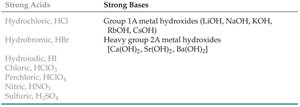
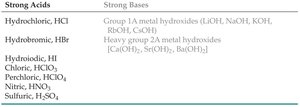
Strong acids and bases ionize completely in water, while weak acids and bases ionize only partially.
Strong Acids | Strong Bases |
|---|---|
Hydrochloric (HCl), Hydrobromic (HBr), Hydroiodic (HI), Chloric (HClO3), Perchloric (HClO4), Nitric (HNO3), Sulfuric (H2SO4) | Group 1A metal hydroxides (LiOH, NaOH, KOH, RbOH, CsOH), Heavy group 2A metal hydroxides (Ca(OH)2, Sr(OH)2, Ba(OH)2) |
Acids and Bases in Solution
Acids ionize in water to form H+ ions, which are often represented as hydronium ions (H3O+). Bases dissociate to form OH− ions. Some bases, like NH3, generate OH− by reacting with water.
Acid–Base Titrations
A titration is a laboratory technique where a solution of known concentration (titrant) reacts with a solution of unknown concentration (analyte). The equivalence point is when the reactants are in their stoichiometric ratio and completely reacted.
Gas-Evolution Reactions
Definition
Gas-evolution reactions produce a gaseous product, either directly from ion exchange or by decomposition of an intermediate.
Oxidation and Reduction (Redox Reactions)
Definitions
Oxidation is the loss of electrons, while reduction is the gain of electrons. Redox reactions involve the transfer of electrons between reactants.
Oxidation: Increase in oxidation state (loss of electrons).
Reduction: Decrease in oxidation state (gain of electrons).
Oxidation States
Oxidation states are assigned to atoms in compounds to track electron flow. They are imaginary charges based on a set of rules.
Free elements: Oxidation state = 0.
Monatomic ions: Oxidation state equals the ion charge.
Sum of oxidation states: In compounds, sum is 0; in polyatomic ions, sum equals the ion charge.
Group 1A metals: +1; Group 2A metals: +2.
Nonmetals: Follow priority rules (e.g., F: −1, O: −2, H: +1).
Identifying Redox Reactions
Redox reactions are identified by changes in oxidation states. The reactant causing reduction is the reducing agent, and the reactant causing oxidation is the oxidizing agent.
Reducing agent: Contains the element that is oxidized.
Oxidizing agent: Contains the element that is reduced.
Activity Series
The activity series ranks metals by their tendency to lose electrons (undergo oxidation). Metals at the top are most reactive and likely to be oxidized.
Summary
This chapter covers the fundamental concepts of solutions, concentration, solubility, precipitation, acid-base, gas-evolution, and redox reactions, providing essential knowledge for understanding aqueous chemistry and laboratory applications.
