 Indietro
Chapter 5: Thermochemistry – Study Notes for General Chemistry
Guida di studio - Note intelligenti
 Appunti personalizzati basati sui tuoi materiali, ampliati con definizioni chiave, esempi e contesto.
Thermochemistry
Introduction to Energy and Thermodynamics
Thermochemistry is a branch of thermodynamics that focuses on the energy changes, particularly heat, associated with chemical reactions. Energy is defined as the ability to do work or transfer heat.
Thermodynamics: The study of energy and its transformations.
Thermochemistry: The study of chemical reactions and the energy changes involving heat.
Joule (J): The SI unit of energy.

Chemical Energy and Electrostatic Potential Energy
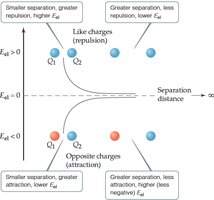
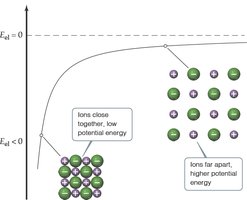
Chemical energy in molecules is mainly potential energy, especially electrostatic potential energy (), which arises from interactions between charged particles.
Electrostatic Potential Energy: Energy due to the attraction or repulsion between charged particles.
Energy is released when chemical bonds are formed; energy is consumed when bonds are broken.
First Law of Thermodynamics
Law of Conservation of Energy
The first law states that energy can be converted from one form to another, but it cannot be created or destroyed.
Examples: Chemical energy converted to heat (heating homes), sunlight converted to chemical energy (photosynthesis).
System and Surroundings
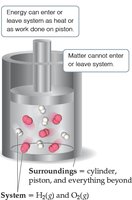
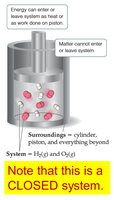
In thermochemistry, the system is the part of the universe under study, and the surroundings are everything else.
System: The reactants and products (e.g., hydrogen and oxygen molecules).
Surroundings: The container, piston, and everything beyond.
Types of Systems
Open System: Exchanges heat and mass with surroundings.
Closed System: Exchanges heat but not mass.
Isolated System: Exchanges neither heat nor mass.
Internal Energy
Definition and Change in Internal Energy
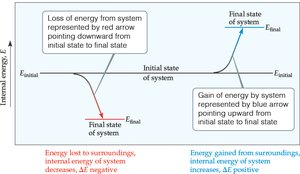
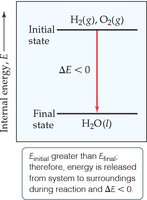
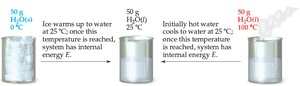
The internal energy () of a system is the sum of all kinetic and potential energies of its components. The change in internal energy () is the difference between the final and initial energies:
Energy Exchange: Heat and Work
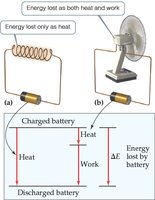
Energy is exchanged as either heat () or work ():
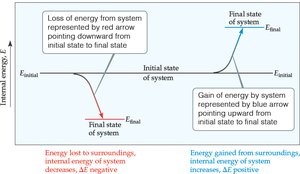
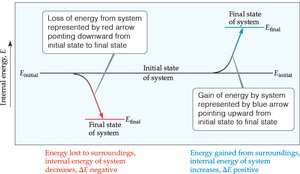
Sign conventions: Positive means system gains energy; negative means system loses energy.
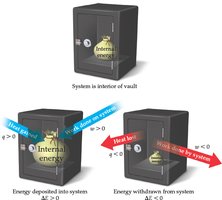
Thermodynamic Quantities
Thermodynamic quantities have three parts: a number, a unit, and a sign.
Positive sign: System gains energy.
Negative sign: System loses energy.
Heat Exchange: Endothermic and Exothermic Processes
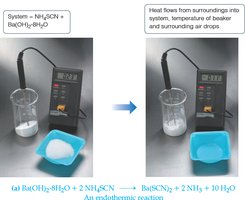
Endothermic Processes
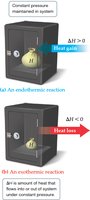
Heat is absorbed by the system from the surroundings.
Temperature of surroundings decreases.
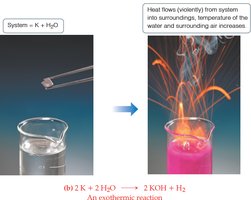
Exothermic Processes
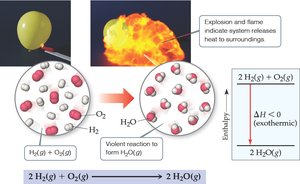
Heat is released by the system into the surroundings.
Temperature of surroundings increases.
State Functions
Definition and Examples
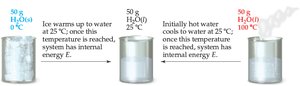
A state function is a property that depends only on the current state of the system, not on the path taken to reach that state.
Internal energy () is a state function.
Heat () and work () are not state functions.
Work
Pressure-Volume Work
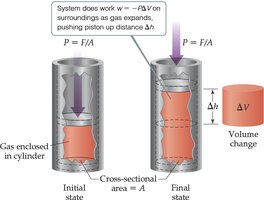
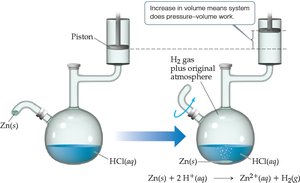
The most common work in chemistry is mechanical work due to volume changes in gases.
Work done by a gas:
Negative sign indicates work done by the system.
Enthalpy
Definition and Calculation
Enthalpy () is the sum of internal energy and the product of pressure and volume:
At constant pressure, (heat at constant pressure).
Endothermic and Exothermic Reactions
Endothermic: (heat absorbed)
Exothermic: (heat released)
Enthalpy of Reaction
Definition
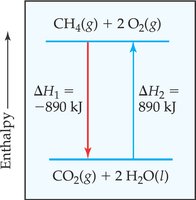
The enthalpy of reaction () is the difference between the enthalpy of products and reactants:
Properties of Enthalpy
Enthalpy is an extensive property (depends on amount).
Enthalpy change for reverse reaction is equal in magnitude, opposite in sign.
Depends on states of reactants and products.

Calorimetry
Measurement of Heat Flow
Calorimetry is used to measure heat flow in reactions. The instrument is called a calorimeter. 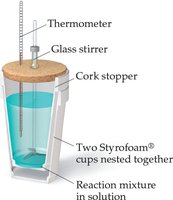
Heat Capacity and Specific Heat
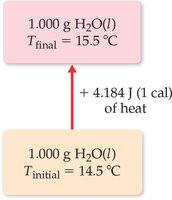
Heat capacity: Energy required to raise temperature by 1 K.
Specific heat: Energy required to raise 1 g of substance by 1 K.
Molar heat capacity: Energy required to raise 1 mole by 1 K.
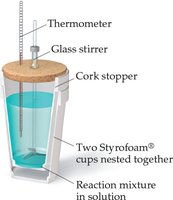
Constant Pressure Calorimetry
Used for reactions in aqueous solution.
Heat change for system found by measuring heat change for water.
Equation:
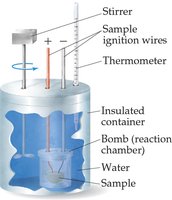
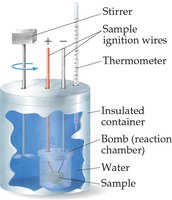
Bomb Calorimetry
Used for reactions at constant volume.
Measures change in internal energy ().
Hess’s Law
Calculation of Enthalpy Changes
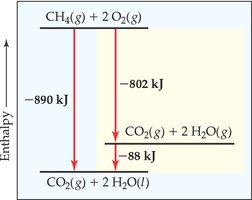
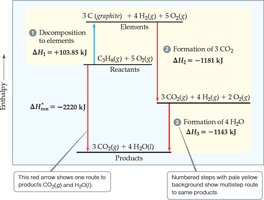
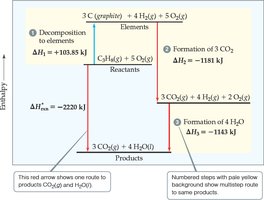
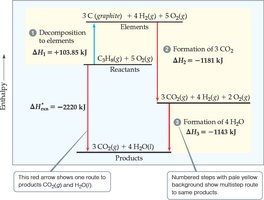
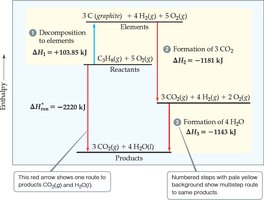
Hess’s Law states that if a reaction is carried out in a series of steps, the overall enthalpy change is the sum of the enthalpy changes for the individual steps.
Because enthalpy is a state function, is the same whether the reaction occurs in one step or several.
Enthalpies of Formation
Standard Enthalpies of Formation
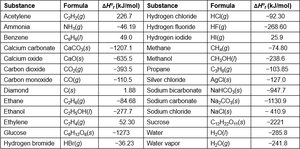
: Enthalpy change for formation of a compound from its elements.
: Measured under standard conditions (25°C, 1 atm).
Calculation of Reaction Enthalpy
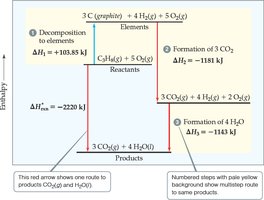
Use standard enthalpy values and Hess’s Law.
Bond Enthalpy
Definition and Application
Bond enthalpy: Energy required to break one mole of a bond in a gaseous substance.
Always positive (energy required).
Greater bond enthalpy means stronger bond.

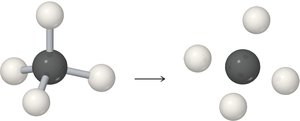
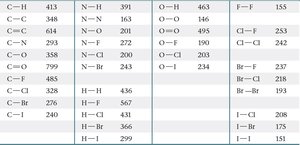
Bond Enthalpy and Enthalpy of Reaction
Add bond energies for bonds made (+).
Subtract bond energies for bonds broken (−).
Estimate for reaction.
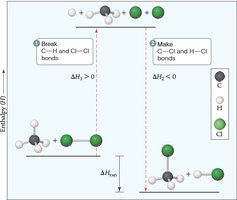
Energy in Foods and Fuels
Fuel Values of Foods
Energy released when 1 g of food is combusted is its fuel value.
Carbohydrates: 17 kJ/g; Fats: 38 kJ/g; Proteins: 17 kJ/g.
Energy in Fuels
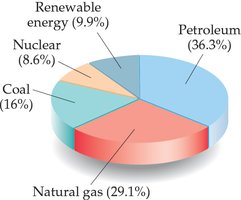
Most energy comes from fossil fuels: petroleum, natural gas, coal.
Other sources: nuclear, renewable energy (solar, wind, hydroelectric, biomass).
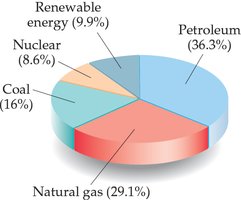

Summary Table: Standard Enthalpies of Formation
Substance | Formula | ΔHf° (kJ/mol) |
|---|---|---|
Acetylene | C2H2(g) | 226.7 |
Ammonia | NH3(g) | -46.1 |
Benzene | C6H6(l) | 49.0 |
Calcium carbonate | CaCO3(s) | -1207.1 |
Carbon dioxide | CO2(g) | -393.5 |
Water | H2O(l) | -285.8 |
Water vapor | H2O(g) | -241.8 |
Summary Table: Average Bond Enthalpies (kJ/mol)
Bond | Enthalpy (kJ/mol) |
|---|---|
C–H | 413 |
O–H | 463 |
H–H | 436 |
Cl–Cl | 242 |
