 Indietro
Chapter 6: Gases – Comprehensive Study Notes for General Chemistry
Guida di studio - Note intelligenti
 Appunti personalizzati basati sui tuoi materiali, ampliati con definizioni chiave, esempi e contesto.
Chapter 6: Gases
Introduction to Gases and Their Importance
Gases are a fundamental state of matter characterized by their ability to expand and fill any container. Understanding gas behavior is crucial in many scientific and practical contexts, such as scuba diving, atmospheric science, and industrial applications. The study of gases involves examining their properties, laws governing their behavior, and deviations from ideality.
Pressure: The Result of Molecular Collisions
Definition and Origin of Pressure
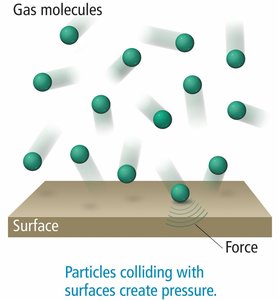
Pressure is defined as the force exerted per unit area by gas molecules as they collide with surfaces. The continuous motion and collisions of gas molecules create pressure within a container.
Pressure Formula:
Key Point: The greater the number of collisions or the force of collisions, the higher the pressure.
Example: Increasing the number of gas molecules in a container increases the frequency of collisions, thus increasing pressure.
Pressure and Density
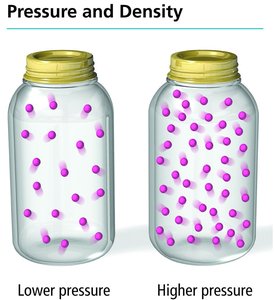
Pressure is closely related to the density of gas molecules. Higher density means more molecules per unit volume, resulting in more frequent collisions and higher pressure.
Lower Pressure: Fewer molecules, less frequent collisions.
Higher Pressure: More molecules, more frequent collisions.
Units and Measurement of Pressure
Common Units of Pressure
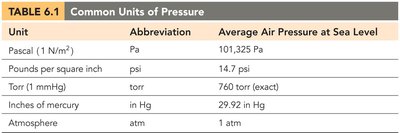
Pressure can be measured in several units, each with specific applications:
Pascal (Pa): SI unit, 1 Pa = 1 N/m2
Pounds per square inch (psi): Common in engineering
Torr (mmHg): Originates from mercury barometer measurements
Inches of mercury (in Hg): Used in meteorology
Atmosphere (atm): Average pressure at sea level
Unit | Abbreviation | Average Air Pressure at Sea Level |
|---|---|---|
Pascal (1 N/m2) | Pa | 101,325 Pa |
Pounds per square inch | psi | 14.7 psi |
Torr (1 mmHg) | torr | 760 torr (exact) |
Inches of mercury | in Hg | 29.92 in Hg |
Atmosphere | atm | 1 atm |
Measuring Pressure: Barometers and Manometers
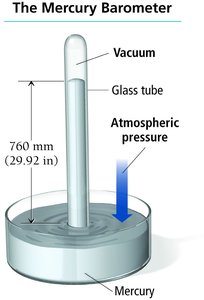
Pressure is measured using devices such as barometers and manometers:
Mercury Barometer: Measures atmospheric pressure by the height of mercury in a glass tube.
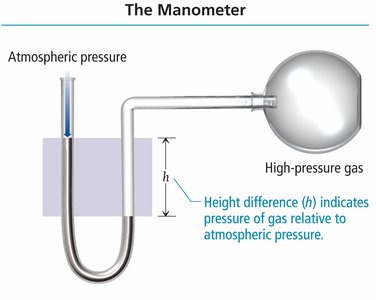
Manometer: Measures the pressure of enclosed gases by comparing the height difference in a U-shaped tube.
Variables Affecting Gas Pressure
Three Key Variables
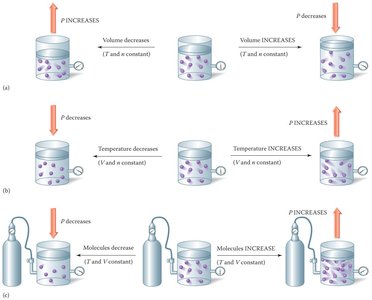
The pressure of a gas in a container is affected by:
Volume of the container (V): Decreasing volume increases pressure.
Temperature of the gas (T): Increasing temperature increases pressure.
Number of gas molecules (n): Increasing the number of molecules increases pressure.
The Gas Laws
Boyle's Law
Boyle's Law describes the relationship between pressure and volume at constant temperature and number of moles:
Formula:
Application: Compressing a balloon decreases its volume and increases its pressure.

Charles's Law
Charles's Law relates volume and temperature at constant pressure and number of moles. Temperature must be in Kelvin.
Formula:
Application: Heating a balloon causes it to expand.

Avogadro's Law
Avogadro's Law relates volume and number of moles at constant temperature and pressure.
Formula:
Application: Adding more gas to a balloon increases its volume.
Combined Gas Law
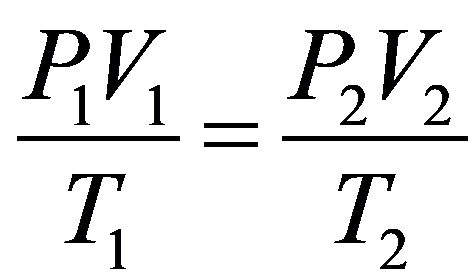
The combined gas law incorporates Boyle's, Charles's, and Avogadro's laws, relating pressure, volume, and temperature:
Formula:
The Ideal Gas Law
Definition and Formula
The ideal gas law relates pressure, volume, number of moles, and temperature for an ideal gas:
Formula:
R: Ideal gas constant, L·atm/(mol·K)
Application: Used to calculate unknown properties of gases under various conditions.
Applications: Molar Volume
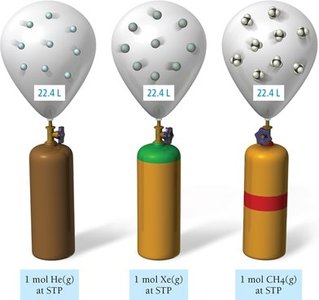
At standard temperature and pressure (STP: 0°C, 1 atm), one mole of an ideal gas occupies 22.4 L.
Applications: Density and Molar Mass
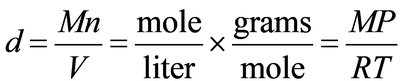
The ideal gas law can be rearranged to calculate the density and molar mass of gases:
Density Formula:
Molar Mass Calculation: Combine mass measurement with ideal gas law to determine molar mass.
Mixtures of Gases and Partial Pressures
Dalton's Law of Partial Pressures
In a mixture of ideal gases, each gas exerts its own partial pressure independently. The total pressure is the sum of all partial pressures:
Formula:
Mole Fraction:
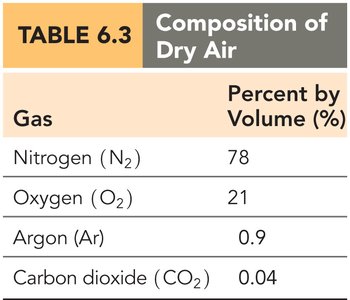
Gas | Percent by Volume (%) |
|---|---|
Nitrogen (N2) | 78 |
Oxygen (O2) | 21 |
Argon (Ar) | 0.9 |
Carbon dioxide (CO2) | 0.04 |
Collecting Gases Over Water
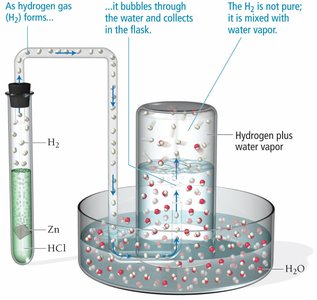
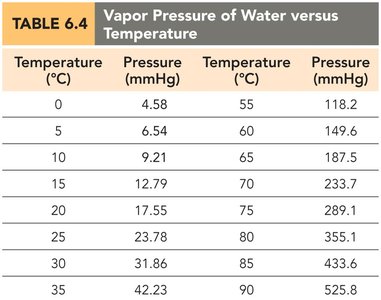
When gases are collected over water, the total pressure includes both the gas and water vapor. The partial pressure of water vapor depends on temperature.
Formula:
Temperature (°C) | Pressure (mmHg) |
|---|---|
0 | 4.58 |
10 | 9.21 |
20 | 17.55 |
25 | 23.78 |
30 | 31.86 |
35 | 42.23 |
Kinetic Molecular Theory
Postulates of Kinetic Molecular Theory
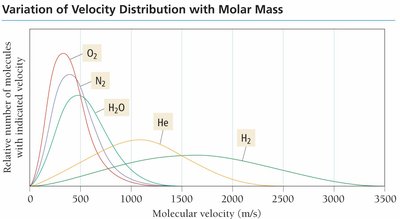
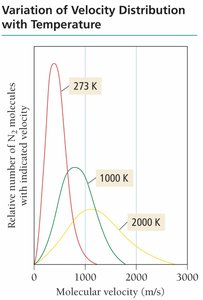
Kinetic molecular theory explains the behavior of gases based on molecular motion:
Particle size is negligibly small.
Average kinetic energy is proportional to temperature (in Kelvin).
Collisions are completely elastic.
Mean Free Path, Diffusion, and Effusion
Definitions and Differences
Gas molecules move randomly, and their behavior can be described by:
Mean Free Path: Average distance a molecule travels between collisions.
Diffusion: Spread of gas molecules in response to a concentration gradient.
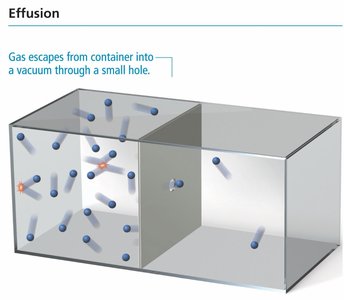
Effusion: Escape of gas molecules through a small hole into a vacuum.
Real Gases: Deviations from Ideal Behavior
Effect of Particle Volume and Intermolecular Forces
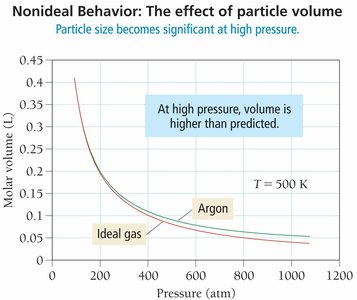
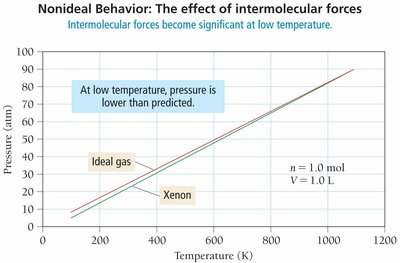
Real gases deviate from ideal behavior at high pressures and low temperatures due to:
Finite volume of gas particles: At high pressure, particle size becomes significant.
Intermolecular forces: At low temperature, attractive forces lower the pressure.
The Van Der Waals Equation
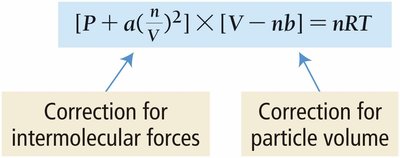
The van der Waals equation modifies the ideal gas law to account for real gas behavior:
Formula:
a: Correction for intermolecular forces
b: Correction for particle volume
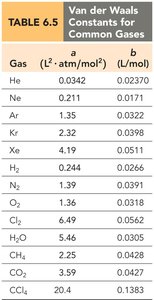
Gas | a (L2·atm/mol2) | b (L/mol) |
|---|---|---|
He | 0.0342 | 0.02370 |
Ne | 0.211 | 0.0171 |
Ar | 1.35 | 0.0322 |
Xe | 4.19 | 0.0511 |
H2 | 0.244 | 0.0266 |
N2 | 1.39 | 0.0318 |
O2 | 1.34 | 0.0318 |
CO2 | 3.59 | 0.0427 |
Real Gases Deviate from Ideal Gas Behavior
The combined effects of particle volume and intermolecular forces cause real gases to deviate from ideal gas predictions, especially at high pressures and low temperatures.
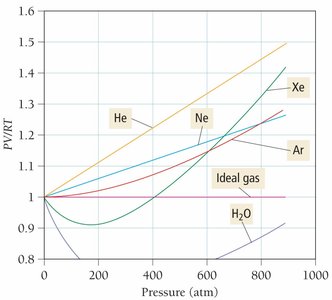
Summary Table: Key Gas Laws and Equations
Law | Equation | Variables Held Constant |
|---|---|---|
Boyle's Law | n, T | |
Charles's Law | n, P | |
Avogadro's Law | T, P | |
Combined Gas Law | n | |
Ideal Gas Law | None | |
Van der Waals Equation | None |
