 Indietro
Chapter 6: Gases – Properties, Laws, and Applications
Guida di studio - Note intelligenti
 Appunti personalizzati basati sui tuoi materiali, ampliati con definizioni chiave, esempi e contesto.
Gases: Basic Nature and Properties
Nature of Gases
Gases are composed of fast-moving particles (atoms or molecules) that are relatively far apart. These particles collide with each other and with surfaces, exerting forces that collectively result in pressure. The large number of collisions per unit area creates measurable pressure.
Pressure: Total force exerted per unit area by gas particles.
Compressibility: Gases are highly compressible due to the large spaces between particles.
Expansion: Gases expand to fill the volume of their container.
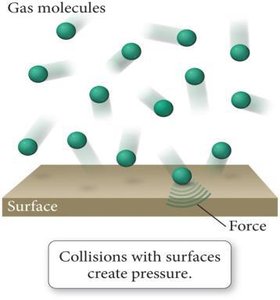
Example: Pressure is often measured in psi (pounds per square inch); 30 psi means 30 lbs of force per square inch.
Pressure and Altitude
Atmospheric pressure decreases with increasing altitude because the number of gas collisions decreases as temperature drops. This affects phenomena such as ear pain during altitude changes due to pressure imbalance.
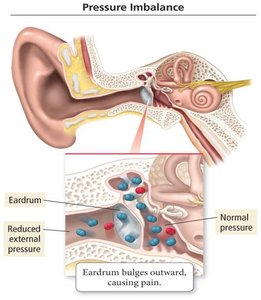
Units of Pressure
Pressure is commonly measured in atmospheres (atm), millimeters of mercury (mmHg), and torr. Standard atmospheric pressure is defined as 1.00 atm = 760 mmHg = 760 torr.
Measurement: Atmospheric pressure can be measured using a mercury barometer.
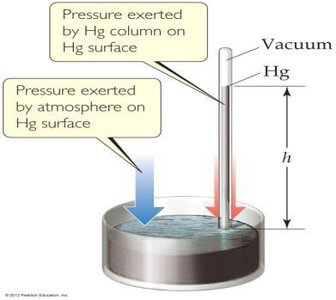
Compressibility of Gases
Gases are highly compressible because their particles are far apart. When pressure is applied, the volume decreases as the particles are forced closer together.
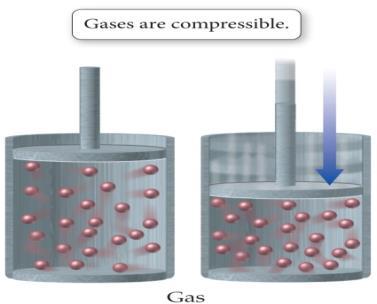
Empirical Gas Laws
Boyle’s Law
Boyle’s Law describes the relationship between pressure and volume for a fixed amount of gas at constant temperature. The two variables are inversely proportional:
Mathematical Form: or
Equation:
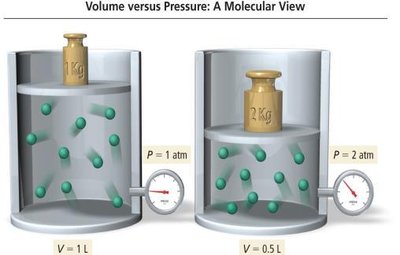
Example: If the volume of a gas is halved, its pressure doubles (assuming constant temperature).
Charles’s Law
Charles’s Law states that the volume of a gas at constant pressure is directly proportional to its absolute temperature (Kelvin).
Mathematical Form: or
Temperature Conversion:
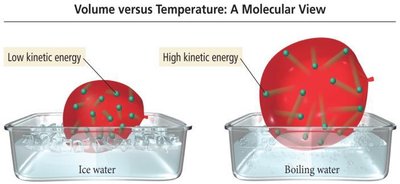
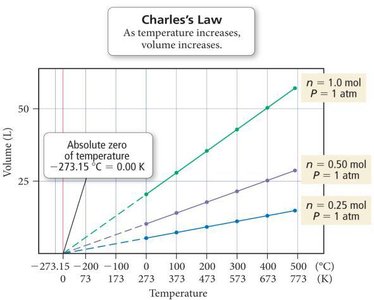
Example: If a gas is heated from 15°C to 38°C at constant pressure, its volume increases proportionally.
Avogadro’s Law
Avogadro’s Law states that the volume of a gas at constant temperature and pressure is directly proportional to the number of moles (n) of gas present.
Mathematical Form: or
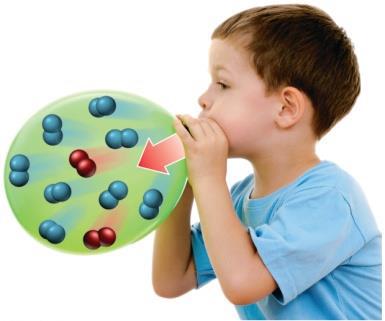
Example: Adding more gas molecules to a balloon increases its volume (at constant T and P).
The Ideal Gas Law
Derivation and Equation
The Ideal Gas Law combines Boyle’s, Charles’s, and Avogadro’s laws into a single equation:
Equation:
Gas Constant: (when P in atm, V in L, T in K)
Ideal Gas Assumptions:
Gas particles are extremely tiny and occupy negligible space.
Particles are in constant, rapid motion.
Forces of attraction between particles are negligible.
Molar Volume of an Ideal Gas
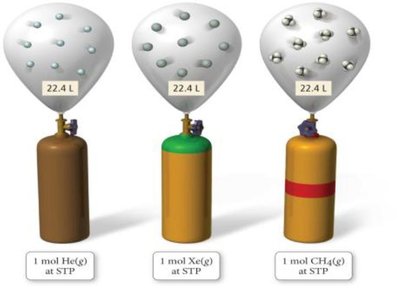
At standard temperature and pressure (STP: 0°C and 1 atm), 1 mole of an ideal gas occupies 22.4 L.
Calculation:
STP: , , ,
Molar Volume:
Molar Mass and Density of Gases
The ideal gas law can be used to calculate the molar mass of a gas from its measured density:
Density Equation:
Molar Mass Equation:
Example: Hot air rises because as air is heated, its volume increases, density decreases, and it becomes buoyant.

Gas Stoichiometry
Stoichiometric Calculations Using the Ideal Gas Law
Gas stoichiometry involves using the ideal gas law to relate volumes, masses, and moles of gases in chemical reactions. At STP, the molar volume simplifies calculations.
Example Reaction:
Volume of CO2 produced: Use molar volume at STP for conversion.
Mixtures of Gases and Partial Pressures
Dalton’s Law of Partial Pressures
In a mixture, each gas exerts its own pressure (partial pressure). The total pressure is the sum of the partial pressures:
Equation:
Partial Pressure:
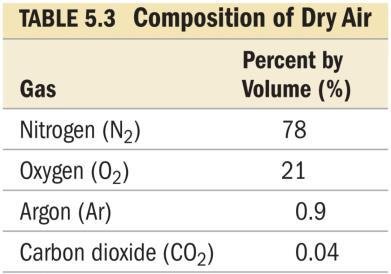
Example: Air is a mixture of nitrogen, oxygen, argon, and carbon dioxide.
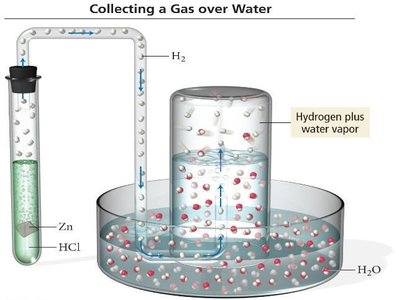
Collecting Gases Over Water
When gases are collected by displacement of water, the total pressure includes both the gas and water vapor. Dalton’s law is used to determine the pressure of the collected gas.
Equation:
Vapor Pressure: Depends on temperature.
Kinetic-Molecular Theory
Key Postulates
The kinetic-molecular theory explains the behavior of gases:
Gas particles are negligibly small.
Average kinetic energy is proportional to temperature.
Collisions are elastic (no energy loss).
Molecular Speed: The root-mean-square (rms) speed of molecules is calculated as:
Equation:
R: 8.314 J mol-1K-1
M: Molar mass in kg/mol
Effusion and Diffusion
Effusion is the escape of gas through a small hole into a vacuum, while diffusion is the spreading of gas throughout a space. Both are inversely related to molar mass.
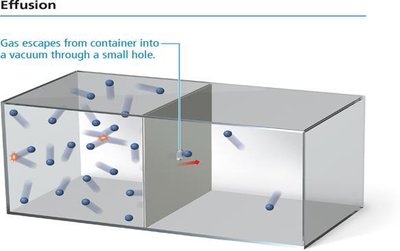
Example: Lighter gases effuse and diffuse faster than heavier gases.
Summary Table: Composition of Dry Air
Gas | Percent by Volume (%) |
|---|---|
Nitrogen (N2) | 78 |
Oxygen (O2) | 21 |
Argon (Ar) | 0.9 |
Carbon dioxide (CO2) | 0.04 |
