 Indietro
Chapter 6: Gases – Properties, Laws, and Applications
Guida di studio - Note intelligenti
 Appunti personalizzati basati sui tuoi materiali, ampliati con definizioni chiave, esempi e contesto.
Gases: Properties and Behavior
Gas Pressure: The Result of Molecular Collisions
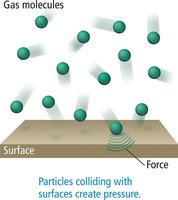
Pressure is the force exerted per unit area by gas molecules as they strike surfaces. Gas molecules are in constant motion, and their collisions with container walls create pressure. The magnitude of pressure depends on the frequency and force of these collisions.
Pressure Formula:
More frequent collisions or higher speed increases pressure.
Atmospheric Pressure Effects
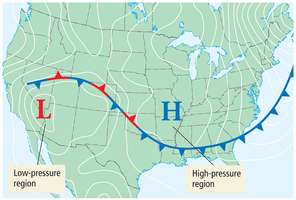
Atmospheric pressure varies with altitude and weather conditions. Regions of high pressure (H) are associated with clear weather, while low pressure (L) regions often bring unstable weather. As altitude increases, the number of gas particles per unit volume decreases, resulting in lower pressure.
Pressure decreases with increasing altitude.
Weather patterns are influenced by pressure differences.
Pressure and Particle Density
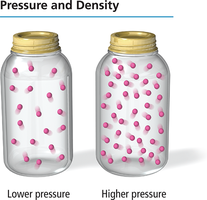
The pressure exerted by a gas is directly related to the density of gas particles in a given volume. Higher density means more collisions and higher pressure; lower density results in fewer collisions and lower pressure.
Increasing the number of gas particles increases pressure.
Increasing the volume (with constant number of particles) decreases pressure.
Gas Laws
Boyle’s Law: Pressure and Volume
Boyle’s Law describes the inverse relationship between the pressure and volume of a gas at constant temperature and amount:
Boyle’s Law Equation:
As pressure increases, volume decreases proportionally.
Graph of P vs. V is a curve; P vs. 1/V is a straight line.
Example: If a diver ascends rapidly, the pressure decreases and the volume of air in the lungs increases, potentially causing injury.
Charles’s Law: Volume and Temperature
Charles’s Law states that the volume of a gas is directly proportional to its temperature (in kelvins) at constant pressure and amount:
Charles’s Law Equation:
As temperature increases, volume increases.
Absolute zero (0 K) is the theoretical temperature where volume becomes zero.
Avogadro’s Law: Volume and Amount (Moles)
Avogadro’s Law states that the volume of a gas is directly proportional to the number of moles at constant pressure and temperature:
Avogadro’s Law Equation:
Equal volumes of gases contain equal numbers of molecules.
The Ideal Gas Law
Combining Gas Laws
The relationships described by Boyle’s, Charles’s, and Avogadro’s laws are combined into the Ideal Gas Law:
Ideal Gas Law Equation:
P = pressure (atm), V = volume (L), n = moles, R = gas constant (0.0821 L·atm/mol·K), T = temperature (K)
Allows calculation of any one variable if the other three are known.
Applications: Molar Volume, Density, and Molar Mass
At standard temperature and pressure (STP: 0°C, 1 atm), one mole of any ideal gas occupies 22.4 L. The density and molar mass of a gas can be determined using the ideal gas law and measured values.
Density Equation:
Molar Mass Equation:
Mixtures of Gases and Partial Pressures
Dalton’s Law of Partial Pressures
In a mixture, each gas exerts its own partial pressure. The total pressure is the sum of all partial pressures:
Dalton’s Law:
Mole fraction relates partial pressure to total pressure.
Kinetic Molecular Theory
Basic Postulates
The kinetic molecular theory models gases as particles in constant motion:
Gas molecules are negligibly small compared to the container.
Average kinetic energy is proportional to temperature.
Collisions are elastic; no energy is lost.
Explaining Gas Laws
Kinetic molecular theory provides molecular explanations for Boyle’s, Charles’s, Avogadro’s, and Dalton’s laws.
Diffusion, Effusion, and Real Gases
Diffusion and Effusion
Diffusion is the spread of gas molecules from high to low concentration. Effusion is the escape of gas molecules through a small hole. Graham’s Law relates the rates of effusion to molar mass:
Graham’s Law:
Real Gases and Deviations from Ideal Behavior
At high pressure or low temperature, real gases deviate from ideal behavior due to intermolecular attractions and finite molecular volume. The van der Waals equation modifies the ideal gas law to account for these effects:
van der Waals Equation:
a and b are constants specific to each gas.
Example: At high pressure, the molar volume of a real gas is larger than predicted by the ideal gas law.
