 Indietro
Chapter 6: Gases – Properties, Laws, and Applications
Guida di studio - Note intelligenti
 Appunti personalizzati basati sui tuoi materiali, ampliati con definizioni chiave, esempi e contesto.
Gases: Properties and Basic Concepts
Properties of Gases
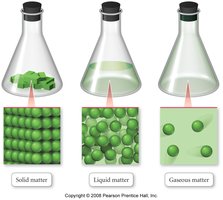
Gases are one of the fundamental states of matter, characterized by their ability to expand and fill any container, high compressibility, and the formation of homogeneous mixtures with other gases. The individual molecules in a gas are relatively far apart compared to solids and liquids, which accounts for these unique properties.
Shape and Volume: Gases take both the shape and volume of their container.
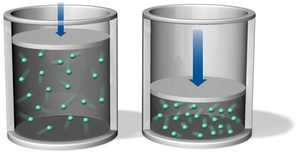
Compressibility: Gases are highly compressible due to the large distances between molecules.
Homogeneity: Gases mix evenly and completely when combined.
Pressure and Its Origin
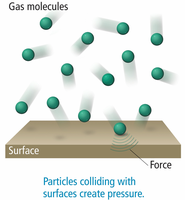
Pressure is defined as the force exerted per unit area. In gases, pressure results from the constant movement of molecules and their collisions with the surfaces around them. Atmospheric pressure is the downward force exerted by the atmosphere due to gravity.
Formula: , where P is pressure, F is force, and A is area.
Atmospheric Pressure: At sea level and 0°C, mmHg.
Pressure and Density
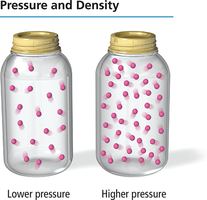
The pressure of a gas depends on the number of gas particles in a given volume, the volume of the container, and the average speed of the gas particles. Higher density (more particles per volume) leads to higher pressure.
Measuring Gas Pressure
Barometer
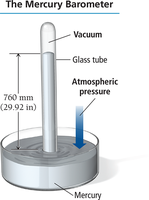
A barometer is a device used to measure atmospheric pressure. The classic mercury barometer consists of a glass tube filled with mercury, inverted in a mercury reservoir. The height of the mercury column is proportional to atmospheric pressure.
Manometer
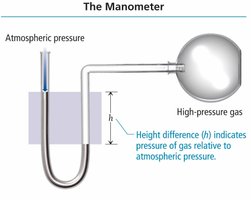
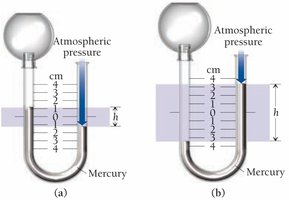
A manometer is used to measure the pressure of a gas in a container relative to atmospheric pressure. An open-end manometer compares the pressure of a gas to atmospheric pressure by measuring the height difference (h) of mercury or another liquid.
Equation: (if gas pressure is greater than atmospheric pressure)
Common Units of Pressure
1 atm = 760 mmHg = 101,325 Pa = 14.70 psi
1 torr = 1 mmHg
1 Pa = 1 N/m2
Gas Laws: Relationships Between Variables
Boyle’s Law: Pressure-Volume Relationship
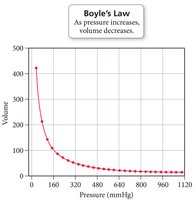
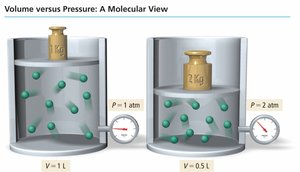
Boyle’s Law states that the pressure of a gas is inversely proportional to its volume at constant temperature and amount of gas.
Equation:
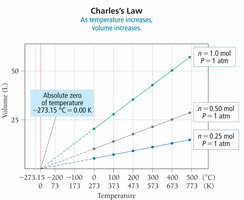
Charles’s Law: Temperature-Volume Relationship
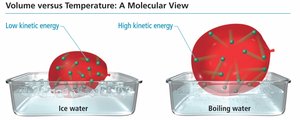
Charles’s Law states that the volume of a gas is directly proportional to its temperature (in Kelvin) at constant pressure and amount of gas.
Equation:
Avogadro’s Law: Mole-Volume Relationship
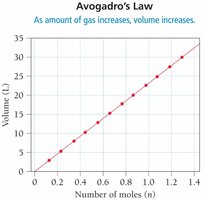
Avogadro’s Law states that the volume of a gas is directly proportional to the number of moles of gas at constant temperature and pressure.
Equation:
Ideal Gas Law
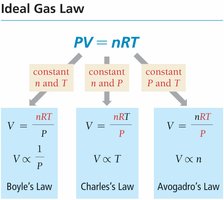
The Ideal Gas Law combines Boyle’s, Charles’s, and Avogadro’s Laws into a single equation that relates pressure, volume, temperature, and amount of gas.
Equation:
R (Gas Constant): L·atm/(mol·K)
Standard Conditions and Molar Volume
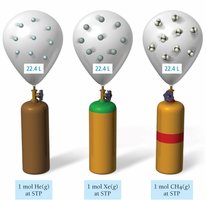
Standard Temperature and Pressure (STP) are defined as 0°C (273.15 K) and 1 atm. At STP, one mole of any ideal gas occupies 22.4 L, known as the molar volume.
Equation: L/mol at STP
Mixtures of Gases and Partial Pressures
Mixtures of Gases
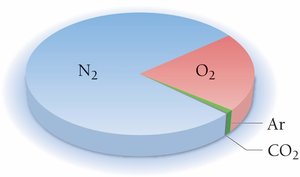
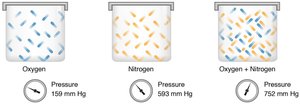
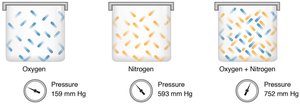
When gases are mixed, each gas behaves independently, and the total pressure is the sum of the partial pressures of each component.
Dalton’s Law of Partial Pressures
Dalton’s Law states that the total pressure of a mixture of unreacting gases is equal to the sum of the partial pressures of the individual gases.
Equation:
Mole Fractions
The mole fraction of a component in a mixture is the ratio of the number of moles of that component to the total number of moles in the mixture. It is useful for relating partial pressures to total pressure.
Equation:
Relationship:
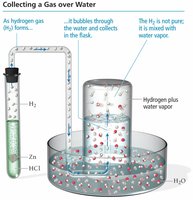
Collecting Gases Over Water
When collecting gases over water, the vapor pressure of water must be considered. The total pressure is the sum of the gas pressure and the vapor pressure of water.
Equation:
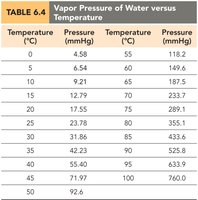
Vapor Pressure of Water vs Temperature
The vapor pressure of water increases with temperature. This relationship is important when calculating the pressure of a gas collected over water.
Temperature (°C) | Pressure (mmHg) |
|---|---|
0 | 4.58 |
10 | 9.21 |
20 | 17.55 |
30 | 31.82 |
40 | 55.30 |
50 | 92.6 |
100 | 760.0 |
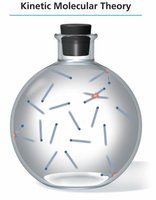
Kinetic Molecular Theory
Basic Assumptions
The kinetic molecular theory explains the behavior of gases based on the motion of their particles:
Gas particles have negligible volume compared to the container.
Gas particles are in constant, random, straight-line motion.
Collisions between particles are elastic (no energy lost).
No attractive or repulsive forces between particles.
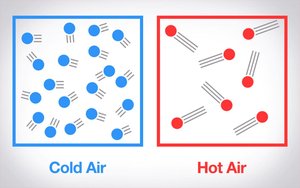
Particle Speed, Temperature, and Energy
At a given temperature, all gases have the same average kinetic energy. Increasing temperature increases the average kinetic energy of the molecules.
Equation for average kinetic energy:
Diffusion, Effusion, and Graham’s Law
Effusion and Diffusion
Effusion is the process by which a gas escapes through a small hole into a vacuum. Diffusion is the movement of one gas through another or through space. Lighter gases effuse and diffuse faster than heavier gases at the same temperature and pressure.
Graham’s Law of Effusion:
Real Gases and Deviations from Ideal Behavior
Ideal vs. Real Gases
Ideal gases assume no interactions between molecules and negligible molecular volume. Real gases deviate from this behavior, especially at high pressures and low temperatures, due to intermolecular forces and finite molecular volume.
van der Waals Equation
The van der Waals equation introduces corrections for the volume of gas molecules and intermolecular attractions:
Equation:
a corrects for intermolecular attractions; b corrects for molecular volume.
Summary Table: Key Gas Laws
Law | Relationship | Equation | Variables Held Constant |
|---|---|---|---|
Boyle’s Law | P ∝ 1/V | n, T | |
Charles’s Law | V ∝ T | n, P | |
Avogadro’s Law | V ∝ n | P, T | |
Ideal Gas Law | PV = nRT | — |
Additional info: This guide includes all major concepts, equations, and applications relevant to the study of gases in a General Chemistry course, including real gas behavior and laboratory techniques for measuring and collecting gases.
