 Indietro
Chapter 6: Gases – Properties, Laws, and Kinetic Molecular Theory
Guida di studio - Note intelligenti
 Appunti personalizzati basati sui tuoi materiali, ampliati con definizioni chiave, esempi e contesto.
Gases: Properties and Characteristics
General Properties of Gases
Gases are a fundamental state of matter characterized by their ability to expand and fill any container, high compressibility, and low density. Most gases are composed of nonmetallic elements or molecular compounds, but substances that are liquids or solids under ordinary conditions can also exist as vapors.
Expansion: Gases expand to fill their containers completely.
Compressibility: Gases are highly compressible due to the large distances between particles.
Low Density: The density of gases is much lower than that of liquids or solids.
Homogeneous Mixtures: Gases always form homogeneous mixtures with other gases.
The Gas Laws
Variables Defining a Gas
Four variables are essential to describe the physical state of a gas:
Pressure (P)
Volume (V)
Temperature (T)
Amount (n, in moles)
The relationships among these variables are described by the gas laws.
Gas Pressure
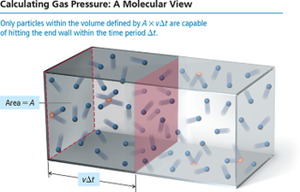
Pressure is defined as the force exerted per unit area by gas molecules as they collide with surfaces. The pressure of a gas depends on the number of particles, the volume of the container, and the average speed of the particles.
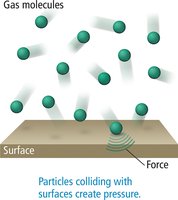
Measuring Gas Pressure: Barometers and Manometers
Gas pressure can be measured using specialized instruments:
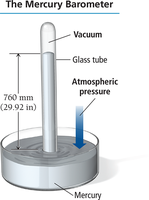
Barometer: Measures atmospheric pressure using a column of mercury.
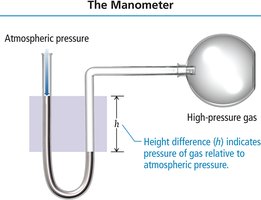
Manometer: Measures the pressure of a gas sample in a container relative to atmospheric pressure.
The Simple Gas Laws
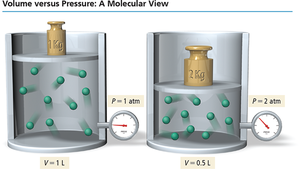
Boyle’s Law: Pressure and Volume
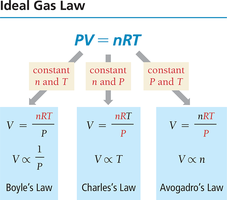
Boyle’s Law states that the volume of a fixed amount of gas at constant temperature is inversely proportional to its pressure.
Mathematical Expression: (at constant T and n)
Equation:
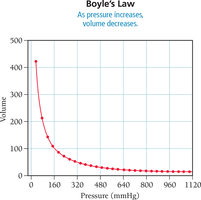
As volume decreases, pressure increases due to more frequent molecular collisions with container walls.
Charles’s Law: Volume and Temperature
Charles’s Law states that the volume of a fixed amount of gas at constant pressure is directly proportional to its absolute temperature (in Kelvin).
Mathematical Expression: (at constant P and n)
Equation:
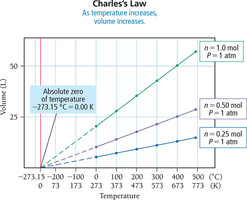
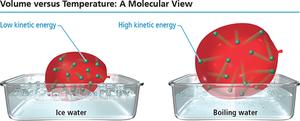
As temperature increases, gas particles move faster, causing more frequent and forceful collisions, which increases volume if pressure is constant.
Avogadro’s Law: Volume and Amount (Moles)
Avogadro’s Law states that the volume of a gas at constant temperature and pressure is directly proportional to the number of moles of gas present.
Mathematical Expression: (at constant P and T)
Equation:
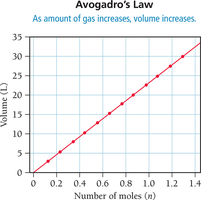
Equal volumes of all ideal gases contain equal numbers of molecules under the same conditions of temperature and pressure.
The Ideal Gas Law
The ideal gas law combines Boyle’s, Charles’s, and Avogadro’s laws into a single equation that relates all four variables:
Equation:
R (Gas Constant): (when P in atm, V in L, T in K)
Standard Temperature and Pressure (STP) and Molar Volume
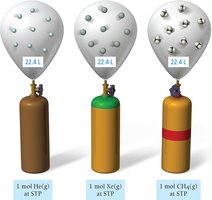
Standard conditions are defined as a temperature of 273 K (0°C) and a pressure of 1 atm. At STP, one mole of any ideal gas occupies a volume of 22.4 L, known as the molar volume.
Density of a Gas
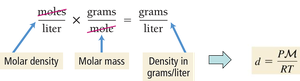
The density of a gas can be calculated using the ideal gas law. At STP, density is the ratio of molar mass to molar volume. For other conditions, the formula is:
Equation:
Where P is pressure, M is molar mass, R is the gas constant, and T is temperature in Kelvin.
Mixtures of Gases and Partial Pressures
Dalton’s Law of Partial Pressures
In a mixture of ideal gases, each gas exerts a pressure independently of the others. The total pressure is the sum of the partial pressures of each component:
Equation:
The partial pressure of each gas can be calculated using the ideal gas law for that component.
Mole Fraction
The mole fraction of a component in a gas mixture is the ratio of the number of moles of that component to the total number of moles. The partial pressure of a gas is equal to its mole fraction times the total pressure:
Equation:
Where
Collecting Gases Over Water
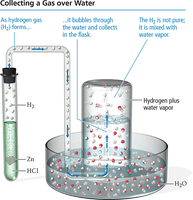
When collecting gases by water displacement, the collected gas is a mixture of the desired gas and water vapor. The partial pressure of water vapor (vapor pressure) depends only on temperature and must be subtracted from the total pressure to find the pressure of the dry gas.
Stoichiometry Involving Gases
Gas Stoichiometry at STP
For reactions involving gases at STP, use the molar volume (22.4 L/mol) to relate moles and volume. For other conditions, use the ideal gas law to convert between volume and moles.


Kinetic Molecular Theory (KMT) of Gases
Postulates of KMT
The kinetic molecular theory provides a molecular-level explanation for the behavior of gases:
The size of gas molecules is negligibly small compared to the distances between them.
The average kinetic energy of gas particles is proportional to the temperature in kelvins.
Collisions between particles (and with container walls) are perfectly elastic—no energy is lost.
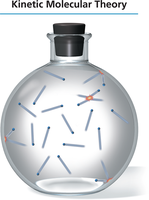
Explaining Gas Laws with KMT
KMT explains why pressure increases with temperature (particles move faster and hit walls more often and harder) and why pressure increases as volume decreases (particles hit walls more frequently).
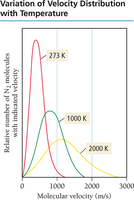
Temperature and Molecular Speed
The root mean square speed () of gas molecules is related to temperature and molar mass:
Equation:
Where R is 8.314 J·mol−1·K−1, T is temperature in K, and M is molar mass in kg/mol.
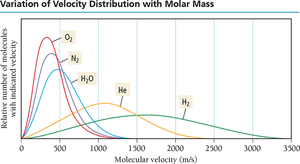
Mean Free Path, Diffusion, and Effusion
The mean free path is the average distance a molecule travels between collisions. Diffusion is the mixing of gases, while effusion is the escape of gas through a small hole. Graham’s Law describes the rates of effusion:
Equation:
Real Gases and Deviations from Ideal Behavior
Limitations of the Ideal Gas Law
The ideal gas law assumes no intermolecular attractions and that gas molecules have no volume. Real gases deviate from ideal behavior at high pressures and low temperatures due to these factors.
Van der Waals Equation
The van der Waals equation introduces two constants, a and b, to account for intermolecular attractions and the finite volume of gas molecules:
Equation:
a: Corrects for intermolecular attractions (larger for stronger attractions)
b: Corrects for the finite volume of molecules (larger for larger molecules)
For ideal gases, both a and b are zero.
