Indietro
Chapter 8: The Quantum-Mechanical Model of the Atom – Study Notes
Guida di studio - Note intelligenti
 Appunti personalizzati basati sui tuoi materiali, ampliati con definizioni chiave, esempi e contesto.
Chapter 8: The Quantum-Mechanical Model of the Atom
Introduction to Quantum Mechanics in Chemistry
The quantum-mechanical model of the atom revolutionized our understanding of atomic structure and behavior. It explains the arrangement of electrons in atoms, the periodic table, and the chemical properties of elements. Quantum mechanics is foundational for modern chemistry, physics, and technology.
Electromagnetic Radiation and Atomic Spectra
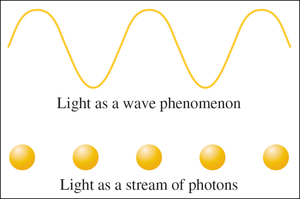
Electromagnetic Radiation: Dual Nature of Light
Light is a form of electromagnetic radiation that travels at a constant speed of m/s. It exhibits both wave-like and particle-like properties, a concept known as wave-particle duality.
Wave Properties: Light can be described by its wavelength () and frequency ().
Particle Properties: Light consists of discrete packets of energy called photons.
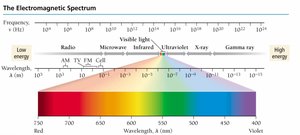
Electromagnetic Spectrum
The electromagnetic spectrum encompasses all types of electromagnetic radiation, from radio waves to gamma rays. Visible light is only a small portion of this spectrum, with wavelengths ranging from approximately 400 nm (violet) to 750 nm (red).
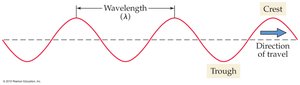
Wavelength and Frequency
Wavelength (): The distance between adjacent wave crests. Frequency (): The number of wave cycles passing a point per second. Wavelength and frequency are inversely related:
Shorter wavelength → higher frequency
Longer wavelength → lower frequency
Energy of Photons
Albert Einstein proposed that light energy is quantized in photons. The energy of a photon is directly proportional to its frequency and inversely proportional to its wavelength:
Where is Planck's constant ( J·s), is the speed of light.
Atomic Spectroscopy and Flame Tests
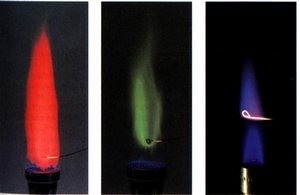
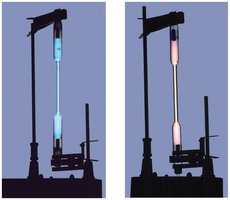
Atoms absorb energy and emit light at specific wavelengths, producing characteristic emission spectra. Flame tests are used to identify elements based on the color of light emitted when their ions are excited.
Each element emits a unique color due to its specific energy transitions.
Emission Spectra
When excited, gas atoms emit light at discrete wavelengths. The emission spectrum of each element is unique and can be used for identification.
The Bohr Model of the Atom
Bohr's Postulates
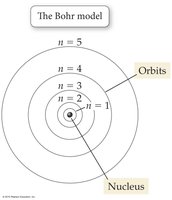
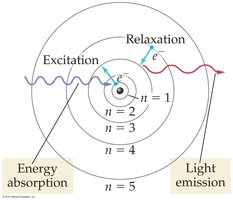
Niels Bohr proposed that electrons in a hydrogen atom move in specific, quantized orbits around the nucleus. The energy of these orbits is fixed, and electrons can transition between them by absorbing or emitting photons.
Electrons exist in quantized orbits at specific energies and distances.
Energy absorption excites electrons to higher orbits.
Energy emission occurs when electrons fall to lower orbits.
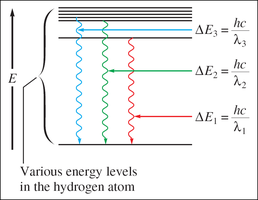
The energy of emitted light corresponds to the difference between orbit energies.
Energy Levels and Transitions
The energy difference between orbits determines the wavelength of emitted or absorbed light:
Quantum Mechanics and Electron Behavior
Wave-Particle Duality of Electrons
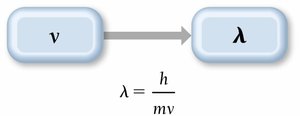
Louis de Broglie proposed that particles, including electrons, exhibit wavelike properties. The wavelength of a particle is inversely proportional to its momentum:
Heisenberg's Uncertainty Principle
Werner Heisenberg stated that it is impossible to simultaneously know both the position and velocity of a particle with absolute certainty. The product of the uncertainties in position () and velocity () is inversely proportional to the mass ():
This principle is fundamental to quantum mechanics and explains why electron behavior cannot be precisely predicted.
Schrödinger's Equation and Orbitals
Erwin Schrödinger developed a mathematical equation to describe the probability of finding an electron at a particular location in the atom. The solutions to this equation are called wave functions, which define orbitals—regions where electrons are likely to be found.
Orbitals are probability distribution maps, not fixed paths.
Quantum Numbers and Atomic Structure
Principal Quantum Number ()
The principal quantum number () defines the energy level and size of the orbital. Higher values correspond to higher energy and larger orbitals.
can be any integer
As increases, the energy difference between levels decreases.
Angular Momentum Quantum Number ()
The angular momentum quantum number () determines the shape of the orbital:
(s orbital): spherical
(p orbital): dumbbell-shaped
(d orbital): more complex shapes
(f orbital): even more complex shapes
Magnetic Quantum Number ()
The magnetic quantum number () specifies the orientation of the orbital in space. It ranges from to .
Summary Table: Quantum Numbers
Quantum Number | Symbol | Meaning |
|---|---|---|
Principal | n | Energy level, size of orbital |
Angular Momentum | l | Shape of orbital |
Magnetic | ml | Orientation of orbital |
Applications and Importance
Quantum Mechanics in Chemistry
Quantum mechanics explains the periodic table, chemical bonding, and the properties of elements. It is essential for understanding lasers, semiconductors, and many modern technologies.
Learning Objectives
Analyze particles (photons and electrons)
Describe orbitals using quantum numbers
Calculate energy changes and wavelengths associated with electron transitions in hydrogen
Relevant Images