 Indietro
CHEM 1120 General Chemistry – Syllabus, Safety, and Course Structure Study Guide
Guida di studio - Note intelligenti
 Appunti personalizzati basati sui tuoi materiali, ampliati con definizioni chiave, esempi e contesto.
Course Overview
This course provides a comprehensive introduction to the foundational concepts of general chemistry, focusing on the structure of atoms and molecules, chemical bonding, reactivity, stoichiometry, and chemical equilibrium. The curriculum is designed to build a strong conceptual framework for understanding chemical phenomena and laboratory practices.
Course Structure and Weekly Topics
Mathematical Tool Box: Covers essential mathematical skills for chemistry, including dimensional analysis and significant figures.
Atomic Structure and Light: Introduces atomic theory, the nature of light, and their interrelationship.
Light Absorption and Emission: Explores how atoms interact with light, including absorption spectra and emission processes.
Electron Configuration and Periodic Trends: Examines electron arrangements and trends in the periodic table.
Ionic and Covalent Bonding: Discusses the formation and properties of ionic and covalent compounds, including crystal structures.
Intermolecular Forces: Analyzes the forces between molecules and their effects on physical properties.
Chemical Reactions and Stoichiometry: Focuses on reaction types, balancing equations, and quantitative relationships in reactions.
Acids, Bases, and Equilibrium: Covers acid-base theory, titrations, and the concept of chemical equilibrium.
Laboratory Safety and Personal Protective Equipment (PPE)
Laboratory Safety Requirements
Because the classroom is also a laboratory environment, strict safety protocols must be followed to ensure the well-being of all participants. Proper attire and equipment are mandatory during all laboratory activities.
No food or drink is allowed in the laboratory.
Closed-toe shoes must be worn at all times. The front of the foot must be completely covered.
Appropriate goggles must be worn during all lab activities and whenever chemicals or glassware are in use. Goggles must be impact-rated and provide splash protection.
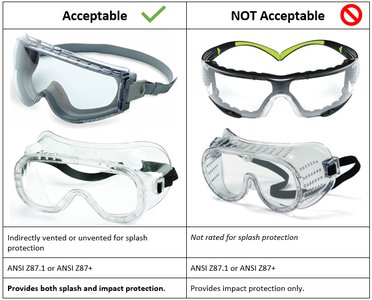
Acceptable goggles are indirectly vented or unvented for splash protection and meet ANSI Z87.1 or ANSI Z87+ standards. Not acceptable goggles may provide impact protection but lack splash protection, which is essential in a chemistry laboratory.
Course Learning Outcomes
Unit 1: Atoms
Use dimensional analysis to relate quantities and perform unit conversions.
Identify isotopes and determine the number of protons, neutrons, and electrons.
Calculate molar masses and convert between grams, moles, and number of particles.
Describe electromagnetic radiation in terms of wavelength, frequency, energy, and color.
Explain the relationship between absorbance, concentration, and molar absorptivity using Beer's Law:
Use the Rydberg equation to calculate energies of absorption and emission:
Relate photon energy to wavelength or frequency:
Predict periodic trends such as ionization energy, electron affinity, and atomic/ionic radius.
Unit 2: Molecules
Translate between names and empirical formulas for ionic compounds.
Identify trends in lattice energy and common crystal structures (SC, FCC, BCC).
Build molecular models and draw Lewis structures, including isomers and resonance forms.
Assign formal charges and identify functional groups in organic molecules.
Predict molecular geometry using VSEPR theory and distinguish between polar and nonpolar molecules.
Explain the relative strengths of intermolecular forces and their effects on boiling points.
Unit 3: Reactions
Identify evidence of chemical reactions and predict products.
Classify reactions (precipitation, acid-base, redox) and balance equations.
Apply stoichiometry to determine limiting reactants, yields, and concentrations.
Determine empirical and molecular formulas from experimental data.
Estimate reaction enthalpies using bond energies.
Unit 4: Equilibrium
Classify compounds as acids or bases and define buffer characteristics.
Describe equilibrium as a dynamic state and calculate equilibrium constants ().
Use and to predict reaction direction and extent.
Calculate pH of weak acid and base solutions.
Apply Le Chatelier’s Principle to predict changes in equilibrium.
Assessment and Grading
Homework (Mastery Questions): 5%
Quizzes: 10%
Graded Laboratory Activities: 20%
Exam 1: 15%
Exam 2: 20%
Final Exam: 30%
All grading disputes must be addressed within a week of the assignment being returned. Any curve will be applied only at the end of the quarter.
Laboratory Schedule Highlights
Density and concentration measurements
Isotope activity
Absorption and emission spectroscopy
Periodic trends and solid-state structures
Molecular structure modeling
Chromatography and acid-base titrations
Equilibrium experiments
Academic Honesty and Inclusivity
Collaboration is encouraged except where individual work is specified. All collaborators must be credited appropriately.
Academic dishonesty will be reported and may result in severe penalties.
The course strives for an inclusive environment, respecting all backgrounds and perspectives.
Additional Information
Required textbook: Chemistry, OpenStax
Access to a personal computer with Microsoft Excel and reliable internet is necessary.
Financial support is available for students in need.
