 Indietro
CHEM 1200 Exam 1 Study Guidance – General Chemistry Concepts and Problem Solving
Guida di studio - Note intelligenti
 Appunti personalizzati basati sui tuoi materiali, ampliati con definizioni chiave, esempi e contesto.
Q1. Which of the statements regarding liquids is incorrect? Choose all that apply.
Background
Topic: Properties of States of Matter
This question tests your understanding of the physical properties of liquids compared to solids and gases.
Key Terms:
Compression: Ability to decrease volume under pressure.
Fixed volume: Liquids have a definite volume but not a definite shape.
Particle arrangement: How closely packed the particles are and their movement.
Step-by-Step Guidance
Review the properties of liquids: They have a fixed volume, are not easily compressed, and their particles can move past each other but are relatively close together.
Compare each statement to these properties. For example, "particles far apart" is more characteristic of gases.
Identify which statements contradict the known properties of liquids.
Consider if "all statements are incorrect" is valid based on your analysis.
Try solving on your own before revealing the answer!
Final Answer:
(A) is incorrect because liquid particles are not far apart; (E) is also incorrect because not all statements are wrong. The correct choices are (A) and (E).
Liquids have particles that are close together, are not easily compressed, and have a fixed volume.
Q2. If , simplify for T in symbols as one simple fraction:
Background
Topic: Algebraic Manipulation of Equations
This question tests your ability to rearrange equations to solve for a variable, a skill used frequently in chemistry for formulas like the ideal gas law.
Key formula:
Step-by-Step Guidance
Start by isolating T on one side of the equation.
Divide both sides by 8.3 to solve for T.
Express the result as a single fraction in terms of PV.
Try solving on your own before revealing the answer!
Final Answer:
, which simplifies to .
The correct answer is (A).
Q3. Which of the following changes is a chemical property? Choose all that apply.
Background
Topic: Physical vs. Chemical Properties
This question tests your ability to distinguish between physical and chemical changes.
Key Terms:
Chemical property: Involves a change in the chemical composition (e.g., burning, rusting).
Physical property: Does not change the chemical composition (e.g., distillation, dissolving).
Step-by-Step Guidance
Identify which changes involve a new substance being formed (chemical change).
For each option, ask: Does the process alter the chemical identity?
Mark those that involve chemical reactions (e.g., burning, rusting).
Try solving on your own before revealing the answer!
Final Answer:
(B) burning wood and (C) metals rusting are chemical changes. The others are physical changes.
Chemical properties involve changes in composition, such as combustion or oxidation.
Q4. Perform the following calculation and report the answer in the correct number of significant figures:
Background
Topic: Significant Figures in Calculations
This question tests your ability to perform calculations and correctly apply significant figures rules.
Key Terms and Formula:
Significant figures: The digits in a number that are reliable and necessary for precision.
Calculation:
Step-by-Step Guidance
Subtract from to get the numerator.
Multiply the result by .
Divide by .
Apply significant figure rules: The answer should have the same number of significant figures as the least precise value used in the calculation.
Try solving on your own before revealing the answer!
Final Answer:
The answer is -640, with two significant figures. The correct choice is (B).
Significant figures are determined by the least precise value in the calculation.
Q5. Which set of powers of 10 (in meters) best matches the sizes of the following objects: hydrogen atom, bacterium, and an office desk?
Background
Topic: Metric Prefixes and Orders of Magnitude
This question tests your understanding of metric prefixes and the relative sizes of common objects.
Key Terms:
Hydrogen atom: meters
Bacterium: meters
Office desk: meters (about 1 meter)
Step-by-Step Guidance
Recall the approximate sizes of each object in meters.
Match each object to the correct power of ten.
Compare the answer choices to your matches.
Try solving on your own before revealing the answer!
Final Answer:
The correct set is (B): (hydrogen atom), (bacterium), (office desk).
This matches the typical sizes for each object.
Q6. Which of the following number(s) have four significant figures? Choose all that apply.
Background
Topic: Significant Figures
This question tests your ability to identify numbers with a specific number of significant digits.
Key Terms:
Significant figures: All nonzero digits, zeros between nonzero digits, and trailing zeros in decimals are significant.
Step-by-Step Guidance
Count the significant figures in each number.
Remember that leading zeros are not significant, but trailing zeros after a decimal are.
Identify which numbers have exactly four significant figures.
Try solving on your own before revealing the answer!
Final Answer:
(A) 0.0650 μg, (B) 1.750 × 10⁻⁹ m, and (C) 0.071 mm have four significant figures.
Trailing zeros after a decimal and all nonzero digits count as significant.
Q7. Which mixture is homogeneous? Choose all that apply.
Background
Topic: Types of Mixtures
This question tests your ability to distinguish between homogeneous and heterogeneous mixtures.
Key Terms:
Homogeneous mixture: Uniform composition throughout (e.g., solutions).
Heterogeneous mixture: Non-uniform composition (e.g., dirt, salt and pepper).
Step-by-Step Guidance
Identify which mixtures have a uniform appearance and composition.
For each option, ask: Can you see different components?
Mark those that are homogeneous.
Try solving on your own before revealing the answer!
Final Answer:
(A) sugar dissolved in water and (C) air are homogeneous mixtures.
Homogeneous mixtures have uniform composition throughout.
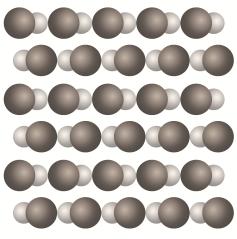
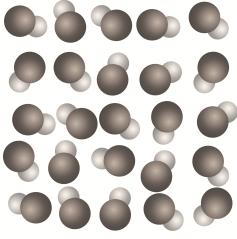
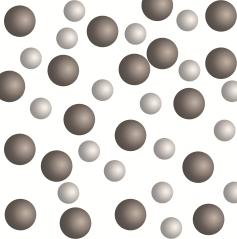
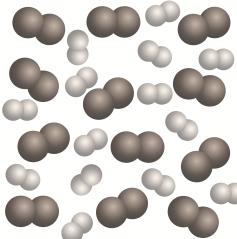
Q8. The sketches below show the same pure molecular compound (hydrogen chloride, HCl) at different temperatures. Which sketch would be correct for a temperature of -66.0°C, knowing melting point of HCl: −114.8 °C and boiling point of HCl: −85.1 °C?
Background
Topic: States of Matter and Phase Changes
This question tests your understanding of phase transitions and how molecular compounds appear in different states.
Key Terms:
Melting point: Temperature at which a solid becomes a liquid.
Boiling point: Temperature at which a liquid becomes a gas.
Step-by-Step Guidance
Compare the given temperature (-66.0°C) to the melting and boiling points of HCl.
Determine the physical state of HCl at this temperature (solid, liquid, or gas).
Identify which sketch corresponds to the correct state (liquid).
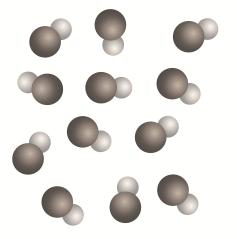
Try solving on your own before revealing the answer!
Final Answer:
At -66.0°C, HCl is a liquid. The correct sketch is Sketch 2 (B), which shows molecules close together but not in a fixed pattern.
This matches the liquid state, where molecules are close but can move past each other.
Q9. Which of the following sentence(s) are INCORRECT?
Background
Topic: Classification of Matter
This question tests your understanding of mixtures, elements, compounds, and chemical formulas.
Key Terms:
Element: Substance made of one type of atom.
Compound: Substance made of two or more elements chemically combined.
Mixture: Combination of substances not chemically bonded.
Step-by-Step Guidance
Review each statement for accuracy based on definitions.
Identify statements that contradict the definitions (e.g., "compound is a mixture of elements").
Mark those that are incorrect.
Try solving on your own before revealing the answer!
Final Answer:
(B) is incorrect because an element is composed of only one type of atom, not just one atom. (C) is incorrect because a compound is not a mixture, but a chemical combination of elements.
The correct choices are (B) and (C).
Q10. A chemist needs to know the mass of a sample of Na2SO4 to 4 significant digits. She puts the sample on a digital scale. This is what the scale shows: If possible, what is mass of the sample with 4 significant digits?
Background
Topic: Measurement and Significant Figures
This question tests your ability to interpret measurements and report them with the correct number of significant digits.
Key Terms:
Significant digits: The digits that carry meaning in a measurement.
Digital scale: Instrument for measuring mass.
Step-by-Step Guidance
Read the value shown on the scale.
Determine if the value can be reported with four significant digits.
Choose the answer that matches the correct number of significant digits.
Try solving on your own before revealing the answer!
Final Answer:
The correct answer is (C) 10.20 g, which has four significant digits.
Reporting the mass with four significant digits ensures precision.
Q12. What is the volume in mL of one marble assuming both marbles are identical? Show all your work, including any measurements with the correct significant figures and units.
Background
Topic: Volume Measurement by Water Displacement
This question tests your ability to determine the volume of an object using water displacement, a common laboratory technique.
Key Terms and Formula:
Water displacement: The volume of water displaced equals the volume of the object.
Volume formula:
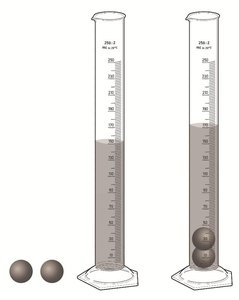
Step-by-Step Guidance
Record the initial volume of water in the graduated cylinder.
Add both marbles and record the new volume.
Subtract the initial volume from the final volume to find the total volume of both marbles.
Divide by two to find the volume of one marble.
Report your answer in mL with correct significant figures.
Try solving on your own before revealing the answer!
Final Answer:
Let be the initial water volume and the volume after adding marbles. The volume of one marble is mL.
For example, if mL and mL, then mL per marble.
Q13. A device recorded data during an experiment, the total amount of data, D, collected is given by the following equation: . How much time will it take to collect bytes of data at a rate of $4500$ bytes/s? Rearrange and solve the equation to solve for time. Show all your work and your answer should be given with correct significant figures and in scientific notation.
Background
Topic: Algebraic Manipulation and Scientific Notation
This question tests your ability to rearrange equations and use scientific notation in calculations.
Key formula:
Where:
= total data (bytes)
= time (seconds)
= data rate (bytes/s)
Step-by-Step Guidance
Rearrange the equation to solve for time:
Plug in the values: bytes, bytes/s.
Perform the division and express the answer in scientific notation.
Round your answer to the correct number of significant figures.
Try solving on your own before revealing the answer!
Final Answer:
seconds
The answer is rounded to three significant figures and expressed in scientific notation.
