 Indietro
CHEM 1910 Foundations of Chemistry: Atomic Perspective and Periodic Table Study Guide
Guida di studio - Note intelligenti
 Appunti personalizzati basati sui tuoi materiali, ampliati con definizioni chiave, esempi e contesto.
Unit 1: Atomic Perspective
Overview of the Course and Learning Outcomes
The CHEM 1910 course reviews foundational concepts in chemistry, focusing on atomic structure, the periodic table, and stoichiometry. Students are expected to master key learning outcomes related to the arrangement of the periodic table, identification of elements, atomic structure, isotopes, and calculations involving atomic mass and Avogadro’s number.
Course Structure: Four tests, a final exam, and opportunities for retesting specific learning outcomes.
Grading for Growth: Recognizes that learning is non-linear and allows for retesting to support mastery.
Required Materials: Calculator, Brightspace, Mastering Chemistry, and the textbook "Atoms First" by McMurray & Fay.
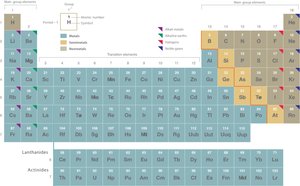
Arrangement of the Periodic Table
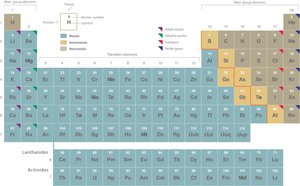
The periodic table is a systematic arrangement of elements based on increasing atomic number. It is divided into regions that classify elements as metals, non-metals, and metalloids, and further into families or groups with similar chemical properties.
Metals: Located on the left and center; typically solid, ductile, malleable, and good conductors.
Non-metals: Found on the right; can be solid, liquid, or gas, usually brittle and poor conductors.
Metalloids: Positioned between metals and non-metals; have properties of both.
Element Families: Alkali metals (Group 1A), Alkaline earth metals (Group 2A), Transition metals (center), Halogens (Group 7A/17), Noble gases (Group 8A/18).
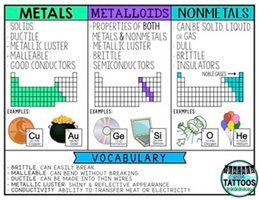
Characteristics of Metals, Metalloids, and Nonmetals
Each class of elements exhibits distinct physical and chemical properties. Understanding these differences is essential for predicting element behavior and reactivity.
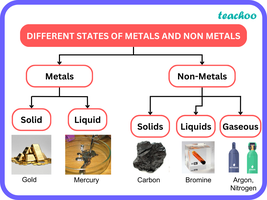
Metals: Solids (except mercury), shiny, malleable, ductile, good conductors.
Metalloids: Semiconductors, brittle, intermediate properties.
Nonmetals: Can be solid, liquid, or gas; dull, brittle, insulators.
Elemental Families and Their Common Properties
Elements in the same group (column) of the periodic table share similar chemical behavior, reactivity, and tend to form ions with similar charges. This is due to their similar valence electron configurations.
Alkali Metals: Highly reactive, form +1 ions.
Alkaline Earth Metals: Reactive, form +2 ions.
Halogens: Very reactive, form -1 ions.
Noble Gases: Inert, rarely form compounds.
Transition Metals: Variable oxidation states, often form colored compounds.
Common Element Symbols and Names
Recognizing the symbols and names of common elements is fundamental for understanding chemical formulas and reactions. Below is a list of frequently encountered elements:
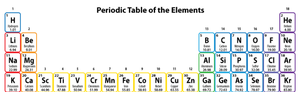
H (Hydrogen), Li (Lithium), Na (Sodium), K (Potassium), Mg (Magnesium), Ca (Calcium), Sr (Strontium), Ba (Barium), B (Boron), Al (Aluminum), C (Carbon), Si (Silicon), Pb (Lead), Cr (Chromium), Mn (Manganese), Fe (Iron), Ni (Nickel), Cu (Copper), Zn (Zinc), Ag (Silver), Hg (Mercury), N (Nitrogen), P (Phosphorus), As (Arsenic), O (Oxygen), S (Sulfur), F (Fluorine), Cl (Chlorine), Br (Bromine), I (Iodine), He (Helium), Ne (Neon), Ar (Argon)
Internal Structure of the Atom
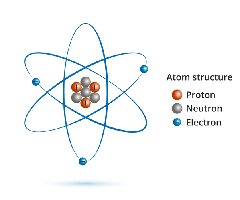
An atom consists of three main subatomic particles: protons, neutrons, and electrons. Their arrangement and properties determine the identity and behavior of the atom.
Protons (p): Positively charged, located in the nucleus, mass ≈ 1 amu.
Neutrons (n): Neutral, located in the nucleus, mass ≈ 1 amu.
Electrons (e-): Negatively charged, orbit the nucleus, mass ≈ 1/1836 amu.
Atomic Number (Z): Number of protons; defines the element.
Mass Number (A): Number of protons + neutrons.
Isotopes and Atomic Mass
Isotopes are atoms of the same element with different numbers of neutrons. The average atomic mass of an element is calculated based on the masses and relative abundances of its isotopes.
Isotope Symbol: where A = mass number, Z = atomic number, X = element symbol.
Average Atomic Mass Formula:
Example: Carbon has two stable isotopes: and .
Mole Concept and Avogadro’s Number
The mole is a fundamental unit in chemistry representing a specific number of particles (atoms, molecules). Avogadro’s number is the number of particles in one mole.
Avogadro’s Number: particles/mol
Molar Mass: Mass of one mole of a substance (g/mol)
Conversions: Mass ↔ Moles ↔ Number of atoms
Formula:
Balanced Nuclear Reactions
Nuclear reactions involve changes in the nucleus of an atom, resulting in the formation of new elements or isotopes. Balancing nuclear reactions requires accounting for both mass number and atomic number.
Example:
Steps: Ensure sum of mass numbers and atomic numbers are equal on both sides.
Study Strategies for Chemistry
Active learning strategies such as problem-solving, making flashcards, and creating study guides are more effective than passive reading. Students should regularly review learning outcomes and practice applying concepts.
Make flashcards: For element names, symbols, and vocabulary.
Draw diagrams: Highlight regions of the periodic table.
Write practice questions: For each learning outcome.
Summary Table: Properties of Metals, Metalloids, and Nonmetals
Category | Physical State | Conductivity | Malleability/Ductility | Examples |
|---|---|---|---|---|
Metals | Solid (except Hg) | Good | Malleable, Ductile | Cu, Au, Fe |
Metalloids | Solid | Semiconductors | Brittle | Si, Ge |
Nonmetals | Solid, Liquid, Gas | Poor | Brittle | O, N, Br |
Additional info:
Some content was inferred from standard General Chemistry curriculum to ensure completeness and clarity.
Images included only where directly relevant to the explanation of the paragraph.
