 Indietro
Chemical Bonding II: Valence Bond and Molecular Orbital Theory – Study Notes
Guida di studio - Note intelligenti
 Appunti personalizzati basati sui tuoi materiali, ampliati con definizioni chiave, esempi e contesto.
Chemical Bonding II: Valence Bond and Molecular Orbital Theory
Introduction
This chapter explores advanced models of chemical bonding, focusing on Valence Bond Theory and Molecular Orbital Theory. These theories address limitations of Lewis structures and provide deeper insight into molecular geometry, bond strength, and magnetic properties.
Valence Bond Theory
Limitations of Lewis Theory
Lewis theory is useful for predicting general trends in molecular properties but has several limitations:
Bond Strength and Length: Lewis theory cannot accurately predict these values.
Bond Angles: Only approximations are possible; actual angles often differ.
Resonance: Many molecules require multiple resonance structures, and Lewis theory cannot always represent them correctly.
Magnetic Properties: Lewis theory fails to predict paramagnetism, as seen in O2.
Example: Oxygen (O2) is paramagnetic due to unpaired electrons, which Lewis theory does not predict.
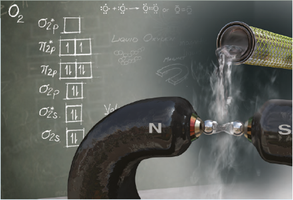
Valence Bond Theory: Orbital Overlap and Chemical Bond
Valence bond theory proposes that bonds form when atomic orbitals overlap. The nature of the overlap depends on the orientation of the orbitals:
Along the axis: Orbitals align directly between nuclei.
Outside the axis: Orbitals align parallel and perpendicular to the axis.
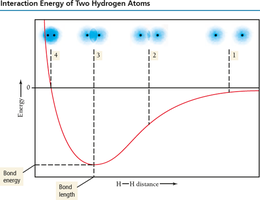
Main Concepts of Valence Bond Theory
Valence electrons reside in quantum-mechanical atomic orbitals (s, p, d, f, or hybrids).
A chemical bond forms when two atomic orbitals overlap and contain two spin-paired electrons.
The geometry of the molecule is determined by the geometry of the interacting orbitals.
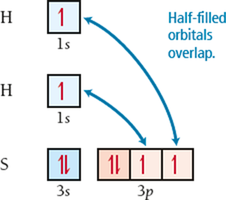
Orbital Diagram for H2S Formation
Bonding occurs when half-filled orbitals on hydrogen and sulfur overlap.
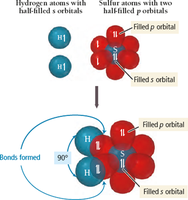
Bonding With Valence Bond Theory
Bonds form when atomic or hybrid orbitals interact.
Orbitals must be aligned along the axis or parallel and perpendicular to the axis.
Hybridization
Hybridization is the mixing of atomic orbitals to form new, degenerate orbitals that maximize bonding and stability. The same atom can exhibit different hybridizations depending on its bonding environment.
More bonds = more full orbitals = more stability.
Hybrid orbitals have larger lobes, allowing greater overlap.
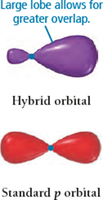
Hybrid Orbitals: Formation and Properties
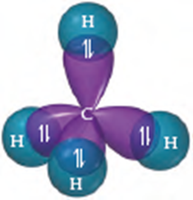
The number of hybrid orbitals formed equals the number of atomic orbitals combined. For example, carbon combines one 2s and three 2p orbitals to form four sp3 hybrid orbitals.
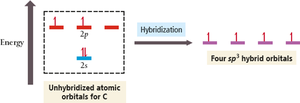
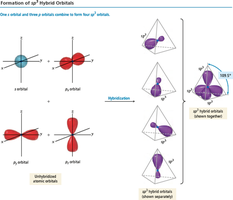
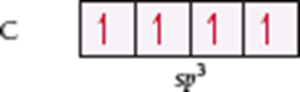
sp3 Hybridization
Atoms with four electron groups exhibit tetrahedral geometry and use sp3 hybrid orbitals for all bonds and lone pairs.
sp2 Hybridization
Atoms with three electron groups exhibit trigonal planar geometry. Carbon is trigonal planar, nitrogen is trigonal bent. Hybrid orbitals are used for bonds and lone pairs, while unhybridized p orbitals form pi bonds.
Types of Bonds: Sigma and Pi
Sigma (σ) Bond: Formed by end-to-end overlap along the axis connecting nuclei. Stronger due to direct overlap.
Pi (π) Bond: Formed by side-to-side overlap of unhybridized p orbitals, electron density above and below the axis. Weaker than sigma bonds.
Bond Rotation
Rotation around sigma bonds is free because the overlap is along the axis.
Rotation around pi bonds requires breaking the overlap, so it is restricted.
Hybridization Schemes
Hybridization depends on the number of electron groups:
Electron Groups | Hybridization | Geometry |
|---|---|---|
2 | sp | Linear |
3 | sp2 | Trigonal planar |
4 | sp3 | Tetrahedral |
5 | sp3d | Trigonal bipyramidal |
6 | sp3d2 | Octahedral |
Molecular Orbital Theory
Introduction to Molecular Orbital Theory
Molecular orbital (MO) theory applies quantum mechanics to molecules, treating electrons as delocalized over the entire molecule. MO theory explains properties such as magnetism and bond order more accurately than Lewis or valence bond theories.
Linear Combination of Atomic Orbitals (LCAO)
MOs are formed by combining atomic orbitals (AOs) from each atom. The number of MOs equals the number of AOs combined. Constructive combination forms bonding MOs (lower energy), while destructive combination forms antibonding MOs (higher energy).
Molecular Orbitals: Bonding and Antibonding
Bonding MO: Lower energy, electron density between nuclei.
Antibonding MO: Higher energy, electron density outside the internuclear axis, contains nodes.
Bond Order Calculation
Bond order is a measure of bond strength and stability:
Bond order = (Number of electrons in bonding MOs - Number in antibonding MOs) / 2
Higher bond order = stronger, shorter bond
Bond order of 0 = unstable, no bond forms
Magnetic Properties
Paramagnetic: MO diagram has unpaired electrons
Diamagnetic: All electrons are paired
Second-Period Homonuclear Diatomic Molecules
MO diagrams for molecules like O2, N2, and F2 are constructed using the energy ordering of atomic orbitals. The bond order and magnetic properties can be predicted from these diagrams.
Heteronuclear Diatomic Molecules
When combining different atoms, the atomic orbital closer in energy to the MO contributes more.
More electronegative atoms have lower energy orbitals, contributing more to bonding MOs.
Nonbonding MOs remain localized on the atom donating its AO.
Polyatomic Molecules
In polyatomic molecules, atomic orbitals from all atoms combine to form delocalized MOs, providing a more accurate description of molecular properties.
Summary Table: Hybridization Scheme from Electron Geometry
Electron Groups | Hybridization | Geometry |
|---|---|---|
2 | sp | Linear |
3 | sp2 | Trigonal planar |
4 | sp3 | Tetrahedral |
5 | sp3d | Trigonal bipyramidal |
6 | sp3d2 | Octahedral |
Key Equations
Bond Order:
Practice Problems and Applications
Draw Lewis structures and apply VSEPR theory to predict electron group geometry.
Use hybridization tables to select the correct scheme.
Sketch atomic and hybrid orbitals, showing overlap and labeling bonds.
Construct MO diagrams for diatomic and polyatomic molecules, calculate bond order, and predict magnetic properties.
Additional info: These notes expand on brief points from the original slides, providing academic context and examples for clarity. Images included are directly relevant to the explanation of orbital overlap, hybridization, and molecular orbital theory.
