 Indietro
Chemical Bonding Theories: VSEPR, Molecular Geometry, Polarity, and Hybridization
Guida di studio - Note intelligenti
 Appunti personalizzati basati sui tuoi materiali, ampliati con definizioni chiave, esempi e contesto.
Chemical Bonding Theories
5.1 - Introduction: Importance of Molecular Shape
Molecular shape is fundamental to the properties and functions of molecules, especially in biological systems. The three-dimensional arrangement of atoms determines how molecules interact, react, and fit into biological receptors.
Lewis Theory: Predicts connectivity and electron arrangement but not 3D shape, does not account for role of orbitals
Advanced Theories: VSEPR, Valence Bond Theory, and Molecular Orbital Theory address the limitations of Lewis structures by explaining molecular geometry and bonding at the orbital level.
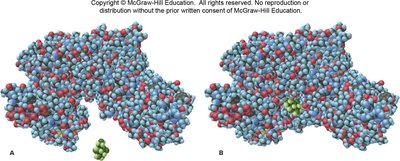
Additional info: The image above illustrates how the shape of an enzyme (hexokinase) and its substrate (glucose) must complement each other for biological activity, emphasizing the importance of molecular geometry.
Valence Shell Electron Pair Repulsion (VSEPR) Theory
Electron Domains and Molecular Geometry
VSEPR theory states that electron groups (regions of electron density) around a central atom arrange themselves to minimize repulsion, determining the molecule's geometry.
Electron Group: Any lone pair, single, double, or triple bond counts as one electron group.
Steric Number: The total number of electron groups around the central atom.
Electron Group Geometry: Arrangement of all electron groups (bonds and lone pairs).
Molecular Geometry: Arrangement of only the bonded atoms.
Bond Angle: The angle between adjacent bonds, characteristic of each geometry.
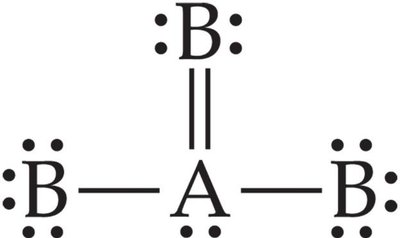
VSEPR Notation
A: Central atom
X: Surrounding atoms
E: Lone pairs on the central atom
Base Electron Domain Geometries
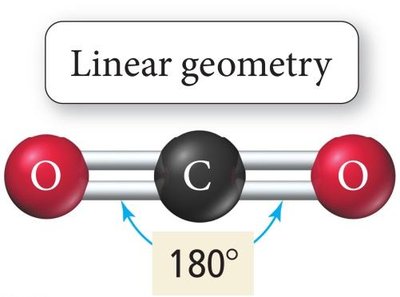
2 electron groups: Linear (180°)
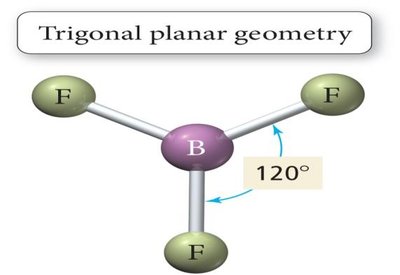
3 electron groups: Trigonal planar (120°)
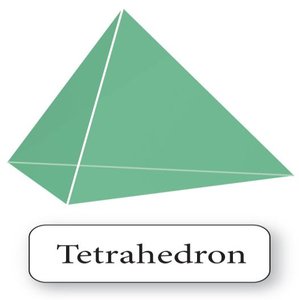
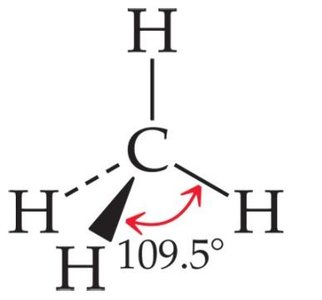
4 electron groups: Tetrahedral (109.5°)
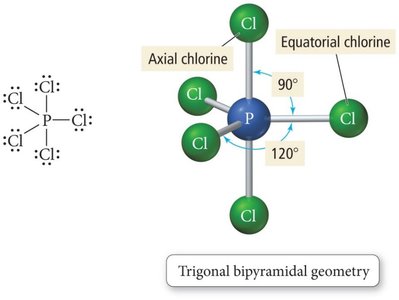
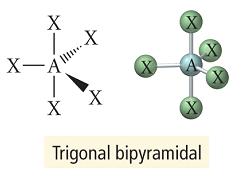
5 electron groups: Trigonal bipyramidal (120° and 90°)
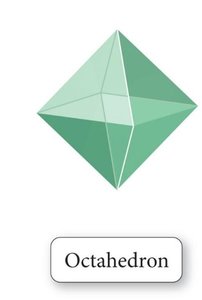
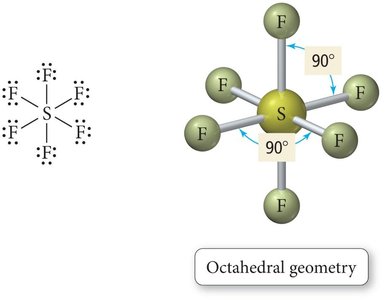
6 electron groups: Octahedral (90°)
Electron Groups | Geometry | Bond Angle |
|---|---|---|
2 | Linear | 180° |
3 | Trigonal planar | 120° |
4 | Tetrahedral | 109.5° |
5 | Trigonal bipyramidal | 120°, 90° |
6 | Octahedral | 90° |

Effect of Lone Pairs on Molecular Geometry
Lone pairs occupy more space than bonding pairs, causing bond angles to decrease and altering the molecular geometry from the base electron group geometry.
Trigonal planar (AX3): 120°
Bent (AX2E): <120°
Tetrahedral (AX4): 109.5°
Trigonal pyramidal (AX3E): <109.5°
Bent (AX2E2): <109.5°


Number of Electron Domains | Electron-Domain Geometry | Bonding Domains | Nonbonding Domains | Molecular Geometry | Example |
|---|---|---|---|---|---|
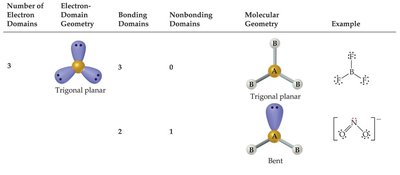
3 | Trigonal planar | 3 | 0 | Trigonal planar | BF3 |
3 | Trigonal planar | 2 | 1 | Bent | NO2- |
4 | Tetrahedral | 4 | 0 | Tetrahedral | CH4 |
4 | Tetrahedral | 3 | 1 | Trigonal pyramidal | NH3 |
4 | Tetrahedral | 2 | 2 | Bent | H2O |


Representing 3D Shapes on Paper
Chemists use different types of lines and wedges to represent three-dimensional molecular structures on two-dimensional paper.
Straight line: Bond in the plane of the paper
Hatched wedge: Bond going into the page
Solid wedge: Bond coming out of the page

Predicting Molecular Polarity
Criteria for Molecular Polarity
A molecule is polar if it contains polar bonds and the arrangement of these bonds is asymmetrical, resulting in a net dipole moment.
Draw the Lewis structure and determine the molecular geometry.
Determine if the bonds are polar (difference in electronegativity).
Assess if the polar bonds add up to a net dipole moment (unsymmetrical shape).

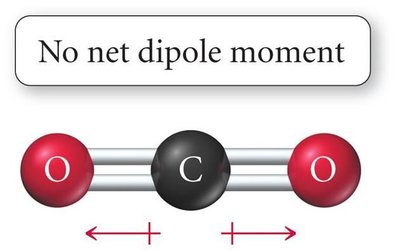
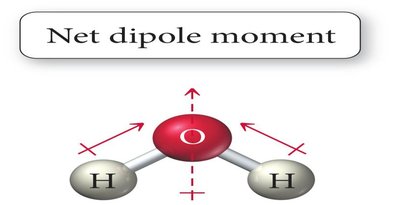


Nonpolar molecules: All dipole moments cancel (e.g., CO2, BF3, CCl4, SF6).
Polar molecules: Net dipole moment remains (e.g., H2O, NH3, SO2).
Valence Bond Theory and Hybridization
Valence Bond Theory
Valence Bond Theory explains covalent bonding as the overlap of half-filled atomic orbitals from different atoms. The geometry of the molecule is explained by the hybridization of atomic orbitals on the central atom.
Hybridization: Mixing of atomic orbitals to form new, equivalent hybrid orbitals oriented for bonding.
Types of Hybridization:
sp: 2 electron groups (linear, 180°)
sp2: 3 electron groups (trigonal planar, 120°)
sp3: 4 electron groups (tetrahedral, 109.5°)
dsp3 (sp3d): 5 electron groups (trigonal bipyramidal, 120°/90°)
d2sp3 (sp3d2): 6 electron groups (octahedral, 90°)
Example: In methane (CH4), the carbon atom undergoes sp3 hybridization, forming four equivalent bonds with hydrogen.
Sigma (σ) and Pi (π) Bonds
Sigma (σ) bonds: End-to-end overlap, all single bonds are sigma bonds.
Pi (π) bonds: Side-to-side overlap of parallel p orbitals, present in double and triple bonds.
Double bond: 1 σ + 1 π
Triple bond: 1 σ + 2 π
Summary Table: VSEPR Geometries and Hybridization
Steric Number | Electron Geometry | Hybridization | Bond Angle | Example |
|---|---|---|---|---|
2 | Linear | sp | 180° | CO2 |
3 | Trigonal planar | sp2 | 120° | BF3 |
4 | Tetrahedral | sp3 | 109.5° | CH4 |
5 | Trigonal bipyramidal | sp3d | 120°, 90° | PCl5 |
6 | Octahedral | sp3d2 | 90° | SF6 |
Key Points and Applications
Molecular shape determines physical and chemical properties, including reactivity and biological activity.
VSEPR theory allows prediction of molecular geometry based on electron group repulsions.
Hybridization explains the observed bond angles and equivalent bonding in molecules.
Molecular polarity is determined by both bond polarity and molecular geometry.
