 Indietro
Chemical Elements & Compounds: Types, Formulas, and Classification
Guida di studio - Note intelligenti
 Appunti personalizzati basati sui tuoi materiali, ampliati con definizioni chiave, esempi e contesto.
Chemical Elements & Compounds
Outline of Topics
This section introduces the foundational concepts of chemical compounds, their classification, and the principles underlying their formulas and nomenclature. The main topics include:
Types of chemical compounds & their formulas
The mole concept & chemical compounds
Composition of chemical compounds
Oxidation states
Naming simple inorganic compounds
Names & formulas of inorganic compounds
Types of Chemical Compounds & Their Formulas
Definition and General Features
A chemical is defined as a distinct compound or element. A key characteristic of all compounds is that they are composed of two or more elements chemically combined in fixed proportions.
Simple chemical compounds (cpds): These are compounds with relatively few atoms, such as CO2, CO, NH3, and H2O.
Complex compounds: These contain more atoms and may have more intricate structures, such as Vitamin C (ascorbic acid) and aspirin (acetylsalicylic acid).
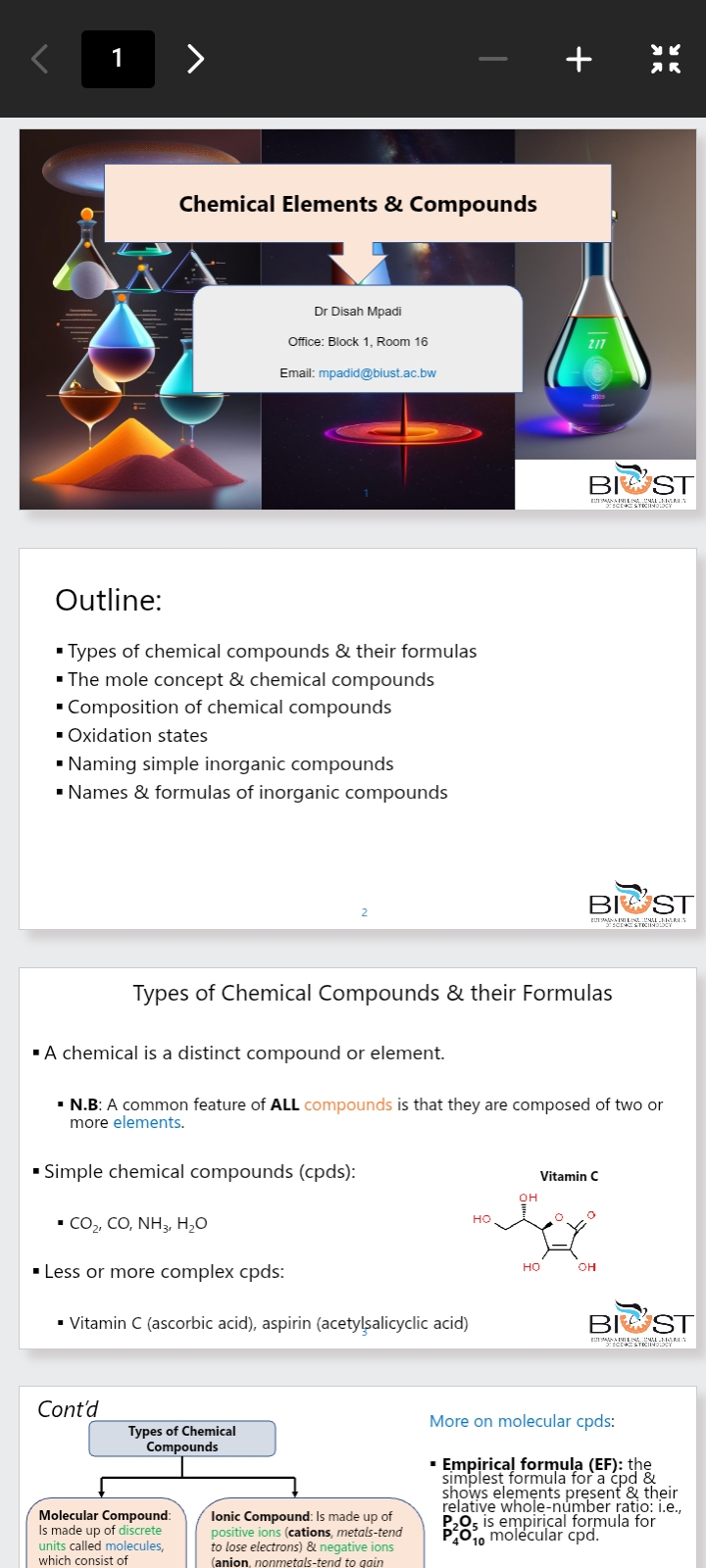
Example: Vitamin C (ascorbic acid) is a complex organic compound with the formula C6H8O6.
Classification of Chemical Compounds
Chemical compounds can be broadly classified into two main types based on their bonding and structure:
Molecular Compounds: Composed of discrete units called molecules. These molecules consist of nonmetals bonded together by covalent bonds.
Ionic Compounds: Made up of positive ions (cations, typically metals that lose electrons) and negative ions (anions, typically nonmetals that gain electrons). These ions are held together by electrostatic forces.
Example: Sodium chloride (NaCl) is an ionic compound, while water (H2O) is a molecular compound.
Empirical and Molecular Formulas
The empirical formula (EF) of a compound is the simplest formula that shows the elements present and their relative whole-number ratios. The molecular formula gives the actual number of atoms of each element in a molecule of the compound.
Empirical Formula Example: is the empirical formula for diphosphorus pentoxide.
Molecular Formula Example: is the molecular formula for the same compound.
Key Point: The empirical formula is always the simplest ratio, while the molecular formula may be a multiple of the empirical formula.
Summary Table: Types of Chemical Compounds
Type | Constituents | Bonding | Examples |
|---|---|---|---|
Molecular Compound | Nonmetals | Covalent bonds (molecules) | H2O, CO2, NH3 |
Ionic Compound | Metals & Nonmetals | Ionic bonds (ions) | NaCl, KBr, CaCl2 |
Additional info: The distinction between empirical and molecular formulas is crucial for understanding chemical composition and stoichiometry. Empirical formulas are especially useful in analytical chemistry and when determining formulas from experimental data.
