 Indietro
Chapter 3 study guide
Guida di studio - Note intelligenti
 Appunti personalizzati basati sui tuoi materiali, ampliati con definizioni chiave, esempi e contesto.
Chapter 3: Mass Relationships in Chemical Reactions
Chemical Equations
Chemical equations use chemical formulas to represent the transformation of reactants into products. The reactants are written on the left, the products on the right, separated by an arrow indicating the direction of the reaction. Coefficients indicate the number of units involved, while subscripts are part of the chemical identity and must not be altered when balancing equations. State symbols (g, l, s, aq) specify the physical state of each substance.
Reactants: Substances consumed in the reaction (left side).
Products: Substances formed in the reaction (right side).
Coefficients: Numbers in front of formulas indicating the number of units (molecules or moles).
Subscripts: Numbers within formulas indicating the number of atoms in a molecule; never changed to balance equations.
State Symbols: (g) gas, (l) liquid, (s) solid, (aq) aqueous.
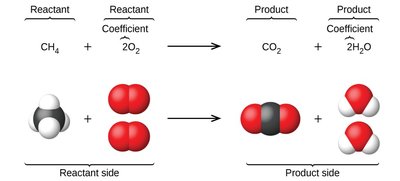
The Law of Conservation of Mass and Balancing Equations
The Law of Conservation of Mass states that atoms are neither created nor destroyed in a chemical reaction; they are only rearranged. Therefore, a balanced chemical equation must have the same number of each type of atom on both sides. Only coefficients may be changed to achieve balance; changing subscripts alters the identity of the substance.
Balancing Steps:
Write the unbalanced equation with correct formulas.
Count each type of atom on both sides.
Adjust coefficients to balance atoms, leaving free elements for last.
Reduce coefficients to the smallest whole numbers.
Check your work by recounting atoms.
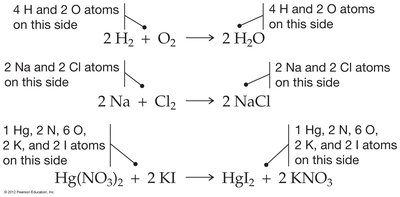
Levels of Chemical Representation
Chemists describe chemical phenomena on three levels:
Macroscopic: Observable properties (e.g., color, temperature change, gas evolution).
Particulate (Microscopic): Behavior of atoms, ions, and molecules (not directly observable, represented with models).
Symbolic: Chemical formulas and equations (compact, precise representation of reactions).
Understanding and switching between these levels is essential for chemical reasoning.
Chemical Symbols: Dual Meanings
Chemical symbols and formulas can refer to both individual particles (molecules, ions) and macroscopic quantities (moles, grams). The context determines the intended meaning. For example, H2O can mean one molecule of water or one mole of water (6.022 × 10²³ molecules).
Molecular and Formula Mass
Molecular Mass (Covalent Compounds)
The molecular mass is the sum of the atomic masses of all atoms in a molecule, as indicated by the chemical formula. For example, the molecular mass of chloroform (CHCl3) is calculated by summing the masses of 1 C, 1 H, and 3 Cl atoms.
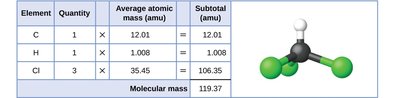
Formula Mass (Ionic Compounds)
Ionic compounds are composed of ions arranged in a lattice, not discrete molecules. The formula mass is the sum of the atomic masses in the smallest whole-number ratio of ions (the formula unit). For example, NaCl's formula mass is the sum of Na and Cl atomic masses.
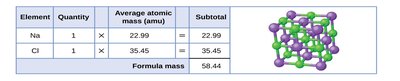
The Mole and Molar Mass
The Mole
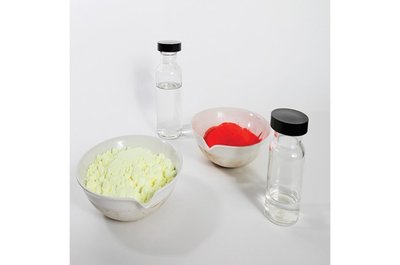
The mole is a counting unit equal to 6.02214076 × 10²³ entities (Avogadro's number). One mole of an element has a mass in grams equal to its atomic mass in amu. The molar mass (g/mol) is the mass of one mole of a substance.
Molar Mass of a Compound
The molar mass of a compound is the sum of the molar masses of its constituent elements, each multiplied by its subscript in the formula. For example, the molar mass of C2H4 is calculated as:
2 mol C × 12.01 g/mol + 4 mol H × 1.01 g/mol = 28.06 g/mol
Converting Between Moles and Grams
Molar mass serves as a conversion factor between grams and moles:
Grams to moles:
Moles to grams:
To convert to molecules: chain in Avogadro’s number.
Stoichiometry: Chemical Arithmetic
Stoichiometry and Balanced Equations
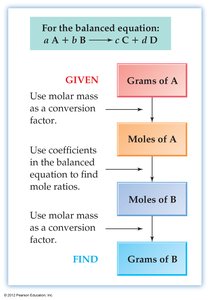
Stoichiometry is the calculation of reactants and products in chemical reactions. The coefficients in a balanced equation represent the relative number of moles of each substance involved. This allows chemists to predict the amounts of products formed from given reactants.

Stoichiometry Calculations Flowchart
Stoichiometric calculations often require converting between grams and moles using molar mass, and using the coefficients from the balanced equation to relate amounts of different substances.
Limiting Reactant
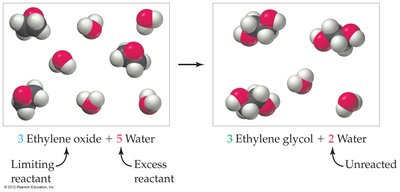
In reactions with unequal amounts of reactants, the limiting reactant is the one that is completely consumed first, thus determining the maximum amount of product formed. The other reactant(s) are in excess.
Theoretical and Percent Yield
The theoretical yield is the maximum amount of product that can be formed from the given amounts of reactants. The actual yield is the amount actually obtained from the reaction. The percent yield is calculated as:
Determining Chemical Formulas
Percent Composition
Percent composition expresses the mass percentage of each element in a compound. It can be calculated from the formula or experimentally determined by analyzing a sample.
Alternatively:
Empirical Formula from Percent Composition
The empirical formula gives the simplest whole-number ratio of atoms in a compound. It is determined by converting percent composition to moles, finding the simplest ratio, and adjusting to whole numbers.
Combustion Analysis
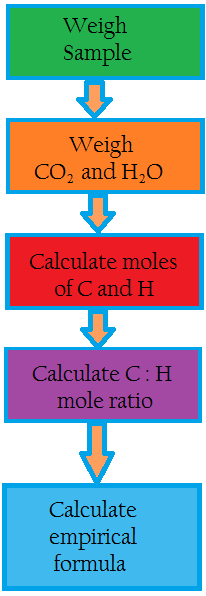
Combustion analysis is a common method for determining empirical formulas, especially for compounds containing C, H, and O. The process involves burning a known mass of sample and measuring the masses of CO2 and H2O produced to calculate the amounts of C and H.
Molecular Formula
The molecular formula gives the actual number of atoms of each element in a molecule. It is a whole-number multiple of the empirical formula. The multiple is determined by dividing the experimentally determined molecular (or molar) mass by the empirical formula mass:
The molecular formula is then obtained by multiplying the subscripts in the empirical formula by this multiple.
Determining Molecular/Molar Masses: Mass Spectrometry
Mass spectrometry is a technique used to determine the masses of atoms and molecules. A sample is ionized, and the ions are separated based on their mass-to-charge ratio. The heaviest ion typically corresponds to the molecular ion, revealing the molecular mass of the compound.
