 Indietro
Chemical Equations, Stoichiometry, and the Mole: Foundations of Quantitative Chemistry
Guida di studio - Note intelligenti
 Appunti personalizzati basati sui tuoi materiali, ampliati con definizioni chiave, esempi e contesto.
Chemical Equations and Reaction Stoichiometry
Introduction to Chemical Equations
Chemical equations are concise symbolic representations of chemical reactions, showing the substances involved and their quantitative relationships. Understanding how to write and balance chemical equations is fundamental to studying chemistry.
Reactants are the starting substances, written on the left side of the equation.
Products are the substances formed, written on the right side.
Coefficients are used to balance the equation, ensuring the law of conservation of mass is followed.
States of matter are indicated in parentheses: (s) for solid, (l) for liquid, (g) for gas, and (aq) for aqueous solution.
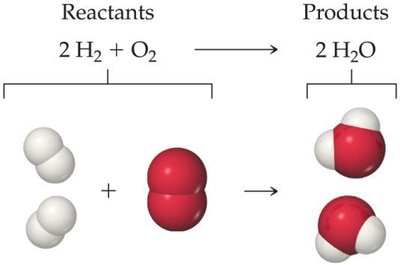
Balancing Chemical Equations
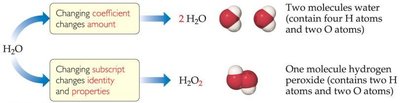
Balancing chemical equations ensures that the number of atoms of each element is the same on both sides of the equation. This is achieved by adjusting coefficients, not subscripts, as changing subscripts alters the identity and properties of the compounds.
Start by balancing the most complex substance.
Balance elements that appear in only one reactant and one product first.
Balance hydrogen and oxygen atoms last.
Check your work by counting atoms of each element on both sides.
Types of Chemical Reactions
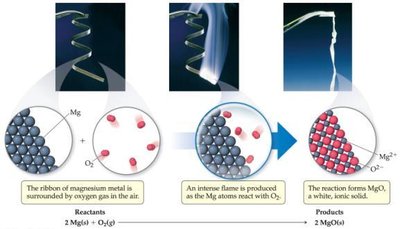
Chemical reactions can be classified into several basic types, each with characteristic patterns and examples:
Combination (Synthesis) Reactions: Two or more substances combine to form one product. Example:
Decomposition Reactions: One substance breaks down into two or more simpler substances. Example:
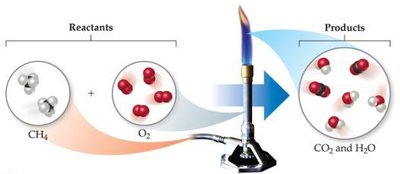
Combustion Reactions: A substance reacts rapidly with oxygen, often producing a flame. Example:
Formula Weights, Molecular Weights, and Percent Composition
Formula and Molecular Weights
The molecular weight (MW) is the sum of the atomic weights of all atoms in a molecule. For ionic compounds, the formula weight (FW) is used, as these compounds do not exist as discrete molecules but as a lattice of ions.
Example: The formula weight of calcium chloride, CaCl2, is calculated as:
Percent Composition
The percent composition of a compound is the percentage by mass of each element in the compound. It is calculated using the formula:
Example: The mass percentage composition of H, C, and O in oxalic acid (H2C2O4) is H: 2.24%, C: 26.68%, O: 71.08%.
The Mole and Avogadro’s Number
Definition of the Mole
The mole (mol) is the SI unit for the amount of substance. One mole contains exactly elementary entities (Avogadro’s number), such as atoms, molecules, or ions. This allows chemists to count particles by weighing macroscopic amounts of material.
1 mole of any substance contains Avogadro’s number of particles.
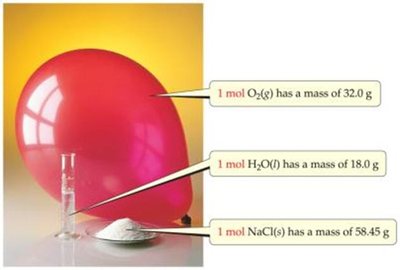
The mass of 1 mole of a substance in grams is numerically equal to its formula or molecular weight in amu.

Molar Mass
The molar mass is the mass of one mole of a substance, expressed in grams per mole (g/mol). For elements, the molar mass is the atomic weight from the periodic table. For compounds, it is the sum of the atomic weights of all atoms in the formula.
Example: The molar mass of H2O is 18.0 g/mol.
Mole Relationships and Stoichiometric Calculations
Stoichiometry involves using balanced chemical equations to calculate the relationships between the amounts of reactants and products. The “mole bridge” connects mass, moles, and number of particles:
Grams ↔ Moles (using molar mass)
Moles ↔ Number of particles (using Avogadro’s number)
Moles of one substance ↔ Moles of another (using coefficients from the balanced equation)

Empirical and Molecular Formulas
Determining Empirical Formulas
The empirical formula gives the simplest whole-number ratio of atoms in a compound. It can be determined from percent composition or experimental data by following these steps:
Convert percentages to grams (assume 100 g sample if necessary).
Convert grams to moles using the molar mass of each element.
Write a pseudoformula using moles as subscripts.
Divide all subscripts by the smallest number of moles.
Multiply all ratios by a factor to obtain whole numbers if necessary.

Determining Molecular Formulas
The molecular formula is a whole-number multiple of the empirical formula. If the molar mass of the compound is known, the molecular formula can be determined by dividing the molar mass by the empirical formula mass and multiplying the subscripts accordingly.
Example: If the empirical formula is C4H8O and the molar mass is 216 g/mol, the molecular formula is C12H24O3.
Combustion Analysis
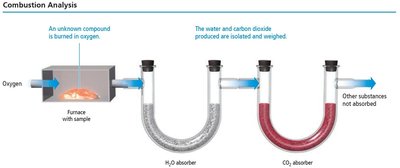
Combustion analysis is a laboratory technique used to determine the empirical formula of compounds containing C, H, and O. A known mass of the compound is burned in oxygen, and the masses of CO2 and H2O produced are measured to calculate the amounts of C and H in the original sample. The amount of O is found by subtraction.
Appendix: Common Cations and Anions
Common Cations
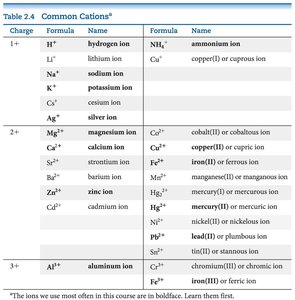
Cations are positively charged ions. The following table lists common cations encountered in general chemistry:
Charge | Formula | Name |
|---|---|---|
1+ | H+ | hydrogen ion |
1+ | Na+ | sodium ion |
2+ | Mg2+ | magnesium ion |
2+ | Ca2+ | calcium ion |
3+ | Al3+ | aluminum ion |
Common Anions
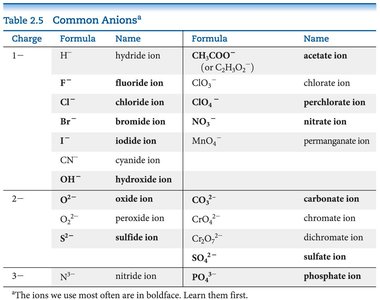
Anions are negatively charged ions. The following table lists common anions encountered in general chemistry:
Charge | Formula | Name |
|---|---|---|
1− | Cl− | chloride ion |
1− | OH− | hydroxide ion |
2− | O2− | oxide ion |
2− | SO42− | sulfate ion |
3− | PO43− | phosphate ion |
Redefining the Kilogram and Avogadro’s Number
Modern Definition of the Mole
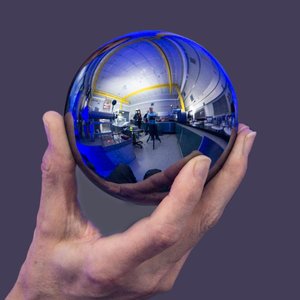
In 2018, the kilogram was redefined based on a fixed value of the Planck constant, and Avogadro’s number was precisely set as particles. This was enabled by manufacturing spheres of pure, single-crystal silicon-28 and measuring the number of atoms in a kilogram using X-ray diffraction.
Additional info: These foundational concepts are essential for understanding quantitative relationships in chemical reactions and laboratory analysis.
