 Indietro
Chemical Equilibrium and Acid-Base Concepts: Study Notes
Guida di studio - Note intelligenti
 Appunti personalizzati basati sui tuoi materiali, ampliati con definizioni chiave, esempi e contesto.
Chemical Equilibrium
Reaction Quotient (Q) and Equilibrium Constant (K)
The reaction quotient (Q) is a value calculated using the concentrations or partial pressures of reactants and products at any point during a reaction. It is compared to the equilibrium constant (K) to determine the direction in which a reaction will proceed to reach equilibrium.
Expression for Q (using concentrations):
Expression for Q (using partial pressures):
Comparison of Q and K:
If Q < K: Reaction proceeds to form more products.
If Q = K: System is at equilibrium.
If Q > K: Reaction proceeds to form more reactants.
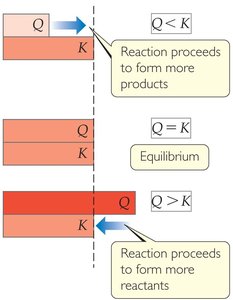
Example: For the reaction NiO(s) + CO(g) ⇌ Ni(s) + CO2(g), if the partial pressures of CO and CO2 are known, Q can be calculated and compared to Kp to predict the direction of the reaction.
Le Châtelier’s Principle
Le Châtelier’s Principle states that if a system at equilibrium is disturbed by a change in temperature, pressure, or concentration of a component, the system will shift its equilibrium position to counteract the disturbance.
Adding a substance: The system shifts to consume some of the added substance.
Removing a substance: The system shifts to produce more of the removed substance.
Changing pressure (gaseous systems):
Increasing pressure (by decreasing volume): Shifts equilibrium toward the side with fewer moles of gas.
Decreasing pressure (by increasing volume): Shifts equilibrium toward the side with more moles of gas.
Changing temperature:
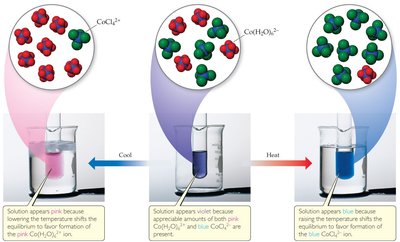
For endothermic reactions (ΔH > 0): Increasing temperature shifts equilibrium to the right (more products).
For exothermic reactions (ΔH < 0): Increasing temperature shifts equilibrium to the left (more reactants).
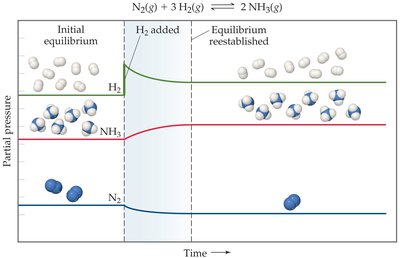
Visual Examples of Equilibrium Shifts
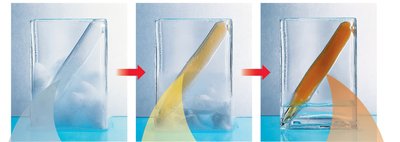
Color changes and concentration changes can visually indicate shifts in equilibrium due to temperature or concentration changes.
The Haber Process
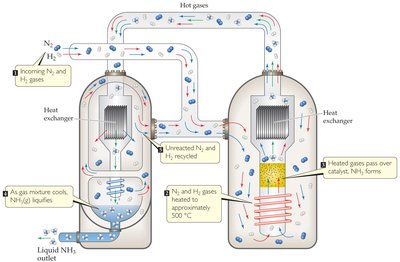
The Haber process synthesizes ammonia from nitrogen and hydrogen gases. It is an industrially significant equilibrium reaction:
Reaction:
ΔH = –92 kJ (exothermic)
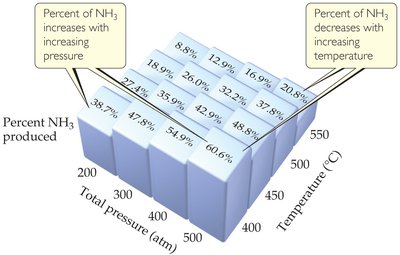
Increasing pressure favors ammonia production (fewer moles of gas on product side).
Decreasing temperature favors ammonia production, but too low a temperature slows the reaction rate.
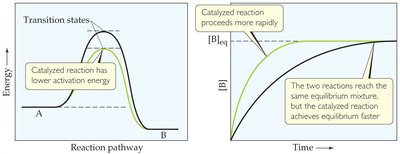
Catalysts: A catalyst increases the rate at which equilibrium is achieved but does not affect the equilibrium concentrations.
Acids and Bases
Acids and Bases in Food & Drink
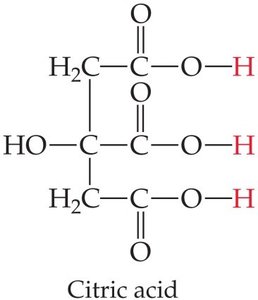
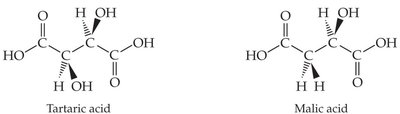
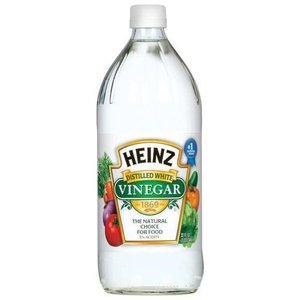
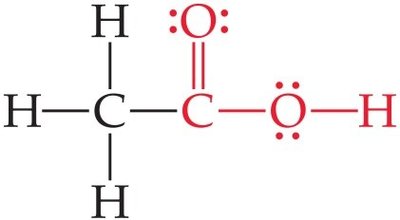
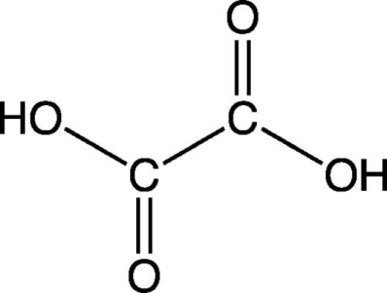
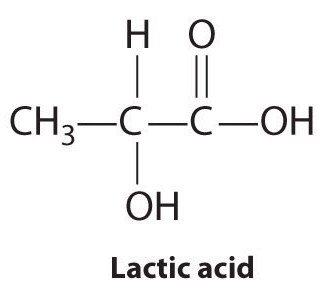
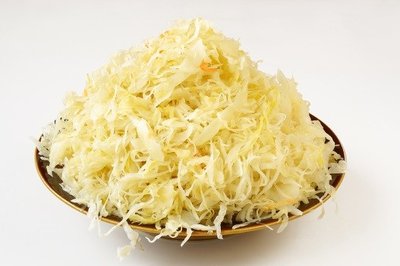
Acids are responsible for the sour taste in many foods and beverages. Common examples include citric acid in citrus fruits, tartaric acid in grapes and wine, acetic acid in vinegar, oxalic acid in rhubarb, and lactic acid in yogurt and sour beers.





Definitions of Acids and Bases
Arrhenius Definition:
Acid: Produces H+ ions in water (e.g., HCl, HNO3).
Base: Produces OH− ions in water (e.g., NaOH, Ba(OH)2).
Brønsted-Lowry Definition:
Acid: Proton (H+) donor.
Base: Proton (H+) acceptor.
Lewis Definition:
Acid: Electron pair acceptor.
Base: Electron pair donor.
Note: The Lewis definition is the most general, encompassing the other two.
Proton and Hydronium Ions
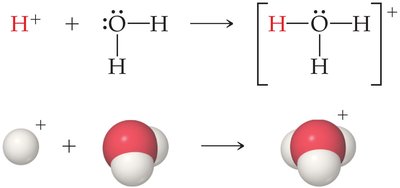
In aqueous solution, the hydrogen ion (H+) does not exist freely but associates with water to form the hydronium ion (H3O+):
Proton Transfer Reactions
According to the Brønsted-Lowry definition, acids donate protons and bases accept them. Amphiprotic substances can act as either an acid or a base depending on the reaction.
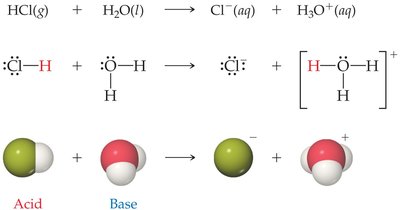
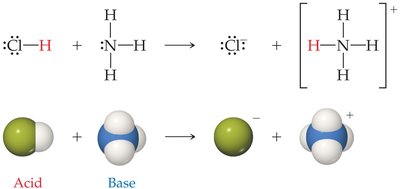
Lewis Acids and Bases
Lewis acids are electron pair acceptors, while Lewis bases are electron pair donors. This definition includes reactions that do not involve protons.
Example: In the reaction between ammonia (NH3) and boron trifluoride (BF3), NH3 donates a pair of electrons to BF3:
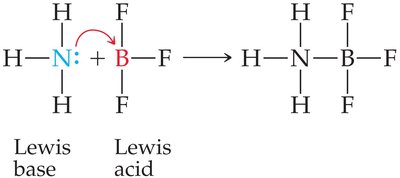
Additional info: Lewis acids often have incomplete octets or multiple bonds, making them electron-deficient, while Lewis bases are electron-rich and contain nonbonding electron pairs.
